



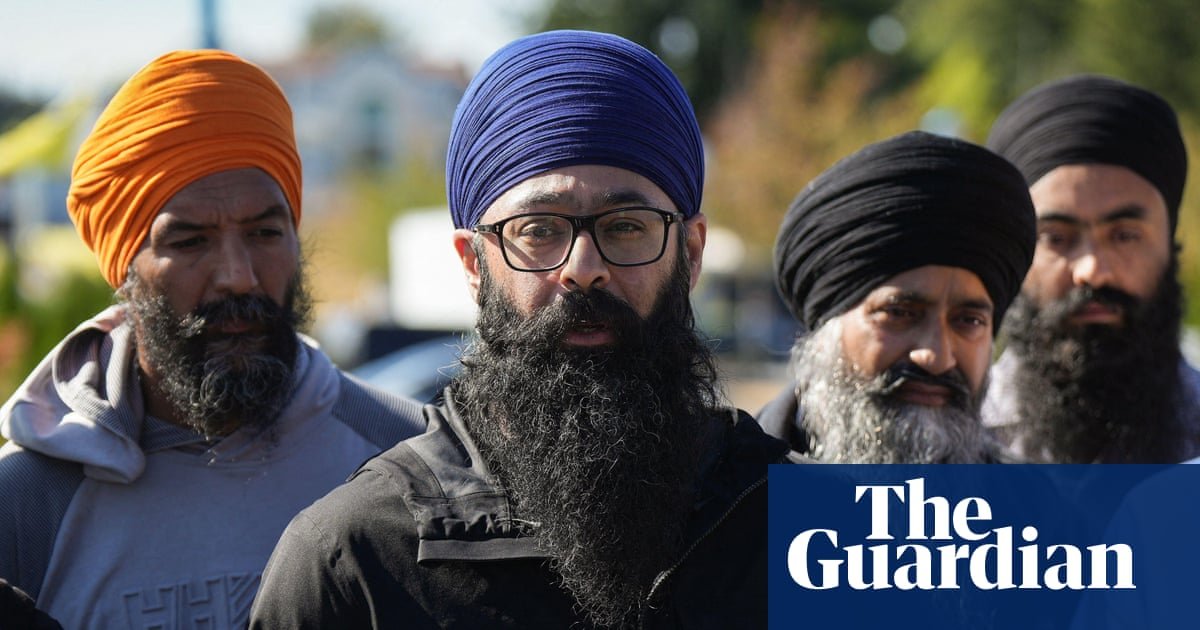
Police in Canada warned a prominent Sikh activist of “credible threat” to his family’s life, days before the prime minister, Mark Carney, visits India in search of new trade deals.
Moninder Singh, who heads the Sikh Federation of Canada, said officers visited his home on Sunday, to warn him that a confidential police informant had passed information suggesting he and his family were at risk.
In 2023, the former prime minister Justin Trudeau accused India of orchestrating the high-profile assassination of Hardeep Singh Nijjar, another Sikh activist and Canadian citizen. Canada’s federal police and spy agency. later repeated the accusations.
Singh, a close friend of Nijjar, said he believed the Indian government was behind the most recent threat.
In a recording of the police warning, shared with the Guardian, an officer tells Singh “it kills me to know you’re in this position” and appears to agree with the activist’s assessment that the threat stemmed from his vocal criticism of India.
“I want everyone to know how a father or a husband would feel in a situation like this. But as an activist, as a leader in the community, I’m not going to be thwarted by this. I’m not going to be silent over this. Silence is what they want,” Singh said.
Singh has been threatened before but said this was the first time his wife and two children had been threatened too. “If people like me start going silent, then, you know, these people that are being extorted, or other members of our community that are actually in line to be assassinated or have violence inflicted on them, then what would happen to them?”
India’s high commission did not respond to a request for comment.
But on Wednesday, a senior Canadian official told reporters the government was “confident” that India’s campaign of threats and violence had ended, adding that if they had not, Carney and a high-level delegation “wouldn’t be taking this trip.”
Like Nijjar, Singh is an outspoken advocate for the campaign for an autonomous Sikh homeland in India, known as Khalistan. The Khalistan movement is banned in India and activists have long been subject to threats. Singh said the campaign of intimidation had escalated in recent months.
He spoke of the latest death threat as Carney and a delegation of top officials prepared to visit India for high-level trade talks.
Trudeau’s accusation prompted a diplomatic crisis with India, involving tit-for-tat expulsions of diplomats. But Carney, who is fighting a separate geopolitical feud with the US, has attempted to mend fences, telling Canadians his government must seek out new markets.
For activists such as Singh, the visit ‘“feels like a slap in the face”.
“How do you separate the violence in this country that’s being inflicted by India – that our own intelligence and law enforcement agencies are telling us is happening – and then reward them with new access to the Canadian market?”
Carney has also attempted to improve relations with China, which detained two Canadians for years after the arrest in Vancouver of the Huawei executive Meng Wanzhou. In a visit last month, the prime minister signed a number of agreements, including plans to end tariffs on canola and to slowly bring Chinese electric vehicles to Canada.
Singh expressed concern that the apparent success of the China trade missions could be replicated in Delhi.
“The difference between India and China, however, is that India has been singled out as being highly violent in Canada over the last several years. It is the one country known to have carried out an assassination on Canadian soil. Other countries and their governments harass or try to silence dissidents – but the actual violence, extortions and murder come from India.”
In June, Canada’s spy agency said Nijjar’s murder signaled a “significant escalation in India’s repression efforts”, reflecting a broader, transnational campaign by Delhi to threaten dissidents.
“Indian officials, including their Canada-based proxy agents, engage in a range of activities that seek to influence Canadian communities and politicians. When these activities are deceptive, clandestine or threatening, they are deemed to be foreign interference,” the report said. “These activities attempt to steer Canada’s positions into alignment with India’s interests on key issues, particularly with respect to how the Indian government perceives Canada-based supporters of an independent homeland that they call Khalistan.”
Federal police say they have uncovered “well over a dozen credible and imminent threats to life”, prompting them to issue “duty to warn” notices.
Investigators also say a suspect linked to the Indian government was surveilling the former New Democratic party leader Jagmeet Singh as part of its network of coercion and intimidation. The suspect, who is thought to have ties to the Indian government as well as the Lawrence Bishnoi gang implicated in Nijjar’s death, knew Singh’s daily routines, travel plans and family. When the RCMP realised there was a credible threat to this life, they placed the federal party leader under police protection.
Singh said he worried that Carney’s high-profile visit to India would allow Delhi to “completely wash their hands” of any accusations of wrongdoing.
“Putting trade before Canadian lives is what we’ve been worried will keep happening for well over a year,” he said. “It’s unfortunate that it’s just going to continue.”


