



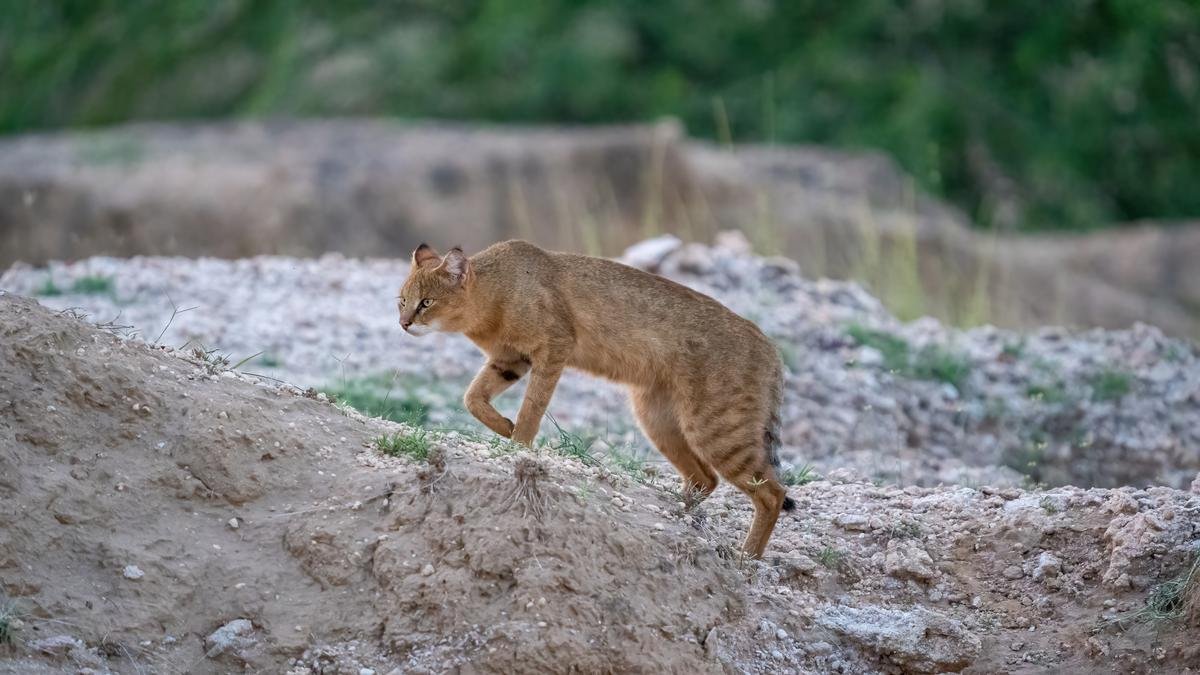
Jungle cats (Felis chaus) are found across diverse habitats, from grasslands and wetlands to deserts. They’re present across Asia, with large populations in India and Nepal, among others. The IUCN Red List lists the species as being of ‘least concern’.
This has led to a “misconception that they are doing fine”, Kathan Bandyopadhyay, a postdoctoral research associate at the University of Illinois Urbana-Champaign, said.
Jungle cats’ populations are in fact considered to be shrinking. In India, they are protected under Schedule II of the Indian Wildlife (Protection) Act 1972, which means hunting or trading them is illegal.
Despite being the most widespread of India’s small cats, jungle cats are understudied and have received little conservation attention relative to larger carnivores such as tigers and leopards.
Conservation baseline
This animal — with a white muzzle, yellow irises, large ears ending in black tufts, and the sometimes faint striping on its long legs — avoids dense forests and heavily-modified landscapes, preferring agro-pastoral and open habitats, according to a new study based on the largest dataset on the species in India.
The study was published in Scientific Reports, and provides a baseline for future conservation planning.
“Until now, we didn’t know about their population status or how they are responding to several habitat and climatic covariates,” Dr. Bandyopadhyay, who undertook this research as a PhD student at the University of Wyoming, said.
The team found human pressure to be the foremost factor influencing where jungle cats live and that while they can tolerate moderate levels of human disturbance, they avoid densely populated areas.
“Our results highlight the importance of agro-pastoral landscapes in conserving wildlife beyond protected areas, especially as urbanisation continues to expand,” Dr. Bandyopadhyay said.
‘An important analysis’
To estimate how many jungle cats were in India and where, the team compiled camera-trap records from more than 26,000 locations across India. These records were a ‘bycatch’ of tiger surveys and were supplemented with data from previous studies, radio-collared individuals, and the authors’ personal observations.
The researchers then included one camera-trap record every 25 sq. km, one radio-collar data point from every 5 sq. km, plus all secondary data (from outside protected areas). Then they used machine-learning to model suitable habitats using the final dataset of over 6,000 records.
The team combined these results with sex-specific home range data to estimate a countrywide population of over 3 lakh jungle cats, with at least 1.57 lakh and at most 4.59 lakh individuals.
“It’s an estimate. It gives you a limit within which the cat is likely to be,” Yadvendradev Jhala, senior scientist at the National Centre for Biological Sciences and the study’s co-author and co-supervisor, said.
Across 21 States with suitable habitats, Madhya Pradesh, Rajasthan, and Odisha were estimated to support the largest populations.
The study is an “important analysis” and has “strengthened the observation that the jungle cat is tightly associated with open natural ecosystems, currently under enormous threat of conversion to other forms of land use, such as built-up areas and large-scale linear infrastructure like highways,” Shomita Mukherjee, senior principal scientist at the Salim Ali Centre for Ornithology and Natural History, Coimbatore, and a member of the IUCN/SSC Cat Specialists Group, said. Dr. Mukherjee was not a part of the study.
Ideal landscapes
Per the study,jungle cats prefer warm, semi-arid regions that are seasonally dry, with moderate rainfall and canopy cover. Their predicted hotspots lie in India’s east rather than in the drier west.
India needs land policies that recognise the ecological value of open ecosystems, Dr. Mukherjee added.
According to her, the finding that jungle cats use agricultural landscapes aligns with previous knowledge of the species. In and around farms, these cats keep rodent populations in check, thus ‘protecting’ crops.
However, these landscapes lie outside protected areas and harbour several threats, including fragmented habitats, speeding vehicles on roads, and poaching, according to the study.
It also pointed to a potential threat from hybridisation with domestic cats, which could compromise their genetic lineage, although Dr. Bandyopadhyay and Dr. Mukherjee cautioned that this idea doesn’t have enough evidence.
Another key threat is the stray dog population, which “acts as a source of wildlife diseases and kleptoparasitism — that means snatching kills from jungle cats and other carnivores,” Dr. Bandyopadhyay said.
Per the study, stray dogs could share foraging spaces with other livestock, so where there is livestock, there could be the risk of these canines as well.
A policy for small cats
According to Dr. Mukherjee, the study’s strengths lie in its large spatial coverage and sample size, although she added that jungle cats from Sikkim had been left out and that the population figures were based on a “meagre dataset of a few radio-collared individuals in just a couple of locations”.
“Yet this should not be seen as a limitation but an effort to get the best out of data currently available,” she added.
Dr. Bandyopadhyay said the records from Sikkim were sporadic and insufficiently viable for the models.
Scientists still have a great number of unknowns, including jungle cats’ denning sites, litter sizes, ranging patterns, densities, and diets.
Small cats are generally hard to study because they are nocturnal and secretive. Public awareness is also low, and few organisations have been willing to fund more study.
Going forward, Dr. Jhala said, there is a need to plan wildlife passageways alongside infrastructure development in agro-pastoral and open habitats.
“When roads pass through a tiger or elephant corridor, there is a policy to try and mitigate those. But when they pass through agro-pastoral landscapes, we don’t plan for it even though these areas support rich biodiversity,” he said.
Ananya Singh is an independent journalist.


