



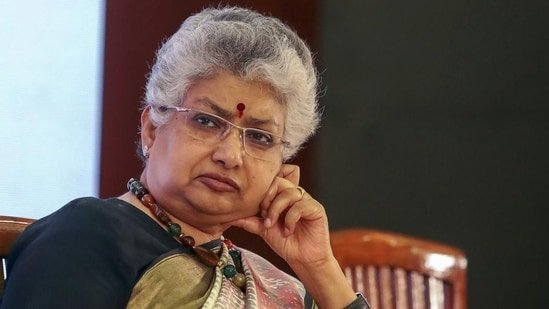
Supreme Court judge Justice BV Nagarathna on Saturday said that the central government must view states as “coordinates and not subordinates”, asserting that India’s constitutional framework establishes a system of “co-equals” rather than a hierarchy.


Speaking at the Rajendra Prasad Memorial Lecture at Chanakya Law University in Patna, she stated that the vertical division of powers between the Centre and states “is not a hierarchy or of priority,” but a carefully designed constitutional balance.
ALSO READ | Rule of law is the essence of democracy: Justice Nagarathna
Addressing the theme ‘Constitutionalism beyond rights: why structure matters’, Justice Nagarathna said that federalism goes beyond mere autonomy.
“It ensures that governance is not a matter of unilateral command, but of negotiation and coordination,” she said, adding that distinct centres of power must act as counterweights to one another, as reported by news agency PTI.
Calling for stronger Centre-state cooperation, she said, “The state governments are not subordinate to the Union government except as stipulated under the Constitution.” She said states must be treated fairly regardless of which political party is in power.
ALSO READ | Justice Pancholi notified as Supreme Court judge despite Justice Nagarathna’s dissent in collegium
She urged political leaders to rise above partisan considerations in matters of governance.
“Inter-party differences… have to be kept aside in the matter of Centre-state relations,” she said, noting that constitutional governance “would not depend on which party may be ruling at the Centre and which other party may be ruling at the state level.”
Citizens should benefit equally from welfare measures undertaken by both levels of government, she added.
“There cannot be a pick and choose approach vis-a-vis the states… Equity, as a matter of fair approach, must be adopted,” she further stated, as quoted by PTI. She also observed that “a mature federation ought not rush to courts as adversaries,” and instead prioritise “dialogue, negotiation and mediation.” Frequent legal disputes between states or with the Centre signal “a weakening of cooperative federalism,” she said.
ALSO READ | Model of injustice against Dalits, tribals in Gujarat: Rahul Gandhi
Speaking on institutional integrity, the judge said safeguarding the Constitution is not limited to moments of crisis but is equally dependent on the day-to-day functioning of key bodies. She named institutions such as the Election Commission, Finance Commission, SEBI, and the Competition Commission of India, stressing that they must act independently, maintain neutrality, and inspire public trust.
The lecture was attended by prominent legal figures, including Supreme Court judge Justice Ahsanuddin Amanullah and Patna High Court Chief Justice K Vinod Chandran. Justice Nagarathna, who is widely expected to become India’s first woman Chief Justice next year, concluded by reiterating that the strength of the Constitution lies not only in the protection of rights but also in institutional structure.
(With inputs from PTI)


