



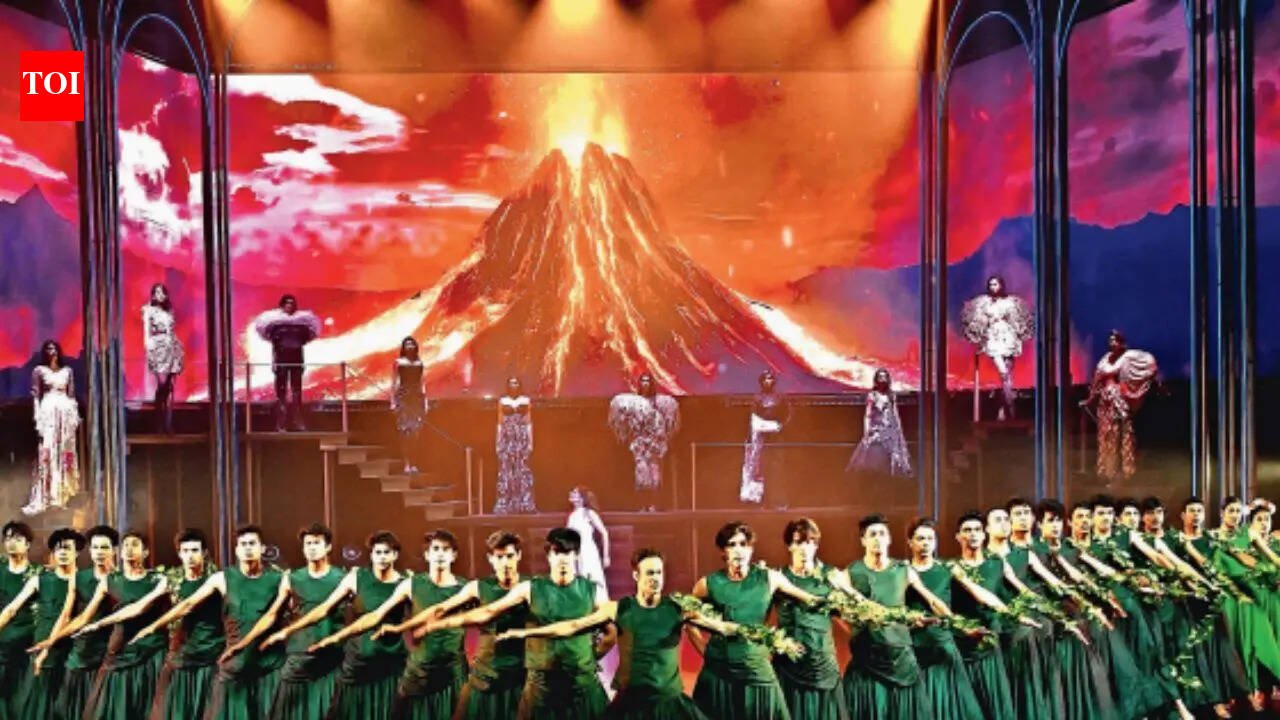
TOI’s magical musical Tesseract can be viewed as that rare star, which visits once every few decades. But unlike the ones that burn bright and vanish, this one sticks around, quietly glowing long after. In minds, hearts, and souls.A paradox opened the evening. In a week when Timothée Chalamet offered a hair-brained cultural provocation – that opera and ballet are “obsolete,” that “no one cares” – Tesseract answered not with a clapback, but with choreography: an elegant, assertive inclusion of ballet so ravishing it felt less like rebuttal, and more like revelation. Meera Jain’s curatorial genius, perhaps unwittingly, reframed legacy as living organism, not museum piece, placing ballet where it has always belonged: in the bloodstream of the present. Art demonstrates what argument cannot.The evening’s spell began at the threshold: interstellar music seemed to bend the hallway into a time tunnel, and a gallery of headlines and archives unfolded like a living prologue: premonitory whispers that we were entering a theatre of multiple dimensions.Within minutes, I lost the ordinary measure of time; three and a half hours dissolved with the hush and rush of a lucid dream. Trays full of treats and a bevy of beverages from the redoubtable kitchens of Indian Accent helped too.I am writing after days of reflection and dreaming: reflecting like the shards and mirrors of the Man in the Mirror sequence, dreaming like Sophia, whose journey and her alter ego’s formed a double helix of identity. Their oscillation was so seamless I often felt the protagonist flicker between two bodies of light, two musics of intention; a quiet triumph of performance craft and directorial design.Satsang: Association with truthWhat lingered were not effects but after-effects: layers that adhere to the mind’s inner surfaces and keep releasing meaning. That peeling and unpeeling has not stopped. My spirit felt stirred; my imagination conscripted; new quadrants of thought opened, new coordinates for feelingrevealed. The production felt like a transmission channeling the long arc of Meera and Samir Jain, their thoughts, their values, their hospitality to courage…not as signature, but as atmosphere.
.
Even when the show vaulted into spectacle, what gleamed most was restraint: the discipline that makes technology serve emotion, not smother it; that lets light reveal rather than blind; that turns movement into syntax rather than ornament. The press, surprisingly, got this right. They called it immersive, interdisciplinary, and a philosophical theatre event rather than a mere extravaganza.However, unsurprisingly, they missed out on seeing and feeling beyond the obvious. Forgive the metaphor, but Tesseract was the most exquisite narcotic for the soul. The benevolent kind, the satsang kind. It had the unmistakable charge, vibrations, and high, of a congregation gathered to listen for truth, to dwell in the company of those who have made a life of seeking it. In this sense, the show became a civic ritual: a room of seekers aligning, for a few hours, around questions that are older than the nation-state and younger than each new dawn.It entered my sleep the way good art does – in rapid succession of dreams and visions, and it stirred the REM wilderness Samir Jain once nudged me to research; a reminder that inner archives can be as unruly (and as luminous) as outer ones.And then that finale: like Kairos’s origami, each crease and fold converged until the very idea of the tesseract revealed itself; not as a stunt, but as the geometry of a thought (and truth) that had been quietly forming all night. The eye for detail was relentless. The section on beauty and art, in particular, pinned me to my seat with its tenderness; it was an aria about what makes us human, and why the aesthetic is not indulgence but oxygen. It connected with such elegance to everything I know of the Times of India Group, of satsang, and of Evoke… a skein of beliefs, mythologies of meaning, turned into a theatre of belonging. Spotlight: Shining light on the truthThe stagecraft, from sets, to lighting, and automation, was cutting-edge in the only way that matters: ideas first, then electronics. Having worked closely with Meera Jain, I know her appetite for the frontier; the cutting edge.This went further – it felt pioneering: rooted in Indian ethos, yet speaking fluently to the world; interweaving journalism’s archive with theatre’s alchemy and technology’s sleight of mind. The show assembled global expertise and integrated live performance with large-scale LED, ARenvironments, illusion design, and a sweeping sound architecture… the kind of interdisciplinary rigour that does not imitate “international standards,” but sets them.Threaded through it all was an Indic grammar of courage: the old vow that truth is not a decree but a discipline. Our epics remind us that the boldest journeys are often into ambiguity, and that to “know” is not to arrive but to abide in inquiry. And I found myself wondering – heresy though it may be to a masthead I love – whether TOI’s line might graduate from “Let Truth Prevail” to “The Geometry of Truth.” After all, what is “prevail” if the unasked question is ‘what is truth?’, and ‘who gets to officiate it?’ A quest into Kairos’s origami-like geometry invites us to seek, to question, to listen, to platform polyphonies of approach and opinion. That feels like the paper, and the production, Iwitnessed: “Ekaṁ sat viprā bahudhā vadanti.”Stardust: Tryst with truthIf there is a roadshow destiny, Tesseract must meet it. Tour the country. Cross oceans. Reach for the stars.May Act 2 bloom into Part 2, with the “future of the planet” chapter dilated into its own deep meditation. Imagine a movement from archival intelligence, which we now shorthand as artificial intelligence, into an epoch of planetary intelligence; where biodiversity, species empathy, and human-animal kinship are re-lit as central plotlines rather than footnotes.The rare and inspirational ability to take the personal, make it political, and then sublimate it into art, too, is why Tesseract moved me so much: it insisted that love scale into responsibility, and pain transform into purpose. As a work of language and light, Tesseract oscillates between surrealism, pop art, and Kafkaesque narratives, visuals, motifs.It is a composograph of cosmic intelligence; its architectonic, symbolic, haptic, figurative elements gather into a grammar of awe-someness. It is a show tinged with the aura of spiritual reverence and multi-sensorial engagement.It is saturated with and by illusion and illumination; pulsing with a transcorporeal rhythm and murmur that recalls the oldest theatre there is: the human body and mind convincing itself it can hold more truth than yesterday.And then the ending… the sprinkling of stardust. In Meera Jain’s opening invocation of her son and grandson, the evening disclosed its lineage: pregnant with poise and panache; and yet, nine months of gestation for a vision like this feels, in hindsight, inevitable. A theatre-child born of travel, agency, care, curiosity, beauty, empathy, love, and familial imagination.Not perfect, but pure. Not bound, but beautiful. Not tangible, but true.


