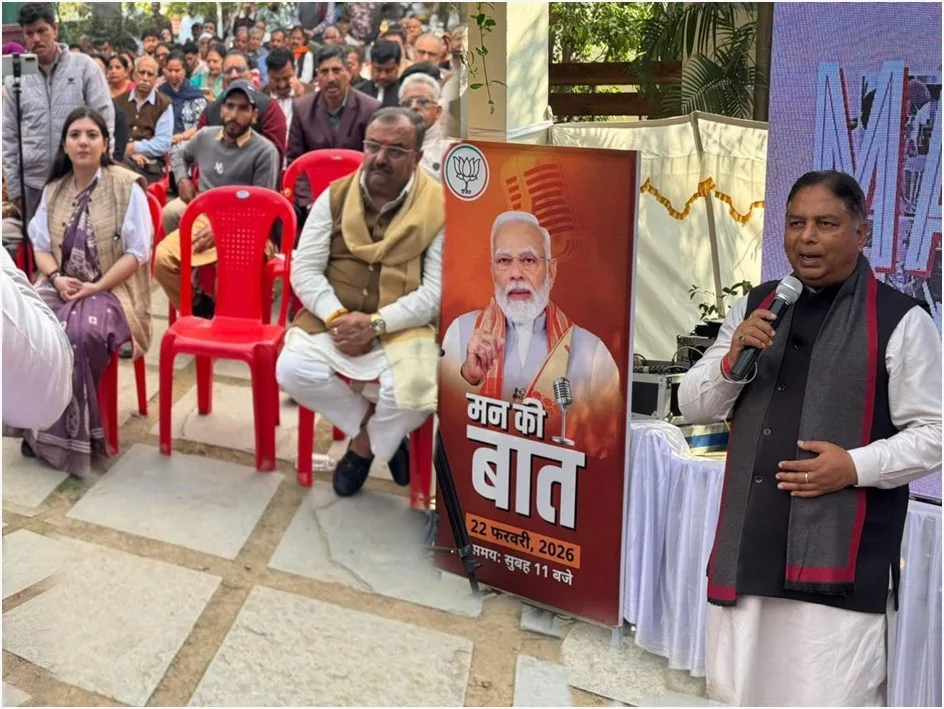
Jammu, Feb 22: On the 32nd anniversary of Parliament’s historic resolution affirming Jammu and Kashmir’s complete integration with India, senior Bharatiya Janata Party (BJP) leader and Jammu MP Sat Sharma on Sunday renewed the call for justice to the people of Pakistan-occupied Jammu and Kashmir (PoJK), describing their suffering as a direct result of past political betrayals.
Speaking at a gathering in Jammu, Sharma said many families in PoJK still live with deep hope and pain. “There is a dire need to give justice to those old ladies who still make two extra chapatis every night, waiting for the Indian Army to liberate them from atrocities and the clutches of illegal occupation by the ISI and Pakistan,” he told the gathering.
The February 22, 1994, resolution—passed unanimously by both Houses of Parliament—declared that the entire state of Jammu and Kashmir, including territories under Pakistani control since 1947, is an “integral part of India”. It demanded Pakistan vacate the illegally occupied areas, condemned the ethnic cleansing of Kashmiri Pandits, and rejected any dilution of India’s sovereignty in the face of continued cross-border terrorism sponsored from across the border.
The BJP leader recalled how certain Kashmir-based leaders and the Congress leadership in Delhi at the time played a role in keeping these regions separated from the rest of Bharat. He appealed to Kashmiris and Dogras on the Indian side to stand in solidarity with their brethren in PoJK, many of whom continue to raise the slogan “Maharaja Gulab Singh Amar Rahe” as a symbol of their enduring connection to the larger Indian identity.
The remarks come against the backdrop of repeated waves of public anger in PoJK. In May 2024, protests erupted over inflated electricity tariffs and the withdrawal of wheat subsidies, turning violent and leaving several people dead. The unrest peaked again in late September–early October 2025 when the Jammu Kashmir Joint Awami Action Committee (JKJAAC) led a massive shutdown and wheel-jam strike across Muzaffarabad, Mirpur, Rawalakot, Kotli, and other towns.
Sharam said the protesters presented a charter of up to 39 demands, including affordable electricity (despite PoJK generating a large share of Pakistan’s hydropower), subsidised food grains, improved roads, healthcare, education, and greater local control over resources. “Security forces responded with force: at least nine people (civilians and police) were killed, more than 200 were injured, mobile and internet services were suspended, and large parts of the region were placed under lockdown. An agreement was eventually signed on October 4, 2025, promising a 25-point package of relief and reforms to be implemented within 90 days. However, reports in early 2026 suggest significant delays, sparking fresh disappointment and sporadic protests,” he recalled.
He continued: “Beyond economic grievances, residents of PoJK routinely face arbitrary arrests, enforced disappearances, custodial torture, discrimination against religious minorities (particularly Ahmadis and Shias), sectarian violence, severe curbs on freedom of expression, harassment of journalists, and misuse of anti-terror laws. Women and children have reported instances of sexual violence and forced recruitment into militant outfits, adding layers of trauma to daily life.”