






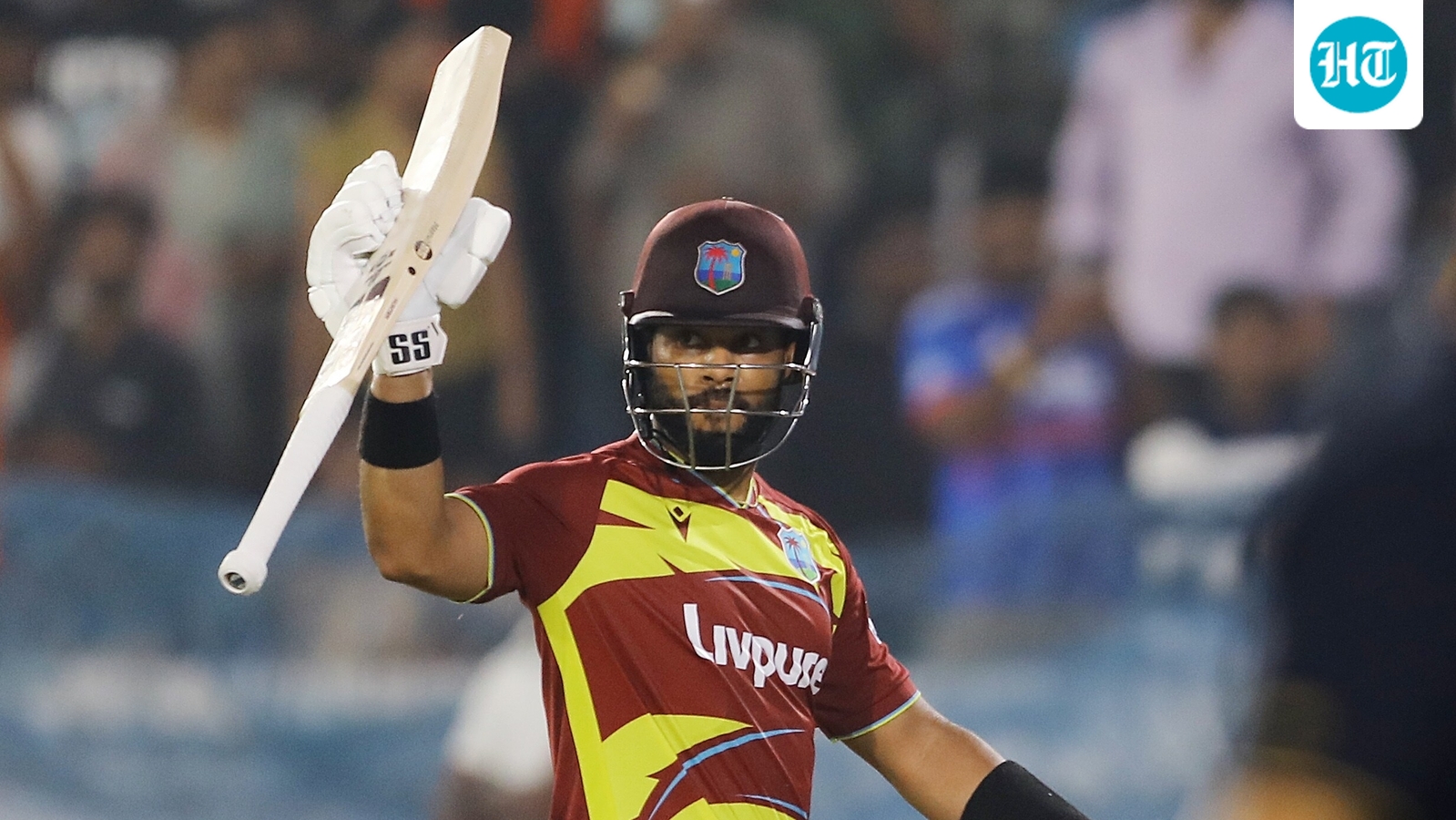
West Indies have drawn level in the five-match T20I series against India after a convincing win in the fourth match. The visitors batted first and posted a massive 247/3 in their 20 overs. The batting effort was led by their skipper, Shai Hope, who scored 102 runs off just 50 balls, continuing his recent run of big scores. In fact, the Indian bowlers must be tired of the very sight of Hope. He has been in imperious touch throughout the series, across ODIs and T20Is. In the seven innings that he has batted in on this India tour, Hope has amassed 539 runs with four centuries.
Hope’s most impressive quality on this tour has been his ability to adapt to different formats and situations. The two centuries he has smashed in the T20I series offer a glimpse into how he has tailored his game to two contrasting scenarios.
Also Read: Shai Hope’s ton, Keemo Paul’s fifer power West Indies to win, level series against India
To start with, Hope’s innings in Ranchi and Hyderabad have quite a few similarities. He scored 102 in both, hit nine sixes each time and faced 45 balls in Ranchi compared to 50 in Hyderabad. The strike rates were broadly comparable, but that is where the similarities end. The match situations were vastly different, as was the way he constructed his innings.
Two centuries in contrasting circumstances
In Ranchi, West Indies were chasing 250, and their start was far from ideal. Mayank Yadav reduced the visitors to 5/2 in the opening over. In Hyderabad, however, West Indies had the advantage of batting first and raced to 79/1 by the end of the powerplay. In Ranchi, Hope was repairing the damage while keeping pace with a formidable chase. In Hyderabad, he was building an imposing total for India to chase.
In the second T20I, Hope kept the scoreboard ticking while holding one end together. His partners took on the aggressor’s role, while the skipper ensured he stayed at the crease and maintained the required scoring rate. Rovman Powell provided the initial impetus with a 13-ball 24 before Sherfane Rutherford took off. He smashed 84 off just 37 deliveries, with the duo adding 120 runs off 54 balls. When Rutherford finally departed, West Indies still needed 72 off 35 balls, with Hope batting on 63 off 32 deliveries.
It was the perfect moment for the Windies skipper to shift gears, and Hope did so emphatically. He smashed his final 39 runs off just 13 deliveries at a strike rate of 300, while Romario Shepherd provided equally explosive support with a 13-ball 34. The duo added 74 runs off just 26 balls to seal the win.
In Hyderabad, West Indies enjoyed partnerships throughout the innings, giving Hope a completely different role. Interestingly, when Powell departed in the 13th over, Hope was batting on 63 off 33 balls. The subsequent partnership yielded 91 runs off 43 deliveries, taking West Indies to a formidable total of 247. In Ranchi, Hope needed just 13 balls to score his final 39 runs; in Hyderabad, he took 17 deliveries to reach the same mark. It underlines his ability to pace an innings and finish it according to the demands of the situation.
Hope’s remarkable acceleration in both innings
In Ranchi, Hope reached his half-century off 24 balls, while in Hyderabad, he took 28. He then needed just 21 and 22 deliveries, respectively, to score his next 52 runs. In both innings, Hope showcased the qualities of a complete T20 batter, capable of accelerating significantly after laying a solid foundation.
The situations were different. In Ranchi, he had to steady the innings, share the workload and then deliver the final punch. In Hyderabad, his task was to keep the momentum going, maintain the scoring rate and help West Indies post an imposing total. Hope passed both tests with flying colours. A closer look at his performances throughout the tour reveals a batter who has repeatedly adapted to the demands of the situation and delivered what his team needed.


