






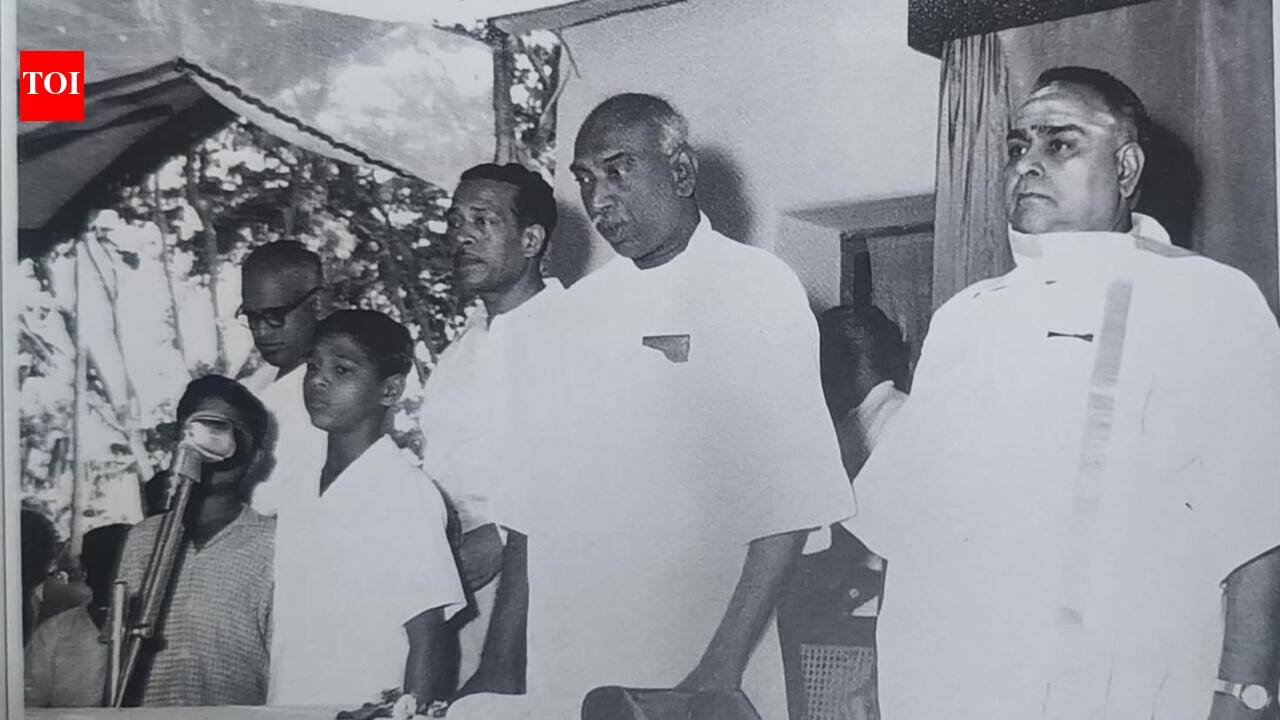
Few places in India have produced as many industrial pioneers as the belt around Kallidaikurichi in southern Tamil Nadu. Long before industrial clusters became a policy buzzword, this corner of Tirunelveli spawned entrepreneurs who helped turn TN into one of India’s manufacturing powerhouses. Within barely 50km emerged the founders of business houses such as the TVS Group, the Amalgamations Group and S N N Sankaralinga Iyer (SNN), among others.Born in Kallidaikurichi on Jan 31, 1901, Iyer made perhaps the boldest leap during the 1930s and 1940s, when India had poor roads, limited communications and almost no industrial ecosystem. He moved from the world of trust-based village banking—where reputation served as collateral—to building India Cements in the late 1940s, when South India had neither the industrial ecosystem nor the infrastructure for such an enterprise. He also founded Indo-Commercial Bank and sowed the seeds of what would become the Sanmar Group. Yet, unlike many industrialists of his era, he cultivated neither celebrity nor public attention, say those who knew him.“He was truly a man of vision,” recalls his grandson, N Kumar, Chairman of Sanmar Group’s Corporate Board. “Even when I knew him, he was constantly educating himself in taxation, economics and other subjects. One can only imagine the intellectual curiosity that led him to establish first a bank and then a cement factory.” Long before international supply chains became routine, Sankaralinga Iyer had limestone samples shipped to Denmark to determine whether they met the chemical specifications required for cement manufacture. Scientific validation of this kind was exceptional in an era when industrial decisions were often guided more by instinct than laboratory analysis.His outlook was similarly international when it came to technology. It was through his efforts that L&T supplied equipment for the India Cements project, bringing global engineering standards into Indian manufacturing at a time when such partnerships were rare.His businesses, however, were built as much around public service as commercial success. For example, Indo-Commercial Bank’s T Nagar branch, located where the present-day Pothy’s showroom stands, opened at 7.30am and gave priority to office-going customers until 9.30am. It also operated an evening shift from 5.40pm to 7.30pm, enabling nearby businesses, including Nalli Chinnasami Chetty Silk House, to deposit their daily collections safely—an unusually customer-centric approach for its time.“He always believed in doing things the right way,” says Vijay Sankar, Chairman of the Sanmar Group and SNN’s great-grandson. “He never cut corners. He never tried to make money by doing the wrong thing. Those are precisely the values we continue to follow.” One of Iyer’s lesser-known qualities was his ability to identify and nurture talent. Former State Health Minister Dr H V Hande recalled how SNN recognised the abilities of T S Narayanaswami—who would later become synonymous with India Cements—and gave him opportunities to grow.Calling SNN the harbinger of South Indian industry, S B Prabhakar Rao, who assisted him during his final years (1968-72) and later worked under his eldest son, grandson and great-grandson, said Sankaralinga Iyer gave his successors not just enterprises to run, but values to live by.Hande also recalled working closely with SNN’s eldest son, K.S. Narayanan, in securing assistance from the Danish International Development Agency (DANIDA) for Tamil Nadu. “If you travel through the South Arcot and Salem districts today, you will still find many of those health centres,” he said, describing it as a contribution for which Tamil Nadu “owes a great debt” to the family.Last week, a book chronicling the life and legacy of SNN was released. “He was not a man of speeches. He was a man of action,” observed journalist and biographer K Balakumar. “He accomplished remarkable feats of enterprise while seeking so little recognition for himself.”He carried “both his veshti and his victories lightly”, leaving behind “no flash, no flourish and no desire for recognition—only the quiet dignity of a man who lived by his values,” a family member said.“The lessons remain timeless,” said Vijay Sankar. “Do things the right way. Take no shortcuts. Live by your principles, values and ethics.”


