



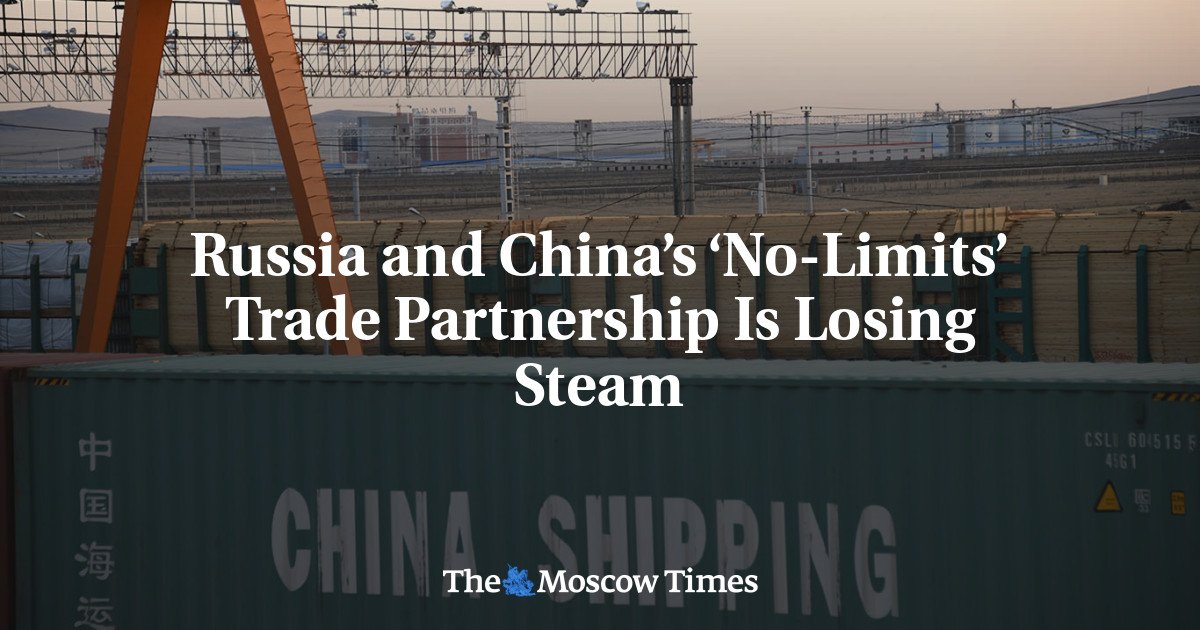
On his visit to China this week, President Vladimir Putin touted Russia’s “no-limits” cooperation with Beijing, Moscow’s key trade partner and a critical economic lifeline since its rupture with the West in 2022.
And judging by the lavish welcome the Russian leader received in the Chinese capital, one might think the relationship has nowhere to go but up.
Yet despite Putin and Xi Jinping’s proclamations of an ever-deepening partnership, analysts say the two countries may be approaching the limits of what the relationship can deliver economically.
China has largely replaced Europe as a supplier of manufactured goods and a buyer of Russian energy exports since the 2022 invasion of Ukraine.
That has helped bilateral trade soar 55% between 2021 and 2025, surpassing the two countries’ shared target of $200 billion set in 2019.
Bilateral trade fell 7% to $227.6 billion in 2025, marking the first decline since the pandemic year of 2020.
Russian exports to China dropped 3.9% to $124.8 billion, while Chinese shipments to Russia fell more sharply, declining 10.4% to $103.3 billion, according to Chinese customs data.
The decline affected bilateral trade across the board.
The value of Russian oil exports to China, which account for about half of Russia’s exports to the country, dropped 20%, while petroleum products fell 33% and coal declined 27%.
Chinese exports of passenger cars to Russia fell 44%, truck exports dropped 67%, telecom equipment declined 27% and computer shipments fell 31%.
Analysts attributed the downturn to lower global oil prices, China’s efforts to diversify energy imports and Moscow’s push for Chinese firms to localize production with moves like hiking its vehicle recycling fee, a de facto tax on imported cars.
This year has seen a more reassuring start to Russia-China trade, something officials in Moscow were keen to trumpet ahead of Putin’s visit to Beijing this week.
Total Russia-China trade rose 20% year-on-year in January-April to $85.24 billion. Russian exports climbed 17% to $47.7 billion, while Chinese exports rose 23% to $37.8 billion.
The recovery was driven in part by disruption in Middle East energy markets caused by the Iran war effectively blocking the Strait of Hormuz, through which roughly one-fifth of global oil supplies pass.
That has boosted demand for Russian crude that does not rely on the Strait of Hormuz. Russian oil exports to China surged by 22%, while oil products increased 9%.
Chinese exports also strengthened as lower Russian interest rates and a stronger ruble revived consumer demand. Car exports nearly doubled, while telecom and computer exports both rose 21%.
Another category that rose sharply was personal-use items shipped to Russia, something likely driven by China lifting visa requirements, allowing Russians to bring goods directly or through shuttle traders.
But analysts warned against interpreting the figures as evidence of a major long-term shift.
While Russia-China trade has posted strong growth in 2026, part of the rebound reflects weak comparisons with 2025, when trade volumes had already declined.
Compared with 2024, Russia-China trade in January-April 2026 grew only 10%, about half the rate implied by comparisons with last year’s lower base.
Russia’s export gains could also fade if the global energy crisis subsides and oil prices start to fall, reducing Moscow’s export revenues.
Russian oil shipments to China were already slowing down by April to an average of 2.2 million barrels per day. That’s still higher than a year earlier, but below first-quarter 2026 levels.
Meanwhile, pipeline gas exports are already running at maximum infrastructure capacity, while the long-delayed Power of Siberia 2 project remains years away from completion.
And because energy accounts for nearly all Russian exports to China, Moscow has little else to offer the Chinese market.
At the same time, Russia’s domestic economy is showing signs of strain.
The Economic Development Ministry forecasts retail trade turnover, one of the key indicators of consumer demand, of just 0.8% in 2026, down from 4.1% a year earlier, indicating weaker consumer demand and limited capacity to absorb additional Chinese imports.
Russian officials have also made clear they will continue pressing Chinese companies to localize car manufacturing, which is likely to weigh further on one of China’s key export categories.
“Our requirements are an extremely high level of localization and standardization with other manufacturers,” Deputy Prime Minister Denis Manturov said.
Given all this, analysts remain cautious about the prospects for sustained Russia-China trade momentum.
Visual China Group / TASS
Economist Andrei Gnidchenko of Moscow-based analytical center CMAKP said trade growth was likely to slow in the second half of 2026 as China accumulated energy reserves and economic activity in both countries remained subdued.
He estimated total trade would end the year only 5% to 10% above 2025 levels, or roughly the same as 2024.
Reflecting on the January-April data, the Kommersant business daily also cautioned against expecting “breakthrough growth” to continue, noting that the biggest trade boost had already happened after 2022.
Moscow-based businessman Andrei Kogan, who works with Chinese firms, said Russian exporters faced intense competition in China beyond the energy sector.
“China’s high-tech and consumer markets are already occupied by domestic manufacturers, so for Russian companies the focus is more often on niche projects, cooperation or localization, rather than direct large-scale exports,” he said.
Alexander Gabuev, director of the Carnegie Russia Eurasia Center, said China was seeking to diversify energy imports rather than become too dependent on Russia, while the Russian market itself was nearing “saturation” for Chinese industrial goods.
“After all, Russia is not a very rich country with a population of 145-150 million, depending on how you count,” Gabuev said in a recent podcast. “It is definitely not the size of the European Union, ASEAN or the United States for Chinese producers.”
A Message from The Moscow Times:
Dear readers,
We are facing unprecedented challenges. Russia’s Prosecutor General’s Office has designated The Moscow Times as an “undesirable” organization, criminalizing our work and putting our staff at risk of prosecution. This follows our earlier unjust labeling as a “foreign agent.”
These actions are direct attempts to silence independent journalism in Russia. The authorities claim our work “discredits the decisions of the Russian leadership.” We see things differently: we strive to provide accurate, unbiased reporting on Russia.
We, the journalists of The Moscow Times, refuse to be silenced. But to continue our work, we need your help.
Your support, no matter how small, makes a world of difference. If you can, please support us monthly starting from just $2. It’s quick to set up, and every contribution makes a significant impact.
By supporting The Moscow Times, you’re defending open, independent journalism in the face of repression. Thank you for standing with us.
Continue
Not ready to support today?
Remind me later.
×
Remind me next month
Thank you! Your reminder is set.


