






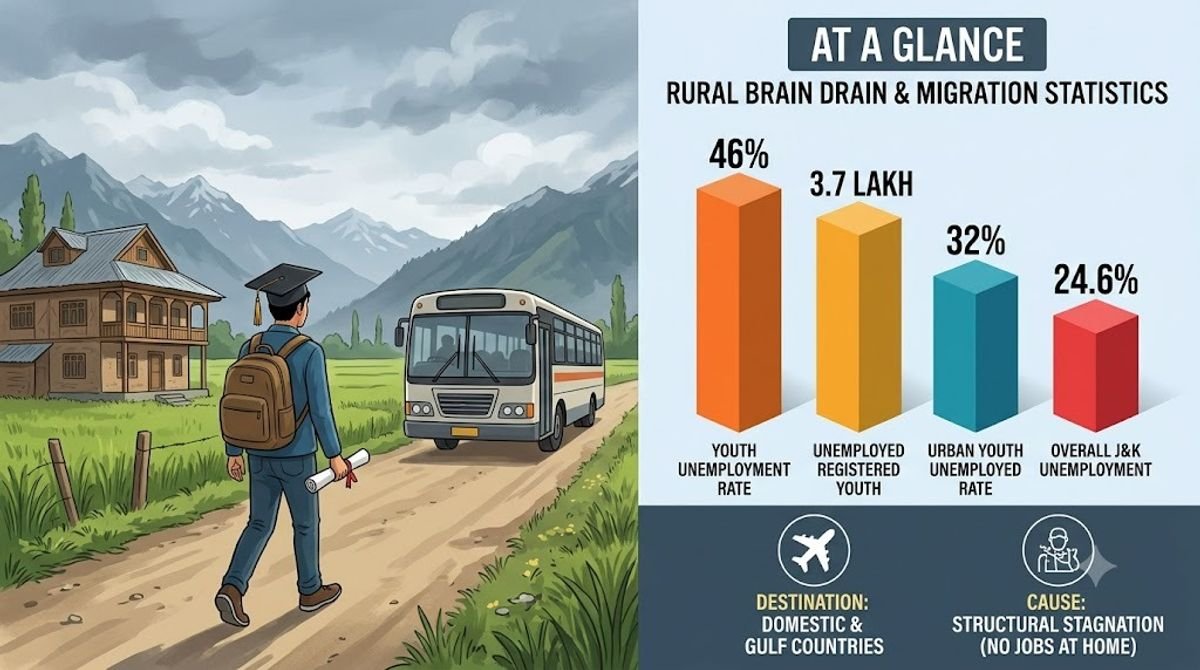
Srinagar, Oct 19: A degree that once promised a secure future is increasingly becoming the beginning of another struggle for many young people in rural Jammu and Kashmir — the search for a livelihood that may take them far away from home.
Behind the migration of a young graduate lies a family’s investment, years of sacrifice and the hope that education will eventually translate into economic security. But when employment fails to materialise, households are forced to confront a difficult reality–whether to continue waiting for opportunities at home, finance a move elsewhere or reconsider the future they had imagined for their children.
For many rural families, migration is no longer simply an individual’s decision to pursue better prospects. It has become an economic calculation involving household income, agricultural assets, educational expenditure, debt and the uncertainty of local employment.
A research paper titled The Economics of Staying, Leaving and Returning: Youth Migration, Local Employment and Household Welfare in the Rural Economy of Jammu & Kashmir, submitted by Kysir Quyoom Mir, who holds NET and JKSET qualifications and a postgraduate degree in Economics, examines this dilemma and its consequences for rural households.
The study approaches migration not merely as the movement of workers from one place to another, but as a household strategy to diversify income, manage financial risks and improve living conditions.
Drawing on the New Economics of Labour Migration framework developed by Oded Stark and David Bloom in 1985, it examines how families make decisions about who should leave, who should remain and whether those who migrate should eventually return.
The central argument is that youth migration cannot be understood solely through differences in wages between locations. “The decision is also shaped by the economic circumstances of the family left behind and the opportunities available to the young person at home,” the research reads. “For generations, education has been regarded as one of the strongest pathways to economic mobility in Jammu and Kashmir. Rural families have invested in schooling, college education and professional qualifications, often prioritising their children’s future over their immediate financial needs.”
Yet the transition from education to employment can be uncertain. The study’s abstract cites estimates indicating that unemployment among educated youth in Jammu and Kashmir is particularly high. It refers to an unemployment rate of around 46 per cent among educated young people, an urban youth joblessness rate near 32 per cent and an overall unemployment estimate of 24.6 per cent. It also cites reports suggesting that more than 3.7 lakh young people are registered as unemployed on the government’s employment portal, including a substantial number of graduates and postgraduates. These figures, which require verification against their original sources and statistical definitions, illustrate the employment concerns that underpin the paper’s analysis.
“For a family in a rural area, prolonged unemployment can mean more than a young person remaining without a salary. It can delay financial independence, increase dependence on parents and place additional pressure on household resources,” the study notes.
Families may continue spending on competitive examinations, coaching, transport and further qualifications while meeting the everyday expenses of the household. Where several educated members are unemployed, these pressures can become particularly severe. Migration may offer a way out of this cycle. A young person who secures employment elsewhere can contribute to household expenses, support siblings’ education, repay family debt or build savings for a future enterprise.
However, leaving home does not automatically guarantee financial stability. Accommodation, travel and living expenses can consume a substantial share of earnings, while insecure employment and the mismatch between qualifications and available jobs may limit the benefits.
The decision to migrate, therefore, involves weighing the potential gains against the financial and personal costs of leaving.
Speaking on the issue, former Vice Chancellor, Indira Gandhi National Open University (IGNOU), Delhi, Prof Muhammad Aslam said: “Alongside poverty, we also witness Rural Brain drain in Kashmir. The migration of educated, skilled people away from rural communities toward urban centers is increasing progressively. This isn’t a new phenomenon. This migration used to be people moving towards urban areas, within the country, but now it is the migration of educated, skilled people moving away from rural communities towards other countries as well including gulf countries, leaving behind older, and less credentialed population.”
Prof Aslam, who international exposure as well, said that both pull and push factors seems to be equally responsible. “Our rural areas offer very fewer job opportunities, low wages, and almost no pathways for professional advancement in knowledge-economy fields. As a result an economy progressively loses its capacity to regenerate itself. The reasons are structural more than cultural. When the economy stagnates, young people leave. When the future of a place feels uncertain, the psychological toll is real and it accumulates,” he said.
He added, “As population thins, social isolation intensifies. The feeling of collective sense of a place erodes. This erosion is psychologically corrosive in many ways that researchers are only beginning to fully quantify. We also need to study rapid cognitive decline including social isolation. A well-planned policy intervention holds a genuine promise in reversing rural outmigration. It requires that we may have to treat the problem as structural rather than cultural. It also implies making their hometowns stay rational and attractive.”


