






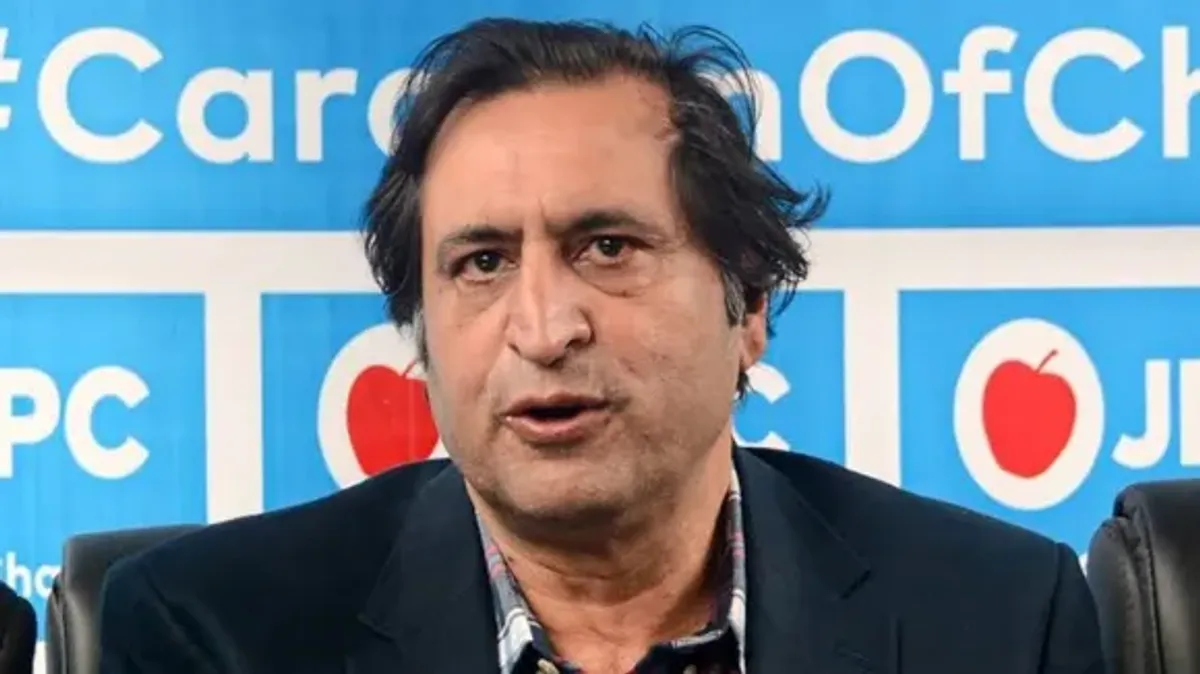
Srinagar, October 21: Jammu and Kashmir Peoples Conference President and MLA Handwara Sajad Lone on Wednesday criticised the elected government over what he described as the collapse of the Union Territory’s child protection framework, warning that since October 14, children in distress and juveniles in conflict with the law have been left without the statutory institutions meant to safeguard their rights.
“As I write this post, a child has no institutional back up, if he or she is in distress,” Lone said, underscoring the gravity of the institutional vacuum created by the lapse of the Child Welfare Committees (CWCs) and Juvenile Justice Boards (JJBs).
Referring to Directorate of Mission Vatsalya Order No. MDICPS/65/2025-03, dated October 13, 2026, Lone said the six-month extension granted under Rules 5 and 15 was intended to facilitate fresh appointments before the extended tenure expired. However, he pointed out that no appointments were made during the entire extension period, while the government’s own order acknowledges that the new CWCs and JJBs are “yet to be constituted.”
With the extension having expired, Lone argued, the absence of duly constituted boards and committees has created a serious institutional vacuum, leaving children without access to the specialised statutory mechanisms designed to protect them.
“The discretion is exhausted. The default is totally by the government. No space for scapegoating,” he asserted, holding the elected dispensation directly responsible for allowing the deadline to pass without ensuring continuity of these critical institutions.
Lone also questioned the apparent contradiction in the government order, which directs officials to attend to children’s matters even as the statutory bodies responsible for adjudicating and determining such cases remain unconstituted. He maintained that Protection Officers and District Child Protection Officers (DCPOs) cannot substitute for the statutory authority of JJBs and CWCs, particularly in matters involving care, bail and inquiry.
“What happens to a child needing urgent relief? The order is silent,” he said, questioning how immediate protection and legally mandated intervention would be ensured in the absence of the competent institutions.
The Peoples Conference chief further drew attention to the continued dysfunction of the State Commission for Protection of Child Rights, the statutory watchdog tasked with monitoring the implementation of child protection laws. Despite having been advertised more than a year ago, he said, the commission remains non-functional, leaving the system without an effective oversight mechanism to identify and address such institutional failures.
“Same Government, two defaults,” Lone remarked, arguing that the lapse of the JJBs and CWCs, coupled with the absence of a functioning child rights commission, reflected a deeper failure of governance. He also raised concerns over the transfer of children’s records to the executive machinery, stressing the need for adequate safeguards to protect the confidentiality and security of sensitive case files.
Recalling his tenure as Social Welfare Minister, during which the Integrated Child Protection Scheme (ICPS) was rolled out in Jammu and Kashmir in 2016–17, Lone described the initiative as a “first-of-its-kind child-friendly regime” and a milestone in juvenile justice. He said the framework was introduced at a time when the region faced a high incidence of minors being arrested by police but lacked an adequate institutional mechanism to protect their rights.
The scheme established a specialised network through which children requiring care and protection, as well as juveniles in conflict with the law, could be dealt with through child-friendly institutions rather than being left without dedicated legal and welfare safeguards.
Lone also criticised the growing reliance on outsourcing within the child protection system, alleging that the approach gained momentum during Central rule and was subsequently pursued even more aggressively by the elected government that assumed office in 2024.
“It is unimaginable for an outsourced employee to stand up to a police officer of a senior rank and fight for a minor,” he warned, questioning whether an outsourced workforce could provide the independence and institutional resolve required to defend vulnerable children against powerful authorities.
Anticipating attempts to deflect responsibility, Lone rejected the possibility of shifting the blame to the absence of Transaction of Business Rules (TOBR) or to files allegedly referred to the Centre. He insisted that the responsibility for ensuring the timely constitution of the boards and committees rested with the elected government.
“Now please don’t come back to say that TOBR is not there. Or that we have sent the file to Centre. They have no role,” he said.
Concluding his criticism, Lone said the consequences of administrative inaction were being borne by the most vulnerable, warning that the failure to maintain essential child protection institutions had left children exposed at a time when they most needed legal protection, institutional support and timely intervention.
“It is our children and the elected government is failing them,” he said.


