






When writing about protest music, it is customary to refer to names that are nearly cliches.
Singers such as Woody Guthrie, Pete Seeger, Bob Dylan, Joan Baez, and Nina Simone; or, more recently, The Clash, Public Enemy, Rage Against the Machine, or Kneecap. All these names have one thing in common: lyrics. Protest music, generally, centres around words of protest. That is probably why jazz is not a genre that springs to mind when talking about protest music because jazz is often instrumental.
There is an unambiguous clarity in the spoken word. It tells us exactly where to stand, whom to blame, and what to march for. Because of this, mainstream music criticism has had a blind spot. It routinely skips past jazz, treating the genre as too abstract, too passive, or perhaps just too beautiful to be political.
A recent episode of the Track Star podcast showed how wrong that can be. Saxophonist Ravi Coltrane sat down with host Jack Coyne to dissect the oeuvre of his legendary father, John Coltrane, whose 100th birth centenary was in September. During the episode, Ravi broke down the dynamics of John Coltrane’s 1963 masterpiece, Alabama. The track, he reminded us, was recorded following a bombing by the Ku Klux Klan of a church in Birmingham, killing four black girls. No vocals. No words. But, as Ravi explained, Coltrane played notes on his sax that seemed to match the cadence of Martin Luther King Jr’s tribute to the victims. The track is like a sermon of resistance delivered via Coltrane’s sax.
What that emphasises is that protest and resistance need not have a conventional vocabulary. In the genre of jazz, the lack of words is not a limitation. In fact, it can strengthen the genre’s profound power of defiance. Listen to the version of Alabama on the album Live at Birdland (1963) and you will likely agree with me.
Even when jazz icons did use language and words, they often subverted the vocal format, treating the human voice not as a means to deliver a catchy tune, but as a searing, radical instrument.
Jazz’s tradition of challenging the status quo stretches back to the early days of the genre. Long before the Civil Rights Movement found its footing in the 1960s, jazz innovators were using their art to infuse dangerous truths into mainstream spaces.
Consider Billie Holiday’s 1939 recording of Strange Fruit, written by Abel Meeropol, a high-school teacher, after seeing horrific photos of southern lynchings. When Holiday sang it, she threw out the soothing delivery expected of big-band vocalists of the era. She slowed it down and spat out the words with devastating starkness. Holiday famously fought her own record label to release it, transforming the jazz vocal into an uncompromising, early civil rights symbol.
A few years later, Duke Ellington would prove that this history could be written without a single word. His 1943 masterpiece, Black, Brown and Beige, debuted at Carnegie Hall with no lyrics. He used the tones, heavy brass textures, and the reed sections of his orchestra to create a definitive sonic history of African-Americans.
Listen to it and see how it maps the trauma of slavery, the overlooked bravery of Black soldiers, and the sophisticated energy of modern Harlem. In an era when Black Americans were systematically stripped of their rights, Ellington used his composition to assert that Black history is American history.
In the mid-20th century, as the civil rights movement gathered momentum, jazz grew more intensified. In 1959, bassist and composer Charles Mingus wrote Fables of Faubus, a scathing strike against Arkansas Governor Orval Faubus, who had deployed the National Guard to block nine Black students from integrating Little Rock Central High School. Columbia Records, scared of the song’s overt political nature, stripped Mingus of his lyrics for its initial release.
But the censorship backfired. Robbed of his words, Mingus leaned into the instrumental arrangement to convey his disgust. The resulting track features a bassline and horn arrangements that seem to drip sarcasm and mockery, horn arrangements depicting Faubus as a tyrannical clown.
The gloves came off in the 1960s. When Nina Simone took the stage, she fused the improvisational brilliance of jazz with revolutionary anger. Triggered by both the Birmingham church bombing and the assassination of activist Medgar Evers, Simone released Mississippi Goddam in 1964. Deceptively wrapped in an upbeat, showtune-style tempo, Simone used her voice to mock institutional demands for Black patience. When she sang, “Too slow… you keep on saying ‘go slow’,” she wasn’t just entertaining a crowd; she was weaponising the jazz cabaret format to disrupt White comfort.
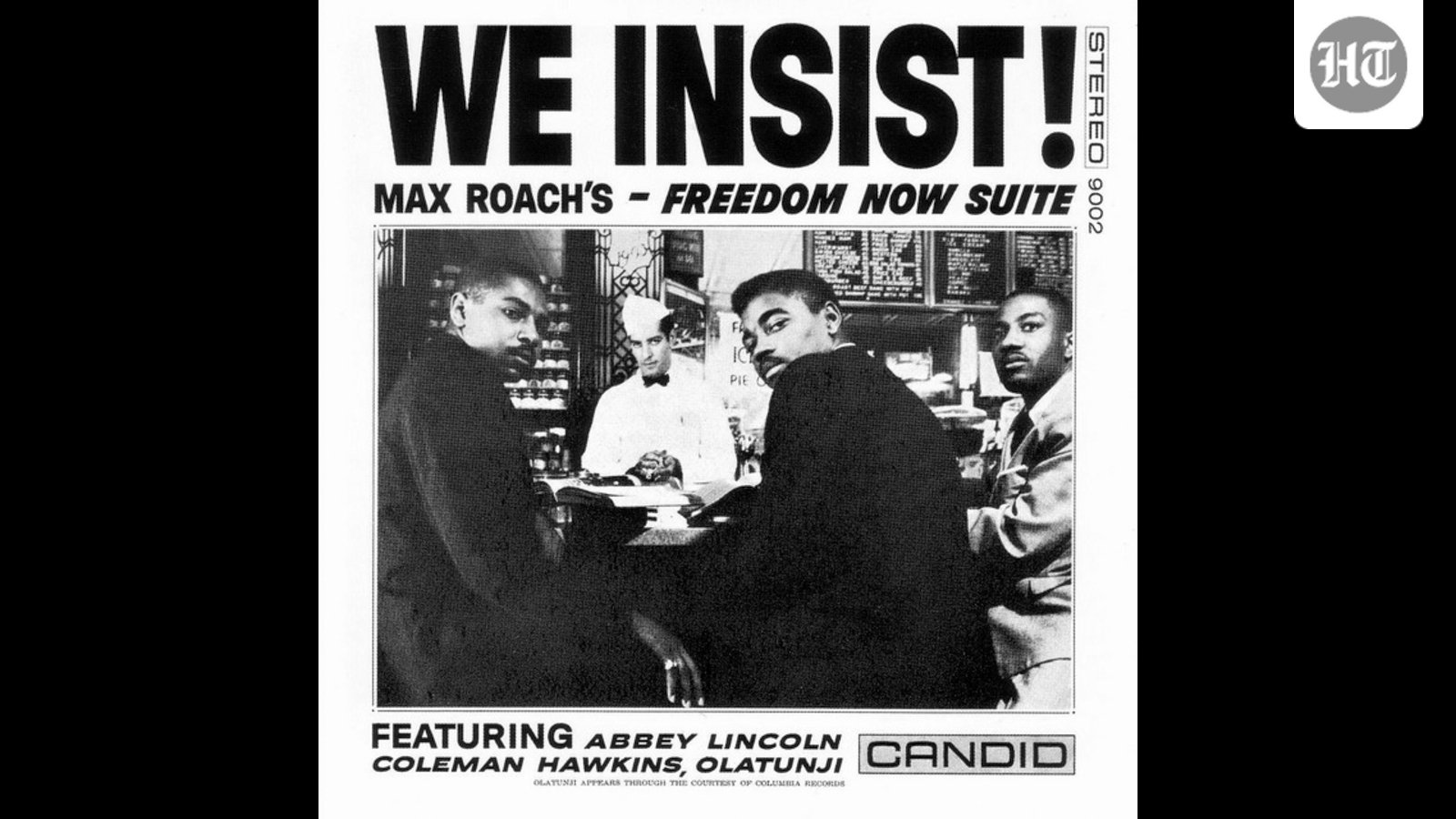
An even-more-radical vocal expression can be found on drummer Max Roach’s 1960 landmark album We Insist! Freedom Now Suite. On the track Triptych: Prayer/Protest/Peace, vocalist Abbey Lincoln abandons traditional lyrics and melodies entirely.
For over a minute of the Protest segment, she unleashes a torrent of raw, wordless shrieks, screams and gasps, matched by Roach’s chaotic, frantic drumming. By bypassing conventional language, Lincoln turned her vocal chords into a horn that became a sonic manifestation of terror in a way that words likely could not do. Listen to the remastered 2022 album; it gives you goosebumps.
This lineage of activism continued to evolve. On his 1986 album, Tutu, Miles Davis’s track, Full Nelson, is an anti-apartheid tribute to Nelson Mandela, using the era’s aggressive electro-funk synthesisers and heavy drum-machine beats to channel the urgent global fight for Black liberation.
More recently, when saxophonist Kamasi Washington released his magnum opus Epic in 2015, it held the track Malcolm’s Theme, a tribute to the legacy of civil-rights leader Malcolm X. The track has lyrics sung by Patrice Quinn and Dwight Trible but is anchored by an active, pulsing upright bass line from Miles Mosley, complemented by Washington’s soaring saxophone and lush, cinematic arrangements. It ends with a clip from a speech by Malcolm X. The piece captures the revolutionary urgency of the modern Black Lives Matter movement. Listening to it again, I find that it builds a bridge right back to John Coltrane’s mourning sax on Alabama.
To exclude jazz from American protest music is to tear whole chapters out of a history book. As Ravi Coltrane put it on Track Star, the emotional truth of a tragedy such as the Birmingham bombing doesn’t have to be laid out in a verse-chorus structure in order to touch the listener.
Whether through a wordless horn, a satirical bassline or a voice pushed to the edge of a Munch-like scream, jazz has spent the last century documenting cracks in the American experiment. The music is still crying, the drums are still beating, and it’s about time we listened.
(To reach out, email sanjoy.narayan@gmail.com. The views expressed are personal)


