



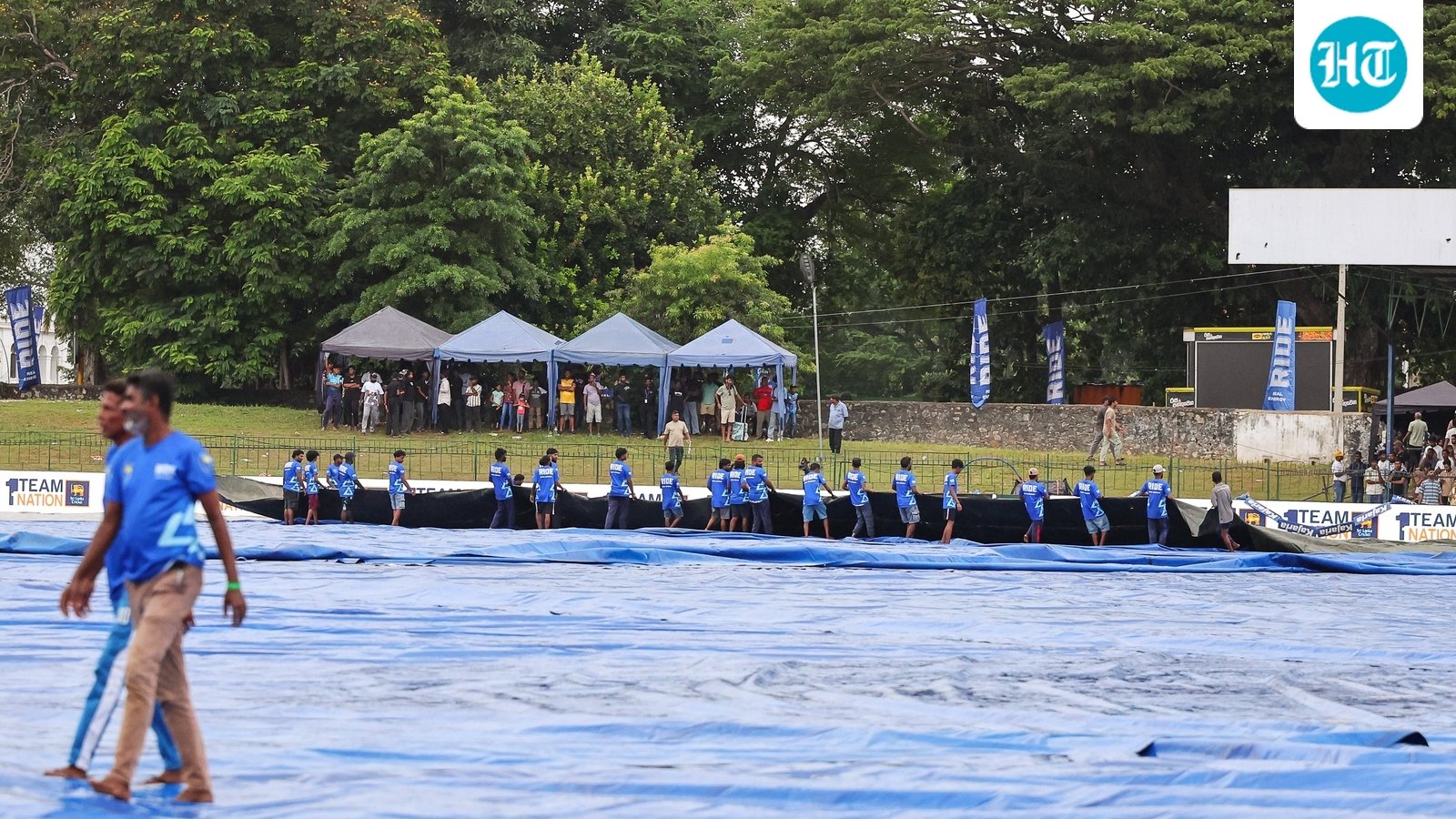
Rain has followed India almost throughout their current Test tour of Sri Lanka. The first Test in Galle lost significant playing time on each of its opening two days, and the second Test in Colombo has again been interrupted repeatedly. With both matches carrying World Test Championship points, the series has provided another reminder of the weather risk attached to scheduling cricket in Sri Lanka during the southwest monsoon.
In Galle, rain shortened the first day before an even bigger interruption followed on Day 2. India resumed on 288 for two, but only 43 overs were possible for the entire day, with play beginning at 2.35pm after a delay of several hours. India eventually won the Test by 165 runs, completing the result shortly before another spell of heavy rain arrived.
The situation has continued at the Sinhalese Sports Club in Colombo. Rain interrupted Day 2 while Dhruv Jurel was batting on 95, forcing an early tea before play eventually resumed at 4.25pm. By the end of Day 3, only 222 overs had been bowled across the first three days, against the standard allocation of 270. Rain and bad light then stopped Day 3 early with Sri Lanka on 265 for eight. On Day 4, another spell of rain ended play with Sri Lanka 229 for six in their second innings, 16 runs ahead after being asked to follow on.
These interruptions have come during a period in which heavy rainfall in parts of Sri Lanka is not unusual. According to Sri Lanka’s Department of Meteorology, the country’s southwest monsoon runs from May to September, with rainfall concentrated particularly in the south-western parts of the island. Galle and Colombo, the two venues for India’s current series, are both located in that high-rainfall belt.
The rainfall numbers behind the scheduling risk
Thirty-year rainfall averages used by the Department of Meteorology show how large the difference can be between Sri Lankan regions during these months. Galle averages 423.5mm of rain in May, 290.5mm in June, 240.7mm in July, 239.8mm in August and 341.2mm in September. That is 1,535.7mm across the five-month southwest monsoon period. Colombo’s corresponding monthly averages are 413.3mm, 247.6mm, 180mm, 162.5mm and 289.7mm, adding up to 1,293.1mm between May and September. Kandy, another major cricketing region with Pallekele nearby, averages 154mm in August and 864.3mm across the five months.
The geographical difference within Sri Lanka is considerable. Hambantota averages only 49.2mm in August, compared with Galle’s 239.8mm. Across May to September, Hambantota’s district average is 307.5mm — about one-fifth of Galle’s figure over the same period. Jaffna’s August average is 33.3mm, and Mannar’s is just 19.2mm.
The recent cricket record reflects that rainfall risk. Pakistan’s two-Test tour in July 2023 had substantial weather interruptions. The clearest example came in the second Test at the SSC in Colombo. Pakistan began Day 2 on 145 for two, but only 10 overs were possible for the entire day. Rain stopped play at 10.43am with Pakistan 178 for two and no further cricket was possible. Less than two months later, the 2023 Asia Cup produced an even larger collection of rain-affected matches in Sri Lanka. India’s first match against Pakistan at Pallekele on September 2 was abandoned after India were bowled out for 266; Pakistan did not face a single delivery. Two days later, India versus Nepal at the same ground required a rain-adjusted chase, with India given 145 to win from 23 overs.
The Super Four meeting between India and Pakistan in Colombo on September 10 was then stopped with India on 147 for two after 24.1 overs. The match had to continue on a specially allocated reserve day on September 11. Four days later, Sri Lanka’s virtual knockout against Pakistan in Colombo was reduced to 42 overs a side because of rain. The tournament therefore had multiple fixtures either abandoned, shortened or pushed into additional days because of the weather. The pattern continued in 2024. Sri Lanka hosted West Indies for three ODIs at Pallekele in October, and all three matches were rain-reduced. West Indies reached 185 for four after 38.3 overs in the first before rain intervened; Sri Lanka were subsequently given a 37-over chase. The second ODI was reduced to 44 overs per side. The third was cut almost in half to 23 overs per side.
New Zealand‘s visit immediately afterwards produced more disruption. The third ODI at Pallekele on November 19 was abandoned after New Zealand had reached 112 for one in 21 overs. Sri Lanka won the series 2-0, with no result possible in the final game. October and November are officially classified separately as Sri Lanka’s second inter-monsoon period, rather than the southwest monsoon, but they are also high-rainfall months. The Department of Meteorology’s 30-year figures put Colombo’s average October rainfall at 385.3mm, higher than its August or September averages. Galle averages 401.5mm in October.
That became particularly important during the 2025 Women’s World Cup. Colombo’s R Premadasa Stadium was allocated a significant block of matches, and rain repeatedly intervened. Australia versus Sri Lanka on October 4 was abandoned without a ball bowled. Sri Lanka then made 258 for six against New Zealand on October 14, only for rain to prevent New Zealand beginning their chase.
England-Pakistan the following day was reduced to 31 overs per side before being abandoned during Pakistan’s chase. New Zealand-Pakistan on October 18 was also washed out. Pakistan-Sri Lanka on October 24 initially became a 34-over match after a delayed start, but only 4.2 overs were ultimately possible. The ICC described it as the fifth rain-affected match of the tournament. Sri Lanka finished that World Cup having had three of their matches washed out.
The numbers therefore cover different competitions and formats: Pakistan’s Tests in 2023, the Asia Cup later that year, consecutive ODI series in 2024, a global ICC tournament in 2025 and now India’s Test tour in 2026. In the current series alone, Galle had a 43-over second day, while the Colombo Test had completed only 222 overs through three days, 48 short of the normal 270-over allocation, before rain again ended Day 4 early. Those interruptions have occurred in August, when historical district rainfall averages stand at 239.8mm for Galle and 162.5mm for Colombo.
For cricket administrators, those are known numbers before a fixture is placed on the calendar. The recent match record provides the other half of the data: repeated lost overs, shortened games, reserve days and outright abandonments when major cricket has been scheduled in Sri Lanka’s wetter months.


