






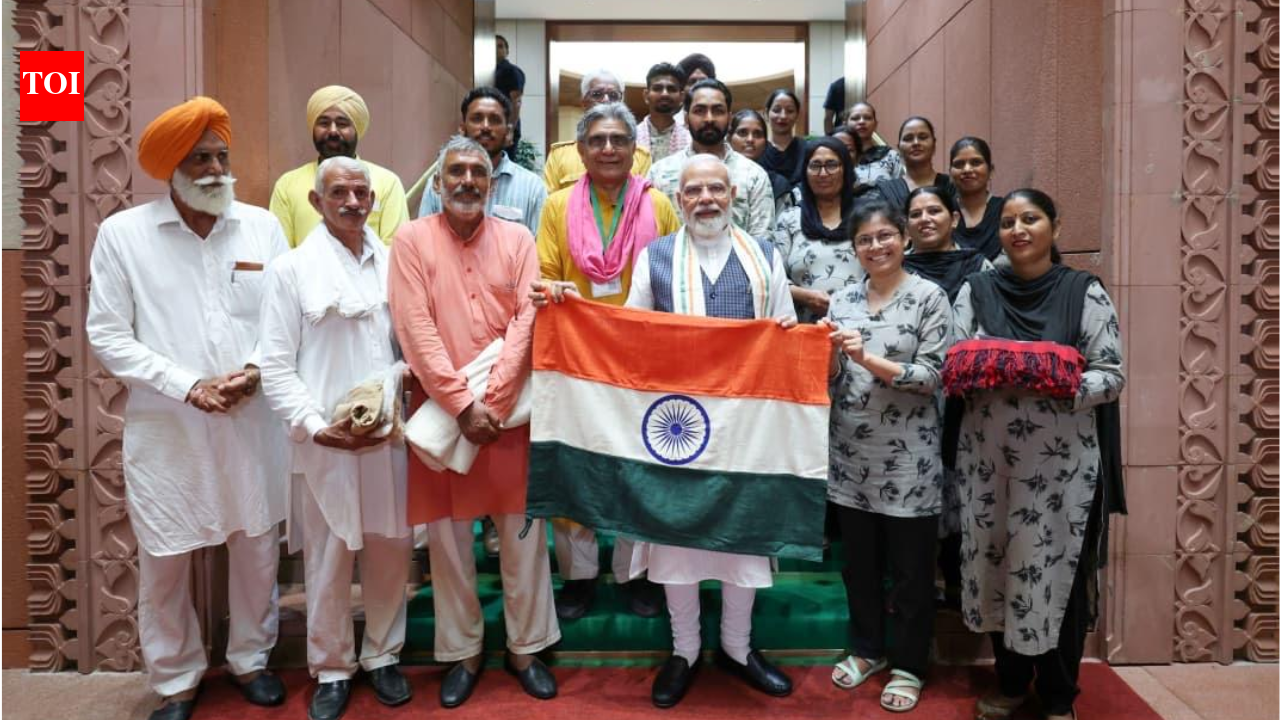
BATHINDA: On the occasion of National Handloom Day, a 20-member delegation from Punjab-based natural farming initiative Kheti Virasat Mission (KVM) met Prime Minister Narendra Modi at Parliament House on Friday and presented him with the Indian National Flag made from hand-spun and handwoven khadi produced using indigenous, non-Bt cotton grown through natural farming methods.The delegation comprised 10 weavers and 10 natural farmers, farmer-trainers, and key team members associated with the initiative. A majority of the weavers were rural women from Nav-Trinjan who have been directly involved in transforming cotton into yarn and yarn into handwoven khadi.Nav-Trinjan represents the complete “Seed to Tiranga” journey, bringing together natural farming, indigenous seeds, desi cotton, khadi, hand spinning, handloom weaving, women’s empowerment, skill development, and rural livelihoods within one integrated model.During his nearly half-hour interaction with the delegation, the Prime Minister inquired about the background and work of the members, listened to their experiences, and especially appreciated the labour, skill, patience, and dedication of the women weavers.The delegation explained that Nav-Trinjan is not merely a weaving project but an integrated model of rural regeneration and farm-to-fabric development. Under this model, natural farmers cultivate indigenous, non-Bt, toxin-free cotton. Rural women then prepare the cotton, spin it by hand on traditional charkhas, and weave it into khadi on handlooms. The fabric is subsequently transformed into value-added products such as khes, shawls, stoles, garments, and even the National Flag.The initiative connects farmers, weavers, women, youth, artisans, conscious consumers, and local markets within a decentralised rural economy.The Nav-Trinjan initiative brings all these ideas together in one practical model. Indigenous cotton is grown through natural farming, value is added locally, women and youth gain skills and dignified livelihoods, traditional crafts are revived, farmers gain stronger market linkages, and economic value remains rooted within rural communities.Rupsi Garg, Director of Kheti Virasat Mission and Head of the Nav-Trinjan Organic Handloom Initiative, presented the complete journey and working model of Nav-Trinjan to the Prime Minister.She explained how traditional spinners and weavers were identified village by village, how knowledge was gathered from khadi and handloom centres across India, and how a new generation of women and youth was trained to build a complete farm-to-fabric value chain rooted in indigenous cotton and rural craftsmanship.She also explained that women in Nav-Trinjan are not merely beneficiaries but artisans, producers, trainers, entrepreneurs, and custodians of traditional knowledge.Surinder Pal Singh Siyag, Chairman of the Nav-Trinjan Committee and a natural farmer, showed the Prime Minister seeds of naturally coloured indigenous cotton, cotton lint, and handwoven fabric produced from it. He explained the potential of traditional Indian cotton varieties that naturally possess colour and can be used to create attractive, environmentally responsible textiles without relying entirely on artificial dyeing.A beautifully handwoven khadi khes/shawl, personally made by Ramandeep Kaur of Village Chaina, was also presented to the Prime Minister.Umendra Dutt, Executive Director of Kheti Virasat Mission, briefed the Prime Minister on KVM’s long-standing work in Punjab in the areas of natural farming, indigenous seed conservation, biodiversity, environmental health, pesticide-free agriculture, pest literacy, desi cotton, millets, rural livelihoods, and Nav-Trinjan.


