



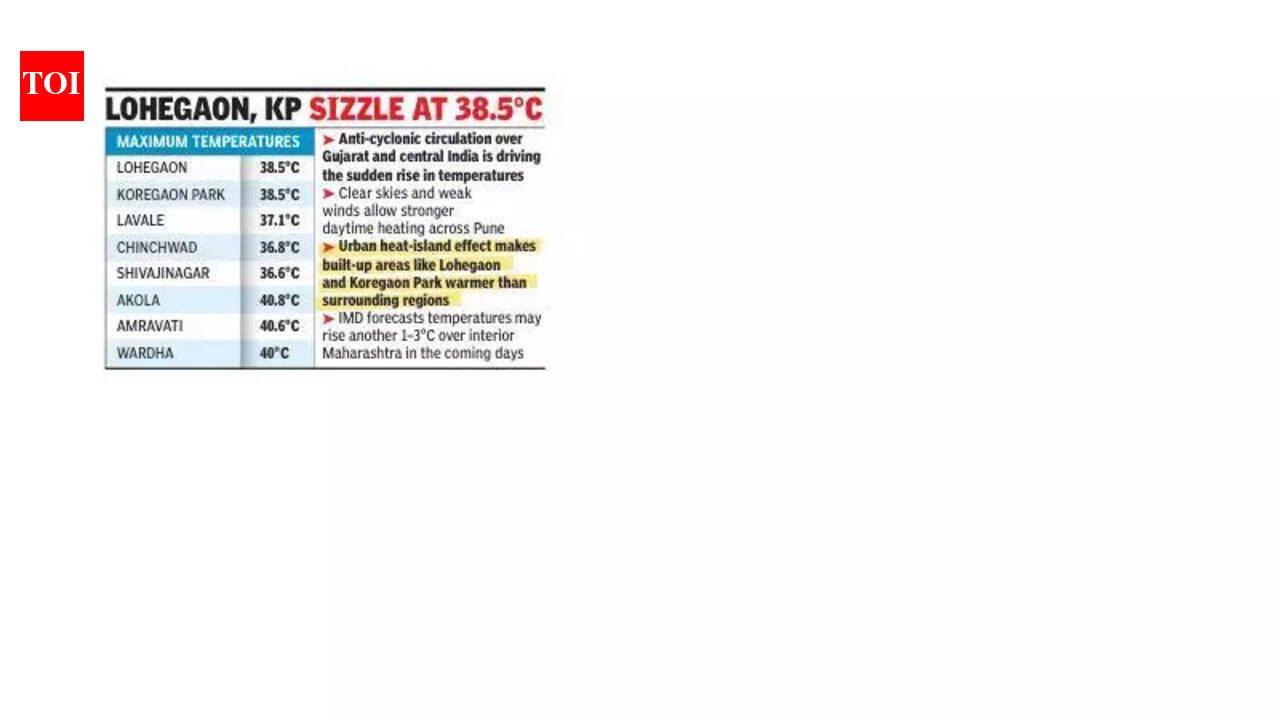
Pune: The city has experienced a sharp rise in daytime temperatures during the first week of March, as dry air, calm winds and anti-cyclonic conditions have pushed up the mercury across the region.Weather data on Saturday showed maximum temperatures reaching 38.5°C in Lohegaon and Koregaon Park, 36.8°C in Chinchwad, 37.1°C in Lavale and 36.6°C in Shivajinagar. In comparison, several stations had recorded temperatures of around 31–32°C on Feb 27, indicating a rapid increase within a short period.Data also revealed extremely low relative humidity levels across the city on Saturday afternoon. Humidity dropped to about 11% in Lohegaon, 14% in Chinchwad, 17% in Magarpatta, 18% in Shivajinagar and around 21% in Koregaon Park, making the heat feel more intense. At the same time, the minimum temperature in Pune was about 15.9°C, resulting in a day–night temperature difference of nearly 20°. Doctors warned that such fluctuations can put stress on the body and may lead to fatigue, dehydration and seasonal illnesses.Meteorologists said the sudden shift from mild weather to hot afternoons often creates the impression that Pune skips the spring season, although such transitions are common in India’s climate.S D Sanap, scientist at the India Meteorological Department (IMD), said the increase in temperatures is mainly due to a persistent anti-cyclonic circulation over Gujarat and central India, including Maharashtra.“Temperatures are rising because of the persistence of an anti-cyclonic circulation over Gujarat and the central Indian region, including Maharashtra. This causes subsidence of air and calm winds, which leads to higher daytime temperatures. Such conditions are typical during the pre-monsoon season,” Sanap said.He added that maximum temperatures in several areas are currently 2–3° above normal. However, parts of Vidarbha, such as Akola and Amravati have recorded departures of more than 5° from normal, meeting the criteria for heatwave conditions. “In Madhya Maharashtra, including Pune, temperatures remain close to normal but may increase by another 2–3° in the coming days,” he said.Sanap also explained that India does not experience a clearly defined spring season, which is why the shift from winter to summer often feels abrupt.“March, April and May are considered the pre-monsoon months in India. Since the country lies in the tropics and receives monsoon rainfall from June to Sept, heat gradually builds up during this period, making the seasonal transition appear sudden,” he said.Low humidity levels are also linked to the same weather pattern. According to IMD, anti-cyclonic circulation brings dry air, clear skies and weak winds, allowing stronger heating during the day.Urbanisation is further intensifying the heat in certain parts of Pune. Areas such as Lohegaon, Koregaon Park and other densely built neighbourhoods tend to warm up faster due to the urban heat island effect, where concrete structures absorb and retain more heat and there is less vegetation to provide cooling.With clear skies expected to persist, IMD has forecast a gradual rise of 1–3° in maximum temperatures across interior Maharashtra over the next few days.Although temperatures in Pune are only slightly above normal, parts of Vidarbha recorded heatwave conditions on Saturday. Akola reported 40.8°C and Amravati 40.6°C, both nearly 5° above normal and meeting heatwave criteria. Wardha recorded 40°C, while several other stations in the region registered temperatures close to 39–40°C, according to IMD data.


