


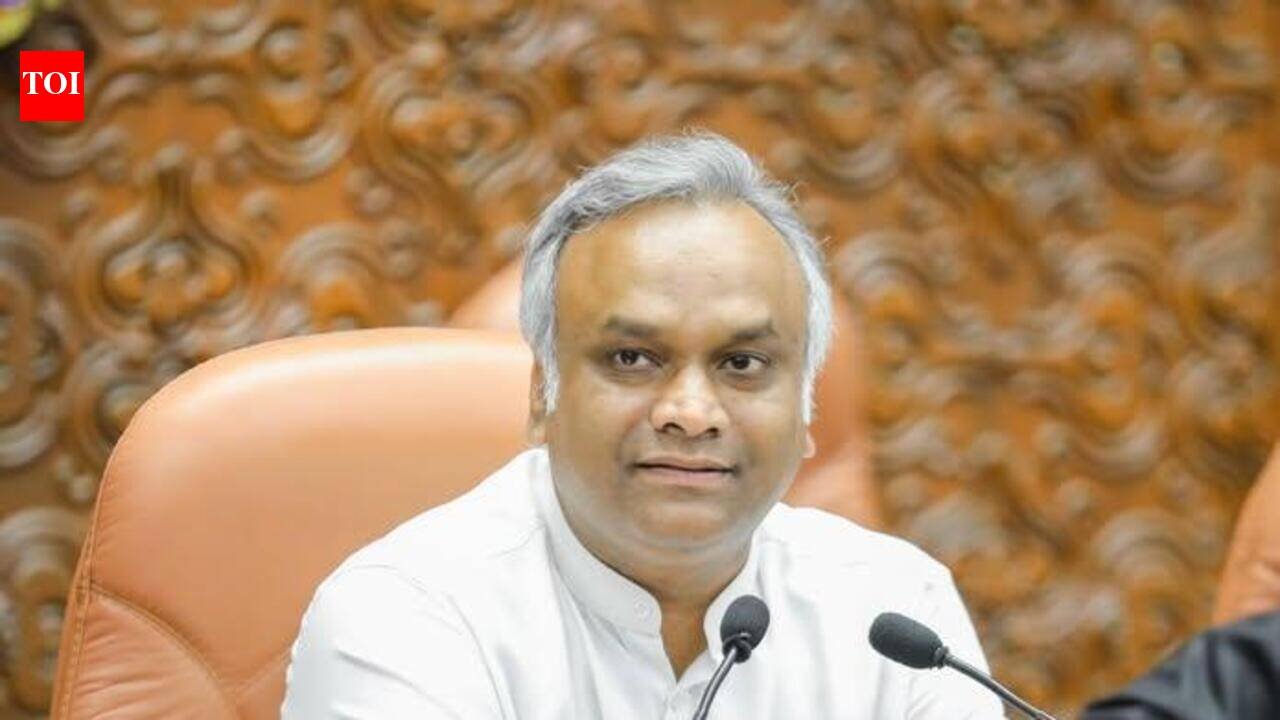
Bengaluru: Home and IT-BT minister Priyank Kharge’s sustained offensive against the century-old Rashtriya Swayamsevak Sangh (RSS) has ignited a fierce political debate across the country.It began with his open letter to RSS chief Mohan Bhagwat demanding details on the organisation’s legal status, registration, funding sources, and institutional accountability. While Bhagwat asserted RSS operates transparently, in full public glare and without state funding and dismissed the inquiry as a politically motivated stunt, the confrontation has polarised the state’s political scene.Senior Congress functionaries and strategists have strongly backed Priyank’s assertive stance, viewing it as a deliberate effort to neutralise any perception of soft-Hindutva within the party while consolidating its core secular vote bank.Given Priyank’s influential ministerial position alongside his stature as the son of Congress president Mallikarjun Kharge, his actions carry significant political heft. The strategy effectively presents a template for how the party might engage with ideological adversaries in other regions, using executive authority to enforce structural accountability.This is not Priyank’s first direct confrontation with RSS. During the organisation’s nationwide centenary route marches last year, Priyank — then serving as the IT-BT and RDPR minister in the previous Siddaramaiah cabinet — successfully pushed for stringent legal compliance. Under his influence, the administration mandated that RSS secure explicit state permission, accept caps on participant numbers, and strictly adhere to govt designated routes. This policy shift laid the groundwork for an administrative model where non-state actors must clear specific regulatory thresholds before using public spaces.The standoff peaked in Priyank’s home constituency of Chittapur in Kalaburagi district. Local authorities initially denied permission for a centenary march, and although the Karnataka high court eventually permitted the march under strict riders, Priyank claimed a tactical victory, noting it was the first time RSS was legally compelled to seek state approval and operate within constitutional bounds.Sources suggest this unrelenting approach against the Sangh Parivar heavily influenced his elevation to the high-profile home portfolio.Political analysts interpret the campaign as a well-calibrated manoeuver to sharpen Congress party’s ideological identity, allowing it to define the terms of political engagement ahead of future electoral battles. By directly challenging RSS, Priyank has positioned himself as one of the party’s foremost ideological voices against the Sangh Parivar, effectively elevating his political profile beyond state lines.Predictably, BJP has hit back, terming the campaign a diversionary tactic to mask governance deficits. BJP spokesperson Mohan Krishna even accused the minister of manufacturing controversy for partisan and political gains, while MP Ramesh Jigajinagi asked “why a Dalit man” needs to be concerned about RSS.K Sudhakar, another MP, alleged Priyank’s national ideological posturing is primarily designed to burnish his credentials with Congress’ high command.Some political commentators also view the development as the emergence of a new-generation Congressmen eager to engage in direct ideological combat that provides party cadres with a potent rallying point.
