


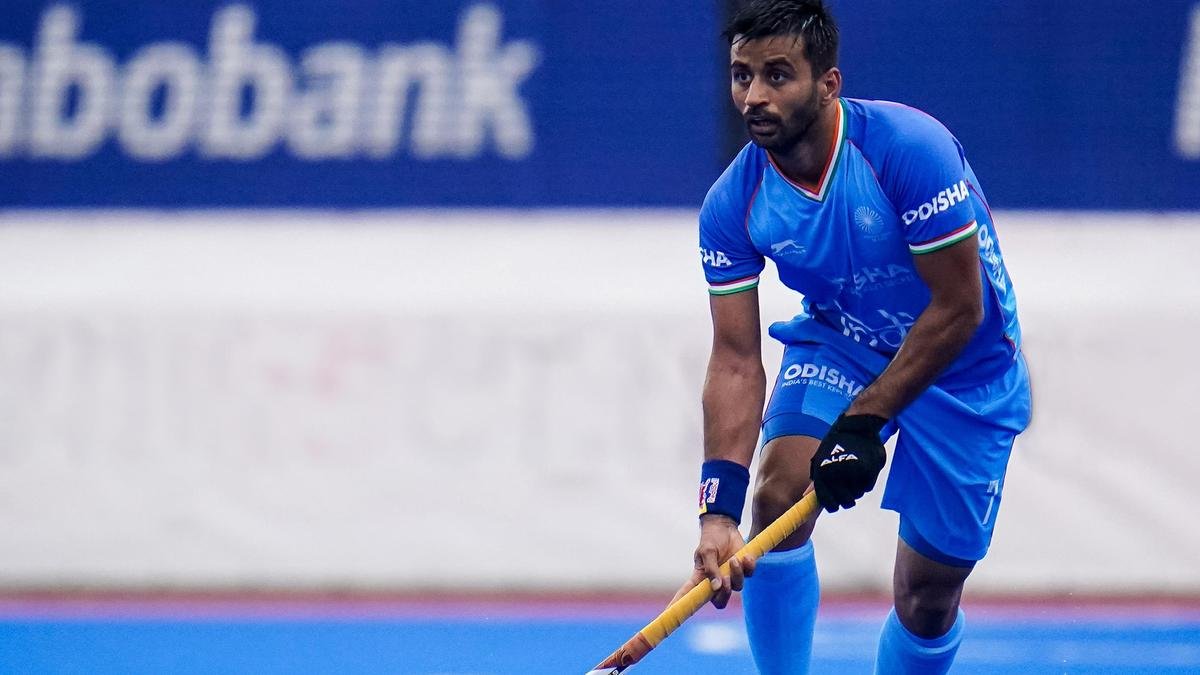
As a 20-year-old fresh-faced youngster, Manpreet Singh was still earning his national spurs when he travelled for the London Olympics in 2012. It was one of the most forgettable outings for the Indian hockey team, a culmination of decades of middling performances and, in many ways, more humiliating than not qualifying four years earlier.
From that baptism by fire to captaining the national team to its first Olympic medal in 41 years at Tokyo, to becoming the first Indian recipient of the FIH Player of the Year award (2019), to becoming the most-capped Indian hockey player with 413 outings – fifth overall and the only one active – Manpreet’s journey has mirrored Indian hockey’s evolvement over the last 15 years. The 33-year-old, still one of the fittest players in the Indian dressing room and the world, is hungry for more.
Excerpts from an interview:
What does this mark mean to you?
It’s a very proud moment. It’s a huge honour to play for your country for so long. I have always wanted to give my 100 per cent every time I wear the India jersey and I have worked hard for it. Staying fit, be conscious of what to eat or not, lots of sacrifices. Staying away from family for months, missing out on all the major moments in my kids’ lives, missing them – when they started walking, talking, everything I have missed. There have been lots of ups and downs but when you finally achieve something, reach a certain point, then all the sacrifices feel worth it and they make the result that much sweeter.
You are also the senior-most player in the side and a midfielder, both roles bringing added responsibility. Does this milestone change anything and does it matter as a player?
I don’t think so. Anyone who knows me, also knows the kind of person I am and the number of caps or captain’s band or anything else doesn’t matter. It is a big honour, playing 413 matches for the country over 15 years, and I am proud of it but it doesn’t change anything on field, you still have to go out there and perform. I have always believed in working as a team. As a senior, it’s my responsibility to lift a youngster if he makes a mistake or is not feeling confident, help him come back to form.
My focus has always been on how to improve as a team and I will continue doing that. 413 matches is huge, you have to maintain your fitness and motivation for so long, you need the support of your entire team, the coaching staff, the federation over the years. It doesn’t mean I stop listening to others because I have played for so long.
Manpreet gets a special jersey from India coach Craig Fulton.
| Photo Credit:
Special Arrangement
What have been the highest and lowest points of your career?
Highest point so far would undoubtedly be the Tokyo Olympics bronze medal. Even though we won again in Paris, Tokyo will always be special because it ended the medal drought for Indian hockey, it was a dream come true after 41 years. Every athlete dreams of an Olympic medal but for us, the glory days of Indian hockey was something we had only heard of, it was something the whole country had been waiting for, for so long.
As for the lowest, I think it would be the 2012 London, my first Olympics. Even though I was a youngster, we had gone with a lot of dreams and hopes of doing well but unfortunately we finished 12th and last there, without winning a single match.
Years ago you had said that every player wants recognition. You are now the most-capped Indian hockey player, a double Olympic medallist, one of the most recognisable names in Indian sports. Have you achieved your dream of being a star?
See, recognition always matters, there is nothing wrong in wanting it. I have always wanted to be part of the Indian team, to do well for the country, win medals. I always dreamt that whenever I retire and return to my village, people would recognise me, know me as an Olympian, as a medallist, appreciate me. Everyone wants that. When you put in so much effort and work so hard for so long, you want people to know about it and recognise that.
It is still important for me. I would want the coming generations to be inspired by me, just like I was inspired by Pargat Singh. I want to do enough to leave a legacy, do enough for the next generation to want to be like Manpreet, play like Manpreet, win like Manpreet, be famous like Manpreet. I want to be a role model for the youngsters, as much for the game as for my fitness. That is very important, for youngsters to understand that Manpreet at 33 is as fit as anyone much younger and be inspired by that. Just like everyone talks about Virat Kohli’s fitness and training and diet at 36, I would want kids to talk about Manpreet’s fitness and training.
But have I achieved my dream of being a star? Maybe, not really. There is a lot more to do still, there is the World Cup, Asian Games, then LA. So, yeah, long way to go still.
What would you say is the secret of your physical longevity and mental strength?
I think the hunger in me. That’s both the biggest motivation and my biggest strength. The drive to play for the country, to keep getting better and most importantly, I do not want to regret anything when I decide to retire. I don’t want to leave with any ‘what ifs’. The hunger which I had as a kid is still there, there are a lot of things I still need to do – an Olympic gold, a World Cup medal are still dreams. Yes there have been a lot of ups and downs, there are more losses than wins but every loss teaches you something.
The biggest motivation off the field, undoubtedly, has been my family. My wife has been a pillar of support in my most difficult times, including when my father passed away in 2016. When my kids watch me on television, when I talk to them on phone and they tell me they are proud of me, nothing can beat that, it pushes me to do more because I always want them to be proud of their father.
They were in Paris also, they travel a lot to cheer me at tournaments. My elder daughter Jasmine is my biggest cheerleader. It pushes me to do better, to be a good role model so that they are proud of their father and understand that all the sacrifices and time away from them was worth it.
Manpreet Singh.
| Photo Credit:
FILE PHOTO: K MURALI KUMAR
Hockey is often considered a poor man’s sport. Have things changed financially from then to now?
A lot. When I first came into the national team in 2011, there was hardly any financial incentive. The only dream was being an India player. But HIL in 2013 changed things. It was a game-changer, it helped improve conditions a lot for me and my family. Like most hockey players, I also come from a poor background and had to struggle a lot but over the years, life has become better, the journey has become easier. I won’t deny that things are a lot better now for hockey players.
The cash awards by Hockey India, individual rewards all have helped. Players have good jobs, there is financial stability. Earlier, no one wanted their kids to play hockey because there was nothing in it. But now things are different, kids are getting interested in hockey.
Talking about the present, how important is this year, how are the preparations so far?
This year is very important for us. Playing England and Pakistan in the Pro League will be useful because they are in our group at the World Cup, for which we will be back here next month. England have been doing well so those games will be important. Then there will be Asian Games which is the ticket to LA Olympics.
Preparations are going well, the matches against Germany and Netherlands were good in terms of the team’s performance regardless of the results. We are excited about the World Cup and the Asian Games and I personally am very hopeful of a good result at the World Cup. It is important because it’s been a very long time since we won a medal at the World Cup and we will try to do that this time.
Who have been the toughest opponents and teams for you?
When I first started playing, it used to feel that other teams were all very strong, very tough. Teams like Australia, with players like Jamie Dwyer or Mark Knowles, looked unbeatable. But I think things have changed a lot over the years, Indian hockey has improved a lot.
Now when we play Germany or Netherlands, we don’t think whether we can match up to them. Now there is confidence that if we play well and stick to our plan and do the basics right, we can defeat any team. Every team is tough but every team is beatable. That is the mindset now. Belgium and Netherlands are among the toughest opponents in world hockey at the moment but if we give our 100 percent, we can defeat them.
It is far more difficult to think of individual players because hockey is a team game but if I had to, there is Arthur van Doren or Tom Boon in Belgium, Alexander Hendrickx is very dangerous with his drag-flicks. Holland has Jorrit Croon, Australia too has good players. It is difficult because every top team in the world has several great players.
A lot was said about you recently. Did it affect you in any way?
Yes there was a lot said and written in the last few months but I knew there was no point in thinking about stuff not in my control. What I had in my control was my fitness and I was clear I will not compromise on that. Whatever else happened, I was sure I won’t let fitness be an issue for my exclusion. I can confidently say that I am as fit as anyone else at the moment and I want to play as long as I can maintain that. I still hold that LA Olympics remains my ultimate target but I am also clear I will walk off the day I feel I am pulling the team down.
Does age matter?
No it doesn’t, it’s just a number. The world’s most-capped player is Belgium’s John-John Dohmen and he was 36-37 when he played at the Paris Olympics. Tom Boon is 36 right now and he has set his sights on LA28, I am three years younger! What is more important is how I take care of my body.
And there is no alternative. World hockey today is at a level where if you are not at peak fitness all the time, you cannot survive. I know I have to work extra hard to keep up with everyone else and I have worked a lot on my fitness over the years because if I don’t I won’t be able to remain in the team. It’s really that simple – your fitness will decide your place in the side.
You said London 2012 was the lowest point of your career. If you had to look back and say something to the 20-year-old Manpreet, what would you say?
Nothing much, just keep playing the way you are, keep giving your 100 per cent every time you step out on the field. Never give up. That’s the biggest lesson I learnt from London and that is the only advice I will give to my younger self and, in fact, to every youngster. There will be a lot of tough situations in life, on and off the field but come what may, don’t give up, don’t walk away unless you are completely incapable of standing up. That’s my philosophy even now.
