





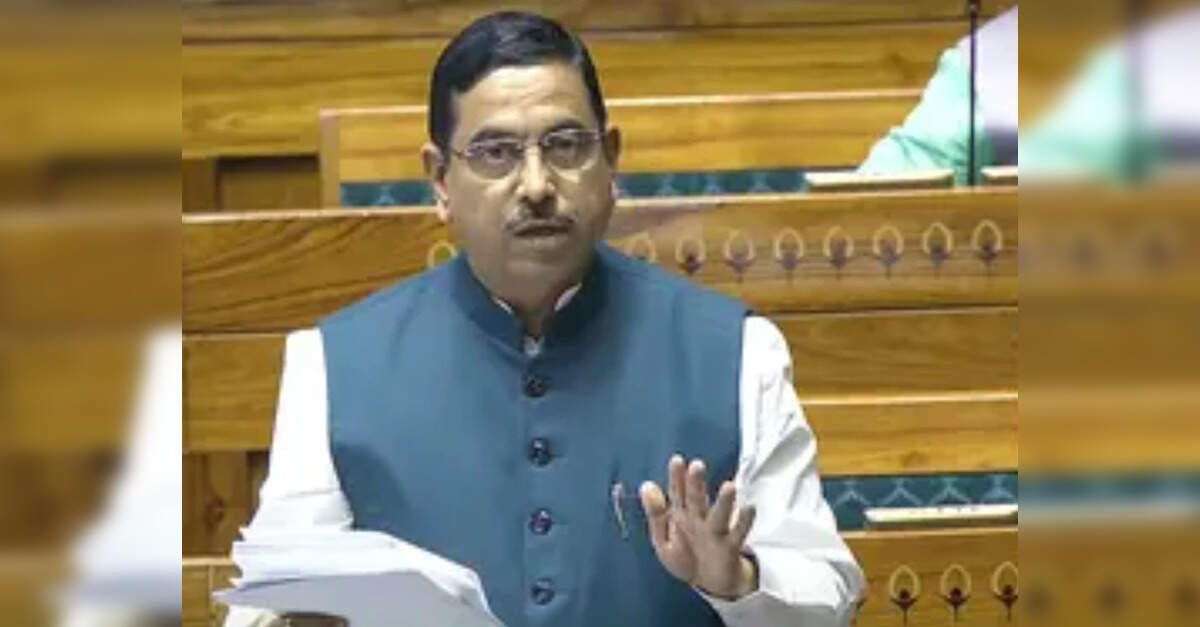
New Delhi: Less than 24 hours after Union Education Minister Dharmendra Pradhan resigned in the wake of the NEET-UG 2026 crisis, the Narendra Modi government moved swiftly to ensure continuity in the ministry, assigning its additional charge to senior Union Cabinet Minister Pralhad Joshi.
Already overseeing the ministries of Consumer Affairs, Food and Public Distribution, and New and Renewable Energy, Joshi now takes charge of the Education Ministry at a time when it is implementing one of the most significant administrative overhauls in its recent history following the NEET controversy.
For the veteran parliamentarian, the assignment comes with an immediate challenge: steering reforms at the National Testing Agency (NTA), overseeing the transition of NEET to computer-based testing, and restoring confidence in India’s examination system.
Pralhad Joshi at a glance
Age: 63
Constituency: Dharwad, Karnataka
Member of Parliament since: 2004
Lok Sabha victories: Five consecutive terms
Current portfolios: Consumer Affairs, Food and Public Distribution; New and Renewable Energy
Additional charge: Ministry of Education
A veteran parliamentarian and organisation man
Joshi represents Dharwad in Karnataka, a constituency he has held since 2004 after winning five consecutive Lok Sabha elections. In the 2024 general election, he retained the seat comfortably, further cementing his position as one of the BJP’s senior leaders from Karnataka.
Born on November 27, 1962, in Bijapur (now Vijayapura), Joshi graduated with a Bachelor of Arts degree from K.S. Arts College, Hubballi, affiliated with Karnataka University, Dharwad. According to his election affidavit, he is an industrialist by profession. He is married to Jyothi Joshi and has three children.
Before entering Parliament, Joshi emerged as a prominent BJP leader during the Hubli Idgah Maidan movement in the early 1990s. He later served as the Karnataka BJP president between 2012 and 2016, helping strengthen the party’s organisation in the state.
Within the BJP, Joshi has built a reputation as an organisational leader and parliamentary manager. His appointments to politically significant ministries over the years reflect the leadership’s confidence in his administrative abilities and legislative experience.
Experience across key ministries
Since joining the Union Cabinet in 2019, Joshi has handled several major portfolios, including Parliamentary Affairs, Coal and Mines. Following the formation of the Modi government’s third term in 2024, he was entrusted with Consumer Affairs, Food and Public Distribution, along with New and Renewable Energy.
Unlike his predecessor Dharmendra Pradhan, however, Joshi has not previously handled the Education Ministry or led education policy at the Union level. His immediate priority is expected to be overseeing the ongoing restructuring of the National Testing Agency and ensuring the smooth conduct of upcoming national entrance examinations.
Previous engagement with education issues
Although he has not previously served as Education Minister, Joshi has been associated with several education-related debates during his political career.
During Karnataka’s 2022 hijab controversy, he supported the implementation of court orders and called for maintaining discipline in educational institutions. He also defended the Karnataka government’s textbook revisions when they came under criticism from opposition parties. Earlier, he had spoken in favour of strict action in connection with a sedition case linked to slogans raised at a college in Hubballi.
These interventions, however, were largely political in nature. The challenges now before him are administrative: implementing examination reforms, overseeing institutional restructuring and ensuring the credibility of one of India’s largest public examination systems.
The challenge he inherits
Joshi assumes charge of the Education Ministry at a time when the government is implementing wide-ranging reforms following the NEET-UG 2026 paper leak controversy.
The National Testing Agency recently terminated 47 officials as part of an internal overhaul, while Higher Education Secretary Vineet Joshi was moved to the Ministry of Panchayati Raj. The Centre has also announced that NEET will shift to computer-based testing from next year, alongside broader reforms aimed at strengthening examination security and governance.
The ministry is also expected to oversee the implementation of anti-paper leak measures announced by the government while addressing concerns raised by students and parents following the cancellation of the original examination and the nationwide re-test.
Immediate priorities
Government notifications describe Joshi’s appointment as an additional charge, suggesting it could remain an interim arrangement pending any future Cabinet reshuffle.
Regardless of the duration of his tenure, his immediate priorities are clear: completing the restructuring of the NTA, implementing examination reforms, ensuring the smooth conduct of future entrance tests and rebuilding confidence in India’s examination ecosystem.
For Joshi, the assignment begins not with a new education policy but with restoring credibility to one of the country’s most important public institutions. His first test will be administrative rather than political, as millions of students and parents look to the government to ensure that the events surrounding NEET-UG 2026 are not repeated.


