



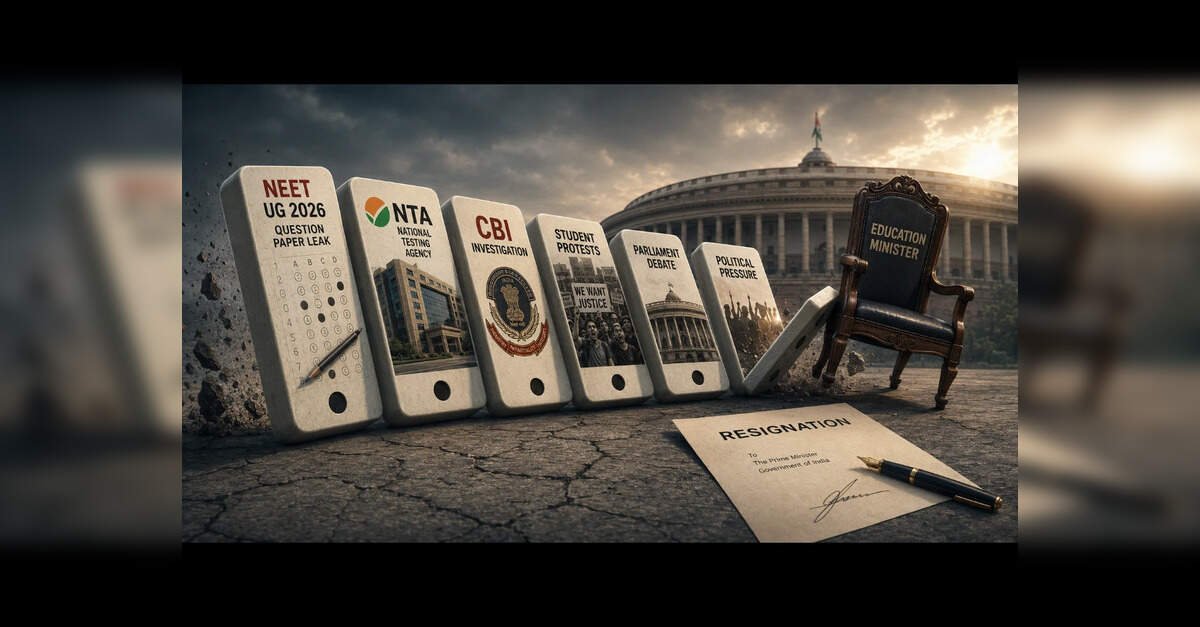
New Delhi: For nearly two months, the Narendra Modi government stood firmly behind Union Education Minister Dharmendra Pradhan despite mounting criticism over the NEET-UG 2026 paper leak. Even as protests intensified, Parliament’s Monsoon Session witnessed repeated disruptions and the Centre carried out a sweeping overhaul of the National Testing Agency (NTA), the official line remained unchanged: Pradhan would stay.
As late as July 24, government sources insisted his resignation would amount to “running away” from the problem rather than fixing it.
Less than 24 hours later, Pradhan resigned, becoming the highest-profile political casualty of India’s biggest examination controversy in recent years.
Timeline: How the crisis unfolded
| Date | Development |
|---|---|
| May 3 | NTA conducts NEET-UG 2026 for over 20 lakh candidates; irregularities surface almost immediately. |
| Early May | Centre hands the matter to the CBI, cancels the examination, announces a re-test and says NEET will shift to computer-based testing from next year. |
| May 15-16 | Chief Justice of India Surya Kant’s remarks trigger the formation of the Cockroach Janta Party (CJP) as a satirical movement. |
| June 6 | CJP holds its first protest at Jantar Mantar demanding Pradhan’s resignation. |
| June 21 | NEET-UG re-examination conducted. |
| June 28 | Sonam Wangchuk begins an indefinite hunger strike at Jantar Mantar. |
| July 16 | Re-examination results declared. |
| July 18 | Wangchuk is shifted to Safdarjung Hospital ahead of the planned Parliament march. |
| July 20 | ‘Sansad Chalo’ march coincides with the opening of Parliament’s Monsoon Session; clashes erupt with Delhi Police. |
| July 21 | Centre announces fast-track examination reforms as the restructuring of the NTA gathers pace. |
| July 22 | Union Ministers J.P. Nadda and Jitendra Singh hold talks with CJP representatives. |
| July 23 | Fresh clashes reported near Sansad Marg. |
| July23- 24 | Higher Education Secretary Vineet Joshi is moved to the Panchayati Raj Ministry. NTA terminates 47 officials. Wangchuk ends his 26-day fast. Government publicly rules out Pradhan’s resignation. |
| July 25 | Pradhan submits his resignation to Prime Minister Narendra Modi. |
From examination controversy to political crisis
The crisis traces back to May 3, when the NTA conducted NEET-UG 2026 for more than 20 lakh medical aspirants. Allegations of a paper leak surfaced almost immediately. The Centre responded within days by ordering a CBI investigation, cancelling the examination and announcing a nationwide re-test. It also unveiled a structural reform by shifting NEET to computer-based testing from next year to reduce the scope for future leaks.
The re-examination was held on June 21 and results were declared on July 16. By then, the controversy had moved well beyond allegations of a paper leak. Questions over the NTA’s credibility, administrative accountability and the integrity of India’s examination system had transformed what began as an examination controversy into one of the biggest governance challenges faced by the Education Ministry in recent years.
This was not new terrain for Pradhan. During the 2024 NEET-UG controversy, he had maintained there was “no evidence of a paper leak” and described the NTA as “very credible”. The position came under intense scrutiny then as well, eventually leading to a Supreme Court-directed re-test for more than 1,500 candidates. Unlike 2024, however, the 2026 crisis ultimately claimed the minister’s office.
From satire to street movement
The protest movement that eventually forced Pradhan’s exit did not begin as one. On May 15, Chief Justice of India Surya Kant made remarks widely interpreted as comparing unemployed youth to “cockroaches”. The following day, political communications strategist Abhijeet Dipke, formerly associated with the Aam Aadmi Party, founded the Cockroach Janta Party (CJP) as a satirical response.
As anger over NEET and separate CBSE on-screen marking issues spread among students, CJP gradually evolved from an online campaign into an organised protest platform. Its first demonstration at Jantar Mantar was held on June 6.
The movement gained national traction on June 28 when education reformer Sonam Wangchuk began an indefinite hunger strike at the same venue, drawing opposition leaders, public figures and sustained media attention.
On July 18, with Wangchuk 20 days into his fast, Delhi Police shifted him to Safdarjung Hospital, a move protest organisers described as an attempt to weaken the agitation ahead of the planned Parliament march.
The crackdown and a parallel reckoning inside the NTA
The ‘Sansad Chalo’ march on July 20, the opening day of Parliament’s Monsoon Session, became the largest mobilisation of the agitation. Thousands of protesters marched towards Parliament under prohibitory orders imposed under Section 163 of the Bharatiya Nagarik Suraksha Sanhita.
Delhi Police used tear gas and baton charges after alleging protesters breached barricades and pelted stones. Police said more than 118 personnel were injured and at least five FIRs were registered. Hospital sources cited in media reports said emergency wards treated a large number of injured protesters, while internet services were suspended in parts of central Delhi. Solidarity demonstrations were also reported from Bengaluru, Bhopal, Guwahati and Agartala. Leader of Opposition Rahul Gandhi described the police response as “disgusting”.
Meanwhile, the government was pursuing a parallel strategy.
Sporadic violence continued through the week, including fresh clashes near Sansad Marg on July 23. On July 22, Union Ministers J.P. Nadda and Jitendra Singh met CJP representatives for nearly two hours. Within the ministry, the administrative overhaul had already begun. Higher Education Secretary Vineet Joshi was transferred to the Panchayati Raj Ministry on July 24, while the NTA terminated 47 officials and indicated further legal action against some of them. The agency also initiated recruitment for senior professional positions as part of what officials described as a comprehensive restructuring.
The exit
Even as the NTA overhaul gathered pace, government sources maintained as late as July 24 that Pradhan’s resignation was not under consideration. Wangchuk ended his 26-day fast the same day after further discussions with ministers, although student groups said their agitation would continue until all demands, including compensation and withdrawal of FIRs, were addressed.
Pradhan’s resignation the following day therefore came as a reversal rather than an inevitability. In his letter to Prime Minister Narendra Modi, he said the government had acted decisively after the controversy surfaced and described his resignation as being in the interest of students and institutional stability. He also thanked the Prime Minister for the opportunity to serve.
At Jantar Mantar, protesters celebrated the announcement. Dipke declared the resignation a victory for the movement and argued that sustained public mobilisation had succeeded in forcing political accountability.
What comes next
The Centre is yet to announce a new Union Education Minister, and it remains unclear whether Prime Minister Narendra Modi has formally accepted Pradhan’s resignation. The restructuring of the NTA, NEET’s transition to computer-based testing and the proposed anti-paper leak reforms announced during the crisis all remain works in progress. Protest groups continue to seek compensation for families of students who died by suicide and the withdrawal of FIRs filed against those detained during the July 20 march.
Pradhan’s resignation closes one chapter of the NEET-UG crisis but not the larger questions it has exposed. The credibility of India’s examination system, the future of the NTA, the implementation of anti-paper leak reforms and the restoration of public trust will now fall to his successor.
For a crisis that began with allegations of a leaked question paper, it ultimately reshaped India’s education administration and claimed the tenure of a senior Cabinet minister who had been part of the Modi government since 2014.


