


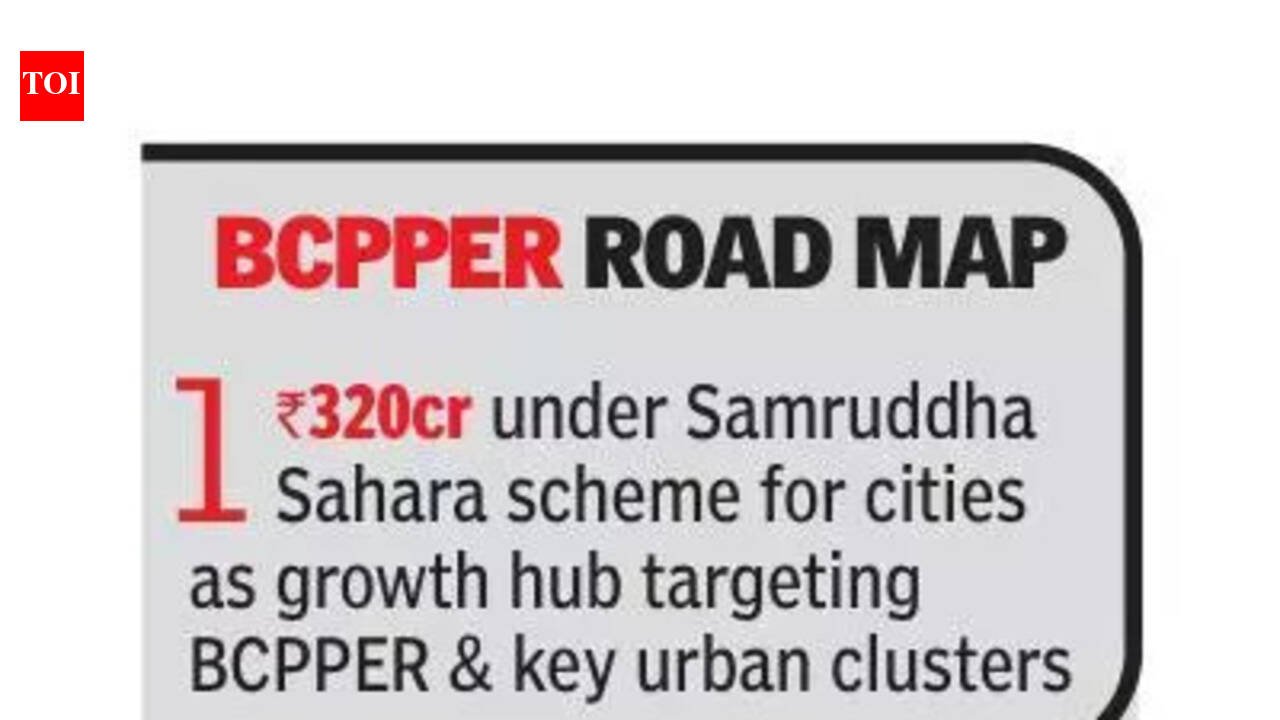
Bhubaneswar: Pushing ahead with urban-led economic growth, chief minister Mohan Charan Majhi on Friday said the state will use the proposed Bhubaneswar-Cuttack-Puri-Paradip Economic Region (BCPPER) as a template to build three additional industrial corridors. The Centre has already committed Rs 5,000 crore for the BCPPER under the new City Economic Regions (CER) framework. The state will activate three new agglomerations — Bargarh-Jharsuguda-Sambalpur (BJS), Berhampur-Chhatrapur-Gopalpur (BCG) and Jeypore-Koraput-Sunabeda (JKS) — to develop them as economic clusters. “The rollout will be done in a phased manner,” Majhi said. Under the Samruddha Sahara scheme, the CM allocated Rs 320 crore, focusing on comprehensive town planning and new city development in BCPPER and major clusters such as Sambalpur and Berhampur. The funds will support area surveys, road networks, sewerage, electrification and other key urban utilities. “The budget will outline the initial financial commitment for the BCPPER. The idea is to demonstrate readiness so that central funds are allocated immediately,” a senior official said. Preliminary assessments suggest the region could account for nearly one-third of Odisha’s economic output once operational, given it already hosts major IT parks, ports, industrial corridors, logistics hubs, tourism centres and the administrative capital. Urban policy expert Manas Rout said the BCPPER could help Odisha attract significantly higher foreign direct investment. “FDI prefers dense, well-connected urban clusters. Odisha has industrial strength, but its cities have never been packaged as integrated investment destinations,” he said. Economist Biswas Ranjan added that a unified economic zone anchored in urban infrastructure would diversify investment beyond mining and mineral-based industries. The govt had earlier allocated Rs 1,342 crore for the Bhubaneswar New City across Gothapatna, Daspur and Malipada for land acquisition and core infrastructure. Urban planners said the ‘New City’ aligns well with the larger BCPPER vision. “BCPPER will work best if new townships, transit corridors and industrial nodes are developed simultaneously,” said researcher Piyush Ranjan Rout.


