



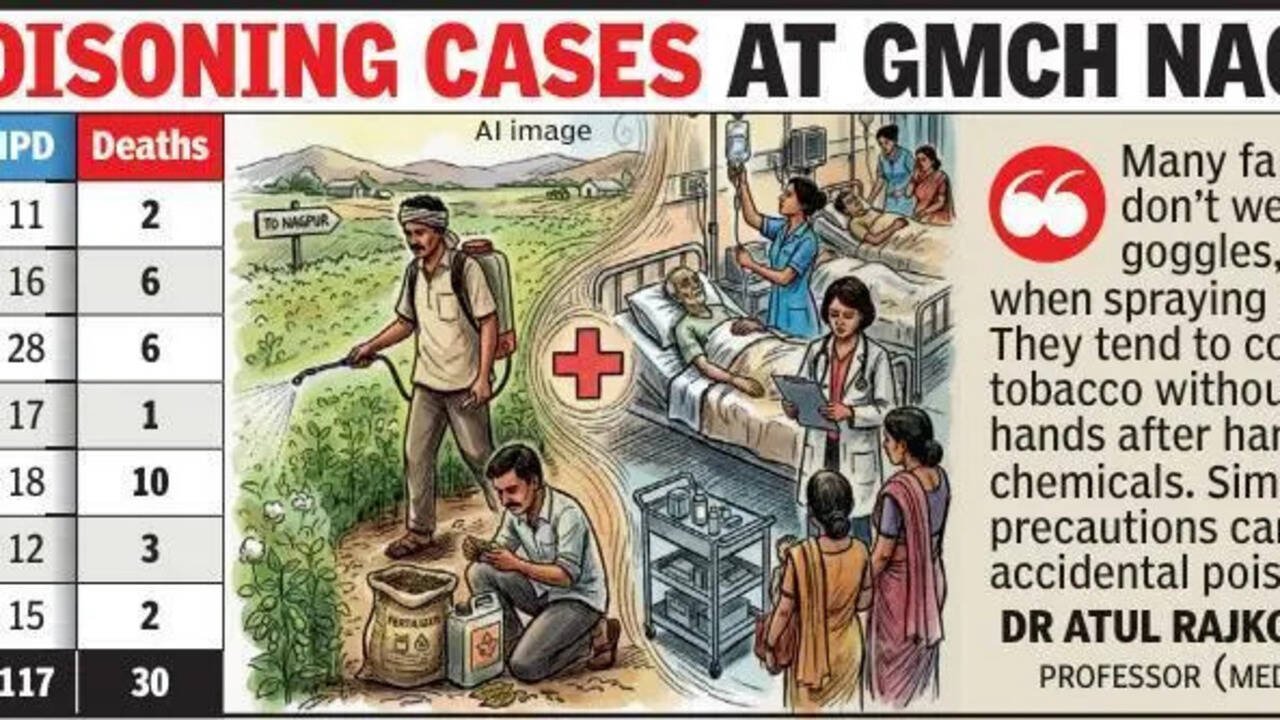
Nagpur: Fields across Central India continue to witness a devastating toll from organophosphate (OP) poisoning with 30 farmers and farm workers succumbing since January after either accidentally inhaling pesticide fumes while spraying standing crops or consuming the toxic chemical amid financial or family distress.GMCH Nagpur recorded deaths of these people from Vidarbha, Chhattisgarh and Madhya Pradesh between January 1 and July 15. Recently two more farmers were wheeled in on ventilators after their condition deteriorated following OP poisoning. However, a lack of registry for such deaths makes these fatalities go unnoticed.Organophosphate (OP) poisoning, commonly caused by exposure to or consumption of agricultural pesticides, emerged as the leading cause of poisoning deaths at Government Medical College and Hospital (GMCH), Nagpur, hospital data showed.The hospital admitted 117 patients with OP poisoning between January 1 and July 15 this year, of whom 30 died, as per data that highlighted severity of pesticide-related poisoning in central India.GMCH treated 130 poisoning cases during the period, recording 32 deaths. OP poisoning alone accounted for 90% of poisoning fatalities (30 of 32 deaths), making it the single largest contributor to poison-related mortality at the tertiary care centre.March clocked the highest number of OP poisoning admissions at 28, while May witnessed the highest death toll of 10, reflecting the increased burden during the peak agricultural season.Between July 1 and 15, the hospital admitted 15 OP poisoning patients, of whom two succumbed.Doctors said GMCH, being a major referral centre, receives critically ill poisoning patients from across Vidarbha and neighbouring Madhya Pradesh and Chhattisgarh.Dr Atul Rajkondawar, professor of medicine at GMCH, said a significant number of OP poisoning cases involved deliberate consumption in suicide attempts, while accidental exposure also occurred among farm workers during pesticide spraying.“Many farmers do not wear protective masks, goggles, or gumboots while spraying pesticides. They also tend to eat or consume tobacco without washing their hands after handling the chemicals, increasing the risk of absorption through the skin and ingestion. Simple precautions such as using protective gear and washing thoroughly before meals can substantially reduce accidental poisoning,” he said.He added that it is difficult to classify every case as suicidal or accidental because patients often arrive in a critical condition and detailed histories are not immediately available.Farm activist Pushpak Khapre from Amravati said unsafe handling practices continued to be widespread in rural areas.“Districts such as Yavatmal are worst affected because of extensive cultivation of crops like soybean and tur that require repeated pesticide application,” he said.


