



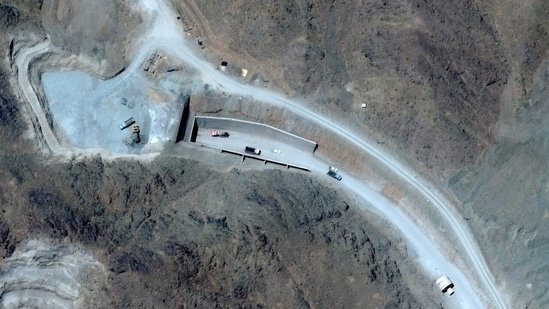
Israeli intelligence believes Iran moved thousands of uranium-enrichment centrifuges into tunnels deep inside a mountain last fall, Israeli and U.S. officials say, a development that would heighten concerns that Tehran could reconstitute its nuclear program.

Israel passed along the intelligence findings to the U.S., saying the centrifuges were transferred to the Pickaxe Mountain site last fall after the 12-day war in June when American and Israeli strikes pummeled Iran’s three main nuclear sites.
As Israel’s war aims have increasingly diverged from the U.S.’s, Prime Minister Benjamin Netanyahu has tried to persuade President Trump to resume all-out attacks on Iran to further set back Tehran’s weapons programs and rebuilding effort. The U.S. has stepped up attacks in the past 10 days, and Trump said the U.S. was prepared to attack Pickaxe Mountain.
Iran’s foreign minister and the United Nations’ nuclear watchdog, the International Atomic Energy Agency, or IAEA, didn’t respond to requests for comment. The White House referred The Wall Street Journal to interviews Trump gave last week about the site.
Pickaxe is “a possible target for a nice big fat shot,” Trump told conservative broadcaster Hugh Hewitt on July 13. It was the first time he has explicitly talked about Pickaxe as a target, although he has previously mentioned an Iranian underground location buried in granite.
Known as Mount Kolang in Iran, Pickaxe has been under surveillance by the U.S. and Israel for years, and what little is known about Iran’s activities at the site suggests it would present challenges to any airstrikes. Located near one of Iran’s main nuclear installations, Pickaxe was commissioned as an underground replacement for an Iranian centrifuge-assembly facility that was badly damaged after a 2020 explosion, which might have been an act of sabotage.
Activity has continued there steadily for the past 15 months, with truck traffic, tunnel reinforcements and a security perimeter springing up, said the Institute for Science and International Security, a think tank on nuclear and nonproliferation issues. There was also work around an older tunnel network that dates from 2007, which Iran has since sealed up.
“It is plausible that Iran moved centrifuges into the tunnels” in Pickaxe, said David Albright, the institute’s president.
Experts estimate that the subterranean complex reaches 300 to 450 feet deep beneath solid rock, with enough room to accommodate several nuclear-related facilities.
Nate Swanson, a U.S. National Security Council director for Iran in the Biden administration, said Tehran’s history of covert nuclear activity means any undeclared activity in a hardened underground site is cause for concern.
“A covert breakout is the worst-case scenario. We don’t know what Iran’s intentions are, but the fact that we can’t verify this site underscores how problematic the status quo is,” Swanson said. “We have to have the IAEA in there to inspect these things.”
Pickaxe wasn’t considered a priority to bomb last year during the Israel-Iran war and hasn’t been targeted in the round of fighting with the U.S. that began on Feb. 28. But officials and experts have long worried that Iran could use the tunnels to store or build nuclear equipment and to set up a small enrichment facility for producing fissile material.
An Israeli military official familiar with the targeting effort expressed concern that the recent war’s airstrikes hadn’t sufficiently targeted nuclear-weapons-related work, saying that there was more work to be done, including at Pickaxe Mountain.
Centrifuges are machines that are used to spin uranium gas, separating isotopes to enrich the material for civilian nuclear energy or potential weapons production. Iran denies ever seeking nuclear weapons but has produced about 1,000 pounds of 60% enriched uranium, near weapons-grade.
The placement of centrifuges at Pickaxe doesn’t necessarily mean Iran is building an enrichment site there. After the June 2025 bombings, Tehran may have put its surviving centrifuges there to minimize their risk of destruction.
It isn’t clear where the centrifuges Israel told the U.S. were taken to Pickaxe came from. Spare centrifuges might have been located at Iran’s main nuclear sites.
But Iran has given the IAEA no access to the site and provided no information about its work or plans there, the nuclear agency has said. Director General Rafael Grossi said in March that Iran in 2021 announced its “intention to have nuclear activity” at the site.
Write to Laurence Norman at laurence.norman@wsj.com, Anat Peled at anat.peled@wsj.com and Alexander Ward at alex.ward@wsj.com


