






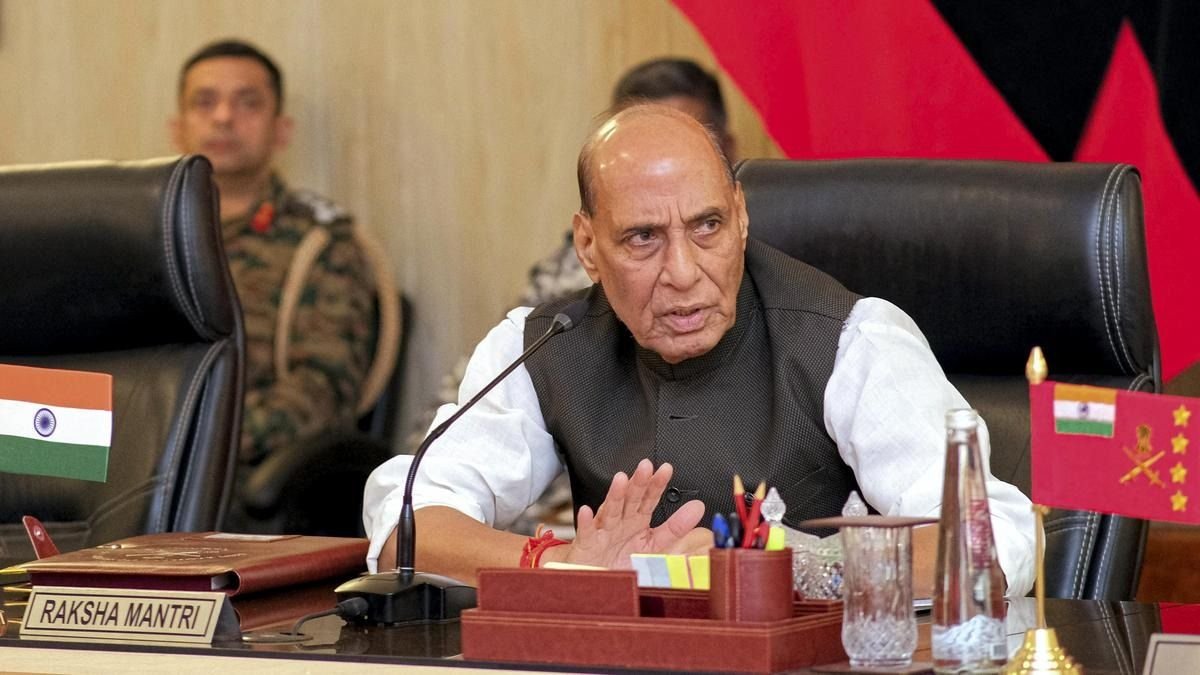
Srinagar, Oct 15: Defence Minister Rajnath Singh on Thursday cautioned Pakistan against any future terrorist attack on India, asserting that the country’s commitment to peace should not be mistaken for weakness and warned that any terror act originating from across the border would invite a stronger response.
Addressing a Defence Conclave in New Delhi, Singh said Operation Sindoor, the Balakot airstrikes and the surgical strikes reflected a decisive shift in India’s approach to terrorism, moving beyond diplomatic condemnation towards proactive military action aimed at dismantling the sources of terror.
“India is committed to peace, but it should not be mistaken for weakness. We’re fully prepared to safeguard sovereignty, integrity and national interests,” Singh said.
He maintained that India’s cultural ethos favoured dialogue, coexistence and peaceful resolution of disputes, but stressed that sustaining peace required military strength, preparedness and the ability to confront aggression.
“Operation Sindoor, Balakot Airstrikes and Surgical Strikes weren’t just military operations; they symbolised a decisive shift in the nation’s approach, moving from diplomatic condemnation to proactive action aimed at rooting out terrorism by reaching its very source,” he said.
The Defence Minister’s remarks underlined the government’s stated resolve to respond firmly to cross-border terrorism while strengthening the country’s ability to detect and counter emerging security threats. Singh also cited the changing nature of terrorism, warning that threats were no longer confined to organised militant groups. He pointed to lone-wolf attackers and what he described as “white-collar terrorism”, calling for heightened vigilance by security agencies and citizens to identify suspicious activities and prevent attacks.
Highlighting the expanding dimensions of national security, Singh outlined what he termed the “5D Security Threat”—disinformation, destabilisation, disruption, deception and destruction.
He said hybrid, high-tech and hyper warfare had made the detection and neutralisation of threats increasingly complex, requiring security agencies to adapt to rapidly evolving methods and technologies.
The changing threat environment, he indicated, demands a broader security response that combines intelligence gathering, technological capabilities and public vigilance rather than relying exclusively on conventional military measures. Singh also claimed that since 2014, the operational lifespan of most terrorists had fallen to less than a year, with security forces neutralising them within a year of their taking up arms against India.
On defence preparedness, he called for a shift towards “smart power”, combining military strength with artificial intelligence, precision-guided weapons, loitering munitions and affordable, adaptable technologies.
“Modern defence strategies must integrate precision-guided weapons and loitering munitions with cost-effective weaponry, human intelligence with artificial intelligence, and advanced systems with low-cost, agile and adaptable technologies to address evolving security challenges,” he said.
Singh said India’s defence strategy was moving beyond meeting immediate operational requirements towards building a self-reliant and future-ready defence ecosystem.
He said 75 per cent of the defence modernisation budget had been earmarked for procurement from Indian industries, highlighting the role of domestic manufacturers, start-ups, micro, small and medium enterprises and individual innovators in strengthening military capabilities.
Citing Operation Sindoor as an example of growing indigenous defence capabilities, Singh referred to the Akash missile system, BrahMos and other advanced equipment used by the armed forces.
He said the operation demonstrated increasing confidence in home-grown defence technologies and reflected the importance of reducing dependence on foreign suppliers.
The Defence Minister also highlighted the expansion of the domestic defence innovation ecosystem. As of March 2026, the Innovations for Defence Excellence initiative had engaged 676 start-ups and innovators and facilitated 551 contracts, he said.
Singh said national security increasingly required coordinated efforts by government agencies, the defence industry, researchers and citizens. He expressed confidence that India would emerge as a developed nation by the centenary of Independence, with technology, economic growth and defence capabilities playing central roles in that ambition.


