


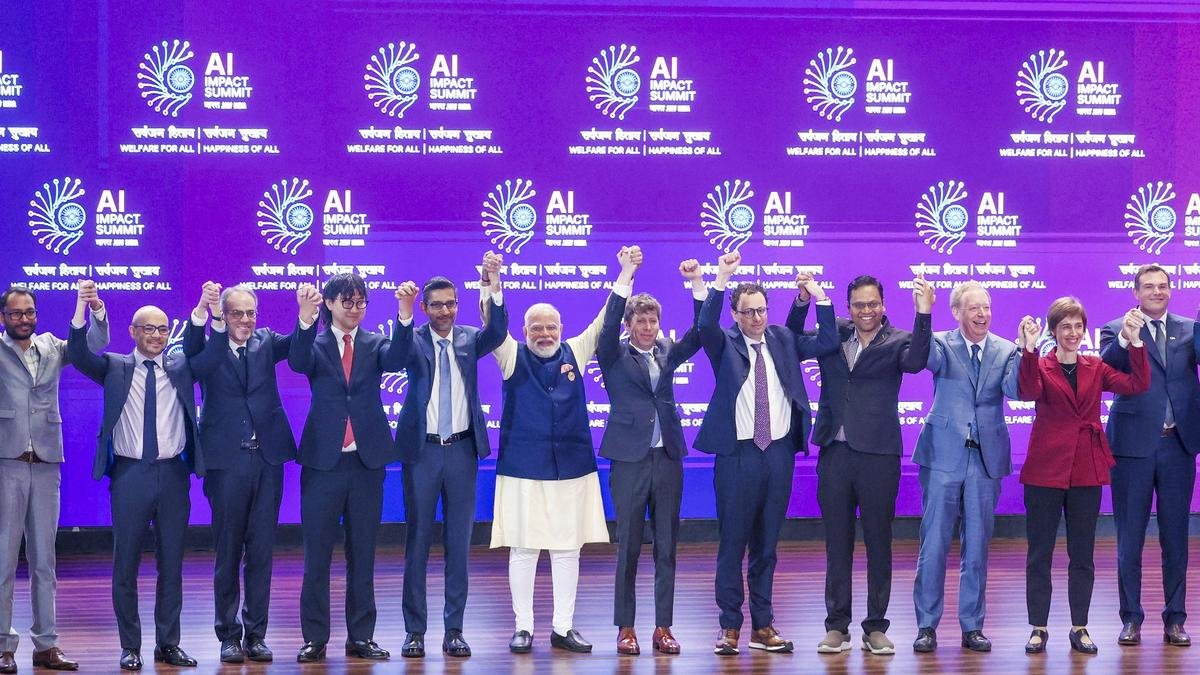
As the AI Impact Summit drew to a close on Friday, it was clear that the government sought, if at least for a week, to make India the centre for all things AI in the world. The crowds showed up, with half-a-million attendees thronging the expo and crowding out all the session rooms. World leaders and Ministers from dozens of countries waded through the heavily-regulated traffic to attend. AI heavyweights such as Sam Altman and Dario Amodei deliver keynotes.
By all means, the users are there: in a report on Friday, OpenAI published a telling insight into how Indians use AI: ChatGPT prompts from here take advantage of the firm’s most advanced data analysis, writing and technical tools available on the platform. This, the firm says, means that Indians have largely closed the “capability overhang,” the gap between what the latest large language models can do, and what they’re actually used for.
It is clear: India is addicted to the potential of AI across personal and professional spheres alike. That will have massive consequences for how the Internet is used, how LLMs diffuse into companies, and what lies ahead for knowledge work beyond the IT industry. As the implementation of Aadhaar, UPI and other such frameworks show, Indians either welcome or eventually embrace the use of digital technologies when it is possible to do so, and scale is more of an amplifier than a restraint, especially when an enthusiastic State is making a push.
Infrastructure layer
A central problem is the infrastructure layer. For previous waves of technology, costs became so manageable that, at least for government projects, achieving sovereign computing resources was entirely an achievable goal. The physical servers of Aadhaar and UPI are within India, and the cost of running these systems is manageable.
Not so for AI, which has drastically disrupted the surprising power efficiency of the Internet. The graphics processing units (GPUs) powering AI — both in training LLMs and running “inference” on them — are in and of themselves expensive. The costs,however, are buried in the opex: AI training runs require millions of dollars’ worth of electricity, and inference in data centres also add up enormously.
India is the world’s most populous country, but only the third largest electricity producer; rural electrification was only substantially completed in the last decade. As with any scarce resource, electricity costs are bound to be challenging, especially when factoring in renewable energy goals, and India’s target to be carbon neutral by 2070. That bodes well for power generation and transmission companies, with guaranteed near-captive clients. It could, however, drive energy prices, at least for AI, up.
The government’s support for the IndiaAI Mission does offer research aid in key areas of urgent interest: for instance, Sarvam AI’s 35 and 105 billion parameter models have benefited from the common compute facility, giving them subsidised access to government-purchased GPUs for training runs. Sarvam, BharatGen and other initiatives are filling the gap that LLMs have in Indian languages, a key step for deployment. (Sarvam’s models are planned to be open source but since that step has not yet been taken, it is hard to pinpoint the extent to which they introduce novel savings and techniques.)
India has the world’s second largest AI userbase, driven by wide Internet coverage. As such, inference costs are likely to be huge. Availability of capital for local infrastructure development is a major challenge: U.S. hyperscalers estimate their collective datacentre spending in the hundreds of billions of dollars a year. The biggest infrastructure investments within Indian borders are currently an outpost of that spending. That leads to a risk of India remaining a net inference importer, either through foreign data centres, or foreign-owned data centres.
Chip layer
The India Semiconductor Mission and hardware assembly initiatives have been largely executed with efficiency, and interest for all its programmes have largely met many of the stated ambitions: smartphones are now among India’s most valuable exports, even as a domestic component manufacturing ecosystem takes shape; capital subsidies have attracted Micron’s packaging facility in Gujarat; and the production-linked incentives for a range of IT hardware and sub-assemblies have gained interest from numerous firms.
But for a mix of historical and economic reasons, the electronics manufacturing ecosystem is, at this point of history, is not a heavy-hitter that holds strategic leverage beyond de-risking hedges by multinationals seeking to avoid volatile outcomes of overly relying on China. There is no disagreement that semiconductor and electronics manufacturing capacity — key for indigenising infrastructure — takes decades to arrive at.
The moment may be critical: if AI ends up remaking the world economy in irreversible ways, such as by cheaply replacing knowledge work at scale, India may find a decades-long industrial policy prematurely clashing against a future these measures are designed to safeguard against. In the most crucial period of this transformation, if AI builders are to be believed — the coming two years — India faces a U.S. jealously guarding and nurturing its own AI industry as the world’s foundation. There are few signs that there will be a serious challenge to this dominance in the coming years.
Human capital
If there are any structural green shoots in India’s AI ecosystem, it is human capital. Much of Silicon Valley’s innovations have been made possible by a steady flow of foreign-born excellence, much of it Indian. The C-suite of the Big Tech firms bears testament to this. As with past generations of brain drain, this is a mixed blessing: while remittances from talent moving abroad is certainly helpful for the economy, retaining enough of the best talent is crucial. To that end, India faces both the investment appetite to pay competitive salaries, and struggles in many parts of the country to offer a quality of life that can urge many to choose the homeland over a different home for their children.
That is on the AI and chip research side. In the IT industry, Claude’s latest models — doing in minutes what would take a human coder a day — have spooked investors about the industry, and further undermined the ability of this industry (benefiting from a not-insignificant amount of labour arbitrage) to act as a path to the middle class.
The government’s stated path so far has taken many of these limitations into account: IT Minister Ashwini Vaishnaw has batted for India mastering deployment, and making the best use of the resources available to it. Yet, there is a major pitfall to be cognisant of: seeking economies is not the exclusive reserve of the constrained.
Published – February 24, 2026 07:00 am IST


