



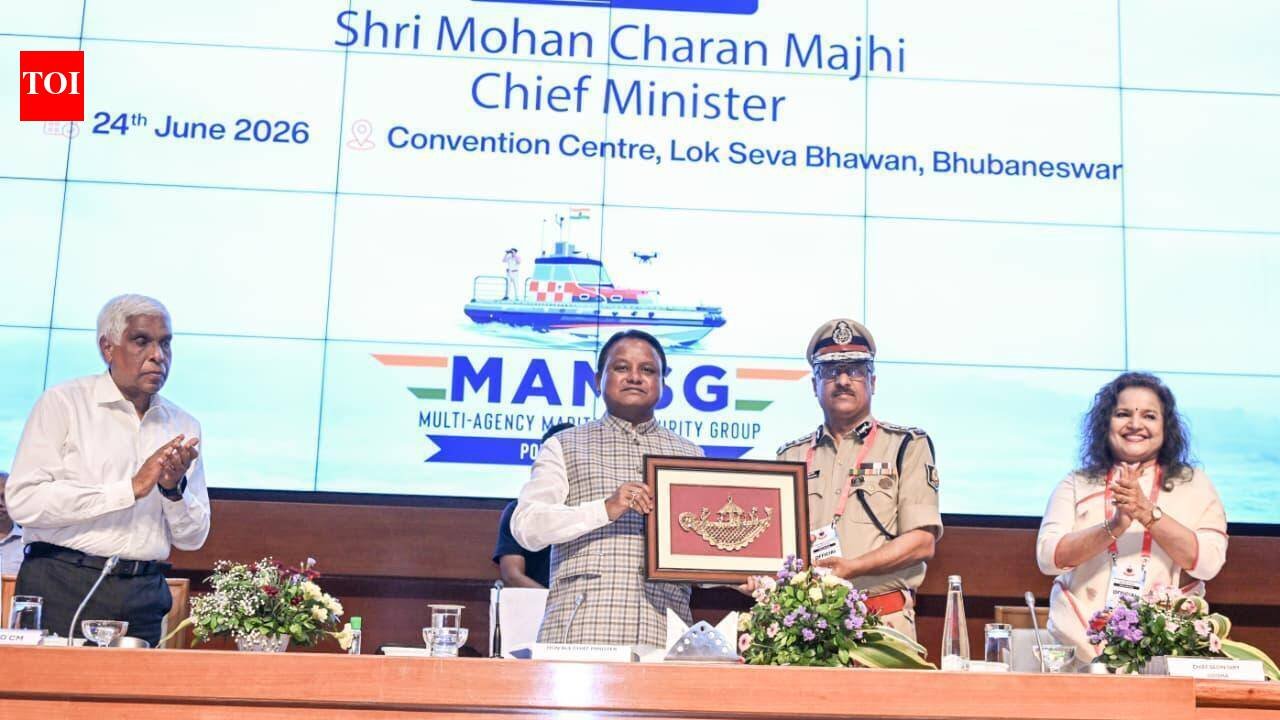
Bhubaneswar: To reinforce its ambitious blue economy agenda and tap into maritime resources, the Odisha govt is turning to technology as a frontline tool against emerging sea‑borne threats.Facing potential challenges of infiltration, terrorism, smuggling, trafficking, unlawful fishing and other transnational crimes, the govt plans to do away with conventional policing and shift to artificial intelligence and unmanned systems technology.Odisha’s nearly 575-km coastline along the Bay of Bengal, dotted with major ports, fishing communities, industrial hubs and ecologically sensitive zones, makes it a strategic asset.“Technology is going to play a major role in reshaping coastal security in the coming days. AI, unmanned systems, predictive analytics, advanced monitoring network and integrated command and control system will usher in major transformation in the maritime security framework,” chief minister Mohan Charan Majhi said at a national-level meeting of the multi-agency maritime security group (MAMSG-policy) in Bhubaneswar on Tuesday.The chief minister underlined Odisha’s pivotal role in driving the nation’s maritime growth and the blue economy. “India is emerging as a major maritime power. Odisha, with its rich maritime heritage, is central to this growth,” Majhi said.He stressed that maritime security goes beyond traditional policing, encompassing protection of critical infrastructure, domain awareness, cybersecurity, disaster management and environmental safeguards.DGP Y B Khurania said the maritime security environment is becoming increasingly complex. “We need constant vigilance and seamless coordination among all agencies. Protecting these requires a robust coastal security framework. The state govt has accorded high priority to coastal security, allocating Rs 149 crore last fiscal and Rs 113 crore this year for infrastructure, technology and manpower,” Khurania said.The DGP outlined key initiatives of Odisha police in recent years. “Our coastal security wing has pursued a two-pronged strategy — capacity optimisation and capacity building. The goal is not just to acquire assets, but to maximise operational effectiveness through smarter deployment, intensive training, intelligence-driven operations and seamless technology integration,” he said.Vice-admiral (retired) Biswajit Dasgupta, national maritime security coordinator, called for a comprehensive strategic framework drawing from global models. Chief secretary Anu Garg stated that maritime security must extend beyond military dimensions, urging focus on both mainland coasts and islands.


