



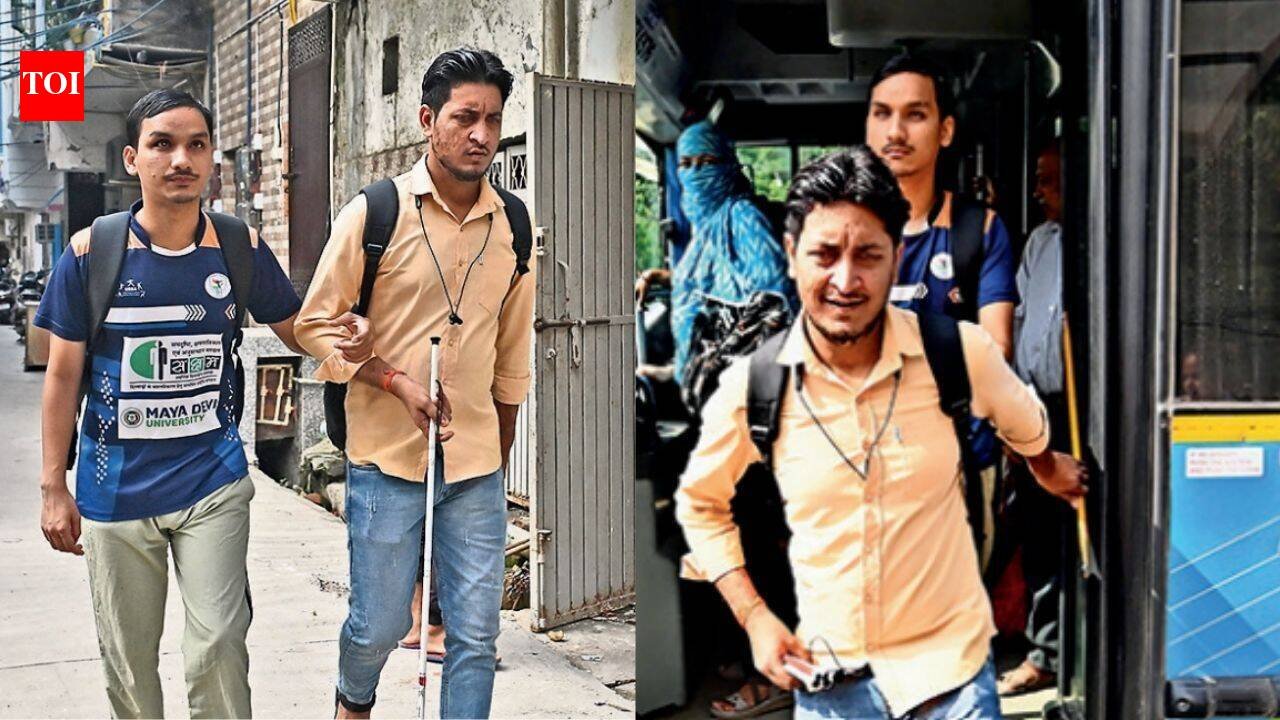
NEW DELHI: Cars, buses and two-wheelers poured in from every direction as Rajan Kumar and his friend, Nikhil, stood in the middle of a chaotic intersection in Burari’s Harit Vihar, a white cane tapping the ground as they waited to board a bus to college on a morning.There was no signal to guide them, no tactile path to lead them and no marked crossing to indicate where they should step next. Yet, the two visually impaired third-year students of Delhi University’s Kirori Mal College crossed the road almost instinctively, negotiating the traffic through sound, memory and years of practice.There is little room for “pity” in the account of their daily routine. What may appear to a sighted person as a “struggle” is a “normal” way of life for Rajan and Nikhil — one they have learnt to navigate using muscle memory, sound and touch, much as others rely on sight.Their concern, they say, is a system that continues to place unnecessary obstacles in their way. TOI recently travelled with Rajan and Nikhil from their hostel in Burari to KMC to experience their daily commute and examine how accessible the journey to campus is.At about 8.30am, TOI photographer Tarun Rawat and this reporter were seated in the hall of a hostel for visually impaired students. The two-storey independent facility, which appeared modest, with little beyond what is needed to survive, currently houses around 30 students. Its walls are lined with certificates celebrating the achievements of current and former residents — from Satyawati College and Rajdhani College to Deshbandhu College.Soon, Rajan, 21, arrived with Nikhil, 19, his friend and fellow third-year KMC student, who hails from Uttarakhand. We were ready to go.Rajan led us through the cramped lane outside the hostel, negotiating an uneven road, potholes, sudden bumps, turns, passing vehicles and stray dogs. His cane moved ahead of his feet, tapping the ground — using the three-tap and two-tap techniques to gauge what lay ahead. Nikhil clutched his hand and walked beside him, trusting his friend to lead the way.It’s the rain that brings with it a real challenge, they said. Every time it pours, the locality gets flooded, with water sometimes reaching up to their knees. “On such days, it is difficult to navigate our way. Sometimes, we simply have to miss our classes,” Rajan said.The two covered around 500 to 600 metres before reaching what they referred to as the “bus stop” — not a bus shelter or even a proper roadside waiting area, but a point along the main road where commuters simply gathered to wave down buses. There was no footpath or pavement to segregate them from traffic wheezing past from all directions.Shortly, some buses began pulling up. One was packed to the brim. Then another, equally crowded. Then another, but even its footboard was full.At one point, Rajan, who is from Bihar and whose father is a truck driver, said, “Looks like we may have to take a rickshaw or a cab.” A cab to the college, nearly 10km away, would mean spending a few hundred rupees instead of making the journey by bus for free. So, they waited some more.Eventually, they could squeeze into a bus, which was packed shoulder to shoulder, with barely room to move inside. So, all four of us stood near the door.Around 10 minutes into the journey, after several passengers got off, Rajan and Nikhil were finally able to take two seats.Around 25 to 30 minutes later, the two began asking passengers whether their stop had arrived. Shortly, they got off near North Campus bus station.Now, they had to cross the road again. There was no zebra crossing; instead, pedestrians took advantage of a broken opening in the middle of the road. A passer-by stepped forward and helped the two.We needed another bus to reach KMC. This one, too, was crowded. Rajan and Nikhil quickly boarded when it stopped. The doors closed before Tarun and I could get in, leaving us to follow them in an auto-rickshaw.The two got off at the stop closest to the college, and began the final 10-minute walk. Again, it was time to negotiate broken tactile paths and sidestep open wires and lounging strays.At places where the footpath disappeared, they moved onto the road; where it reappeared, they stepped back onto it. Their route was not unfamiliar; memory filled in where infrastructure did not.“We have been living in the hostel for years. We have to make candles from July to Oct. We are not paid for it, but the work is in return for our free stay and meals. The hostel has a cab that occasionally drops us to the college,” said Nikhil, whose father has a private job.
ASSUMPTION VS REALITY
Recently, KMC was hosting a talent hunt competition for students with disabilities. Around 60 of them from different colleges were participating.“We didn’t feel like attending classes today,” Rajan said, laughing. “We just came to chill and participate in the talent hunt,” Nikhil added.Inside the campus, the two led us to a room. Chairs were lined up, with students from different batches sitting around a visually impaired professor — Someshwar Sati, coordinator of the college’s Centre for Disability Research and Training.“Let me tell you a true story,” the professor said. “Once, I was auditioning for the role of a blind character. I was convinced I would land the role; after all, I was the only blind person in the room.About 30 minutes later, the casting director called me. I was told, ‘We are sorry, we cannot give you this role.’ I asked why. He said, ‘Because you do not look blind.’”The students burst into laughter.Sati continued, “I said, ‘What do you mean I do not look blind? I am blind.’ He said, ‘No, but you look happy. You are more suitable to generate comedy, not pity in viewers’ minds. You don’t have a sense of tragedy in your persona.’”The story, the professor said, is an illustration of how a disability is often perceived and understood through the way it is portrayed in media and popular discourse.“Not many such people are seen in real life, so the public know us through television and media portrayals — as people with sad stories,” he said. “But it does not have to be that way. If tomorrow, you are unable to use your right hand to eat, will you stop eating? No. You will use your left hand and learn to use it. That’s how it works for us. We have learnt our own ways. There is no sad reality to it.”The professor paused and offered another story, promising this one was “real”, unlike the previous one, he joked, again drawing laughter from the room.“In the 1990s, when I was a student, I was once standing on the roadside near DU arts faculty when a stranger took my hand and helped me cross the road. Once we reached the other side, he said, ‘We have reached.’ I asked, ‘Where?’ He said, ‘You wanted to cross the road, so I helped you.’ I told him, ‘Oh, come on! I was waiting for someone!”Rolls of laughter were heard again as Sati made his point — the assumption that a person with disabilities (PwD) needs help does not necessarily mean that help is needed, or the person offering it knows what is actually required.The professor said such assumptions were often rooted in stereotypes around disability. “PwDs are currently where feminism was in the 1960s and 70s,” he said, before leaving for his next lecture.He teaches English at the college.


