



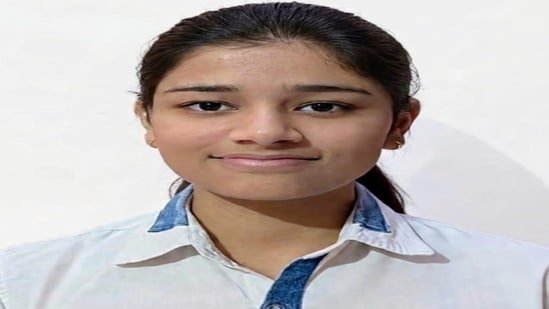
The Central Board of Secondary Education has announced the CBSE 12th Result 2026 on May 15. Akshata Dwivedi of Seth Mr Jaipuria School, Panditkhera, Sunehra, Lucknow has scored 98.4% in the Class 12 board examination.
Akshata while taking to HT Digital shared her preparation guidelines, daily routine and future goals. Check her answers here.
1. What study routine helped you stay consistent throughout the academic year?
What worked for me was three things, done daily without much variation. Understand the concept properly in school, while it’s actually being taught. Come home and restructure it for how you process things. Then keep short revision notes ready for later. No marathon sessions, no rigid timetable. My idea was to never let things pile up. Small amounts every day meant there was never really a backlog to deal with, and the syllabus never felt unmanageable.
2. How did you balance school, tuition, self-study, and personal time during board exam preparation?
I chose not to attend tuition classes. No extra commute and no back-to-back classes draining my energy before I even got home. In school, I stayed fully present. Paying proper attention during class meant I wasn’t relearning everything from scratch at home later. At home, the focus shifted entirely to studying and revision. Personal time stayed in the picture; I didn’t cut it out entirely. A short break, some time away from the desk also helped.
3. Which subjects were the most challenging for you, and how did you overcome difficulties in them?
Geography was tricky initially, with maps, data, and specific locations. My teacher sorted most of that out quickly, so it didn’t stay a problem for long. Psychology was different. That one stayed with me as a concern all the way through, and honestly, I wasn’t fully confident even the night before the exam. It’s not a subject you can memorize your way through. Case studies, application questions, theoretical frameworks necessitated the understanding of what’s being asked. What I ended up doing was sitting with the NCERT textbook, working through the examples on my own until things started clicking. Ended up getting a full 100 in the subject.
4. What role did NCERT textbooks play in your preparation strategy?
For CBSE, NCERT is non-negotiable. My teachers kept us in the clear about it. They continuously specified that any line from those chapters could show up as a question. So I set aside the heavy reference books and committed to the NCERT text. The focus was on understanding the content rather than skimming for key points. Keeping fewer sources but covering them properly seemed more useful than spreading attention across five different books. By the time exams came around, the text felt familiar enough that revision was mostly about confirming what I already knew.
From being called ‘Pakistani’ to CBSE’s apology: Vedant Shrivastava case amid OSM row
5. Did you follow any special techniques for revision and time management before exams?
My revision routine was very simple. After reading a section, I’d close the book and try to explain it back to myself in my own words — not recite, but actually explain it. If something wasn’t clear in that process, I knew I hadn’t understood it well enough yet. Writing answers out on paper was another habit I kept. Speed matters in boards, and structuring an answer under time pressure is a separate skill from understanding the concept. The schedule stayed flexible. One topic, done properly, then the next. No countdown timers.
6. How did you handle stress, pressure, or exam anxiety during the board season?
Boards didn’t feel like a crisis to me, which probably helped more than anything else. My family kept things calm at home — my parents and my brother were genuinely unconcerned in a good way. They weren’t tracking every hour I studied or asking me to predict my marks. That kind of environment took a lot of pressure off. When I needed a break, I took one. Stepped away from the desk, did something else for a while. Coming back after that always felt easier. There wasn’t really a strategy for managing anxiety.
Expert team from IITs formed to help CBSE in portal issues
7. Were mock tests and sample papers important in your preparation? How did they help?
Yes, I solved a few sample papers and reviewed my mistakes after each one. The sections where I found errors and revised carefully were usually the most useful for me. That review gave me clear areas to improve. Understanding the paper pattern and checking writing speed also helped, but most of the learning came from going back and analysing where I was losing marks.
8. What mistakes do you think students commonly make while preparing for CBSE board exams?
Treating boards like a completely different category of exam is where a lot of unnecessary pressure comes from. We’ve all given final exams before, and these aren’t structurally that different. The external attention around them is heavier, which tends to push people toward long hours, and pulling in new reference books weeks before the exam. Preparation spread steadily across the year doesn’t feel dramatic, but it makes the exam period far less stressful. Less to catch up on. Less guesswork about what you know and what you don’t.
9. Who motivated or supported you the most during your journey to becoming a topper?
My family never made the exams feel like a test of my worth. That absence of pressure was probably the most useful thing. No constant check-ins, no comparisons. They were just present in a calm, supportive way. My teachers were genuinely accessible when I had doubts. I could go to them with specific questions and get my doubts cleared.
10. What are your future plans and career goals after achieving this success in CBSE boards?
Law is the immediate plan. My interest in how the legal system shapes policy, and how institutions work within legal frameworks has been there for a while. The longer-term direction is civil services, where a background in law connects meaningfully to administration and policy work. That path is long, and I’m aware of what it takes. But the interest is genuine, and that makes it feel like a reasonable direction rather than an arbitrary one.


