



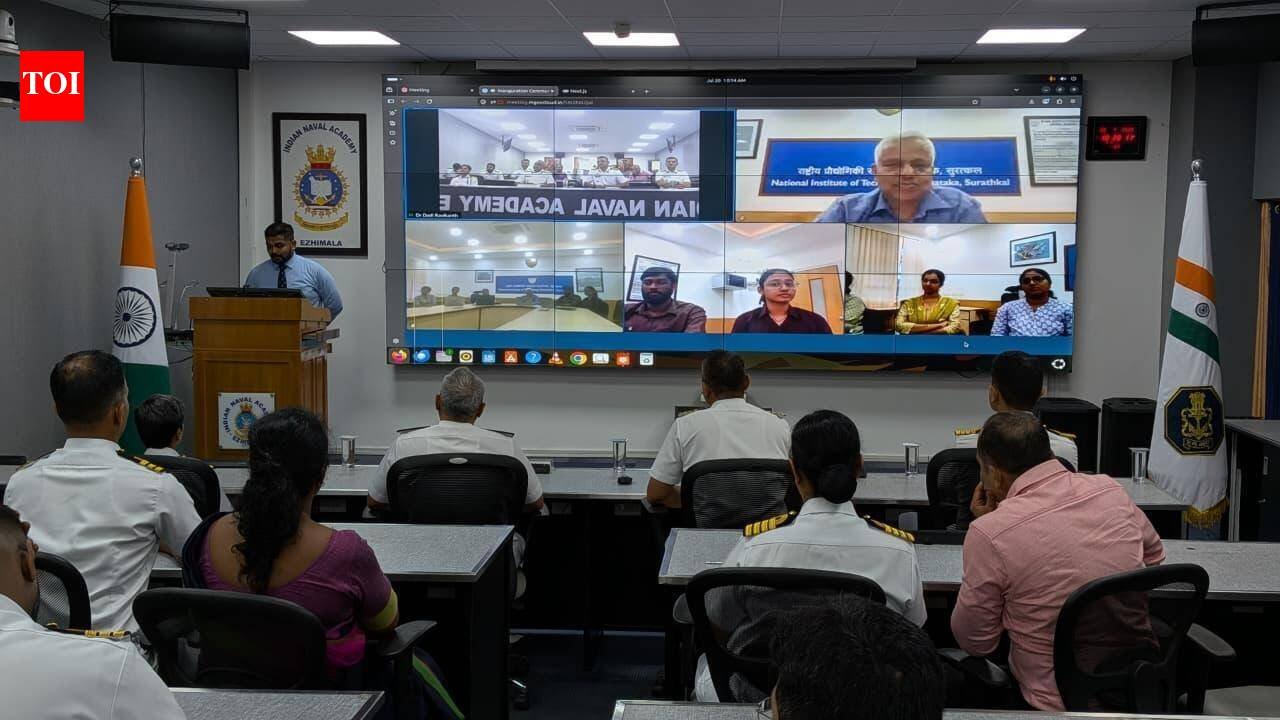
Mangaluru: As India intensifies its push for self-reliance in defence manufacturing, the focus is increasingly shifting from merely teaching engineering to enabling students to build, design and innovate. In line with this vision, the Centre for System Design (CSD) at NITK Surathkal, in collaboration with the Indian Naval Academy (INA), has launched the Marine Mechatronics System Design Virtual Lab, a simulation platform that allows students to gain hands-on experience in complex shipboard engineering systems without requiring access to expensive naval equipment.The virtual laboratory was inaugurated on Monday by Rear Admiral G Rambabu, principal of the Indian Naval Academy. Conceived as an immersive, browser-based learning platform, the lab enables students, educators and researchers to conduct interactive virtual experiments from anywhere. “The initiative aligns with the national objective of creating a skilled engineering workforce capable of contributing to indigenous defence technologies. Engineering students must learn by doing, not just by reading,”said Prof KV Gangadharan, head, Centre for System Design, NITK Surathkal, stressing the need to familiarise young engineers with defence technologies, if India is to design and manufacture advanced military systems domestically.Jointly developed by the faculty of mechanical engineering at the Indian Naval Academy and NITK Surathkal’s Centre for System Design, the platform recreates real-world marine mechatronics systems through advanced simulations. The virtual laboratory currently offers nearly 50 interactive experiments, covering key areas such as ballast and water tank level control, programmable logic controllers (PLCs), marine control valves, sensor interfacing and signal conditioning, microcontroller-based actuator control, and synchro/encoder position measurement.The real laboratory integrates MATLAB Simulink-based marine system models with virtual PLC and Arduino environments, complemented by a web-based Human-Machine Interface (HMI). The simulations allow learners to test concepts, analyse system behaviour and even make mistakes in a completely risk-free environment before working on actual equipment.While the International Maritime Organisation’s Standards of Training, Certification and Watchkeeping (STCW) Code mandates competency in shipboard automation, access to operational vessels and sophisticated marine control systems remains limited due to high costs, safety concerns and operational restrictions. The virtual platform bridges this gap by offering realistic remote experimentation.The laboratory is intended for undergraduate and postgraduate students in naval architecture, marine engineering, mechanical engineering, automation and control engineering, and electrical engineering with marine specialisation.The project was developed under the guidance of Dadi Ravikanth, professorial cadre officer in the Department of Marine & Control at the Indian Naval Academy, Ezhimala, and Prof KV Gangadharan. It forms part of the ministry of education’s Virtual Labs initiative under the National Mission on Education through Information and Communication Technology (NMEICT), a nationwide programme coordinated by IIT Delhi that has developed more than 175 virtual laboratories with over 1,590 web-enabled experiments across engineering disciplines.


