






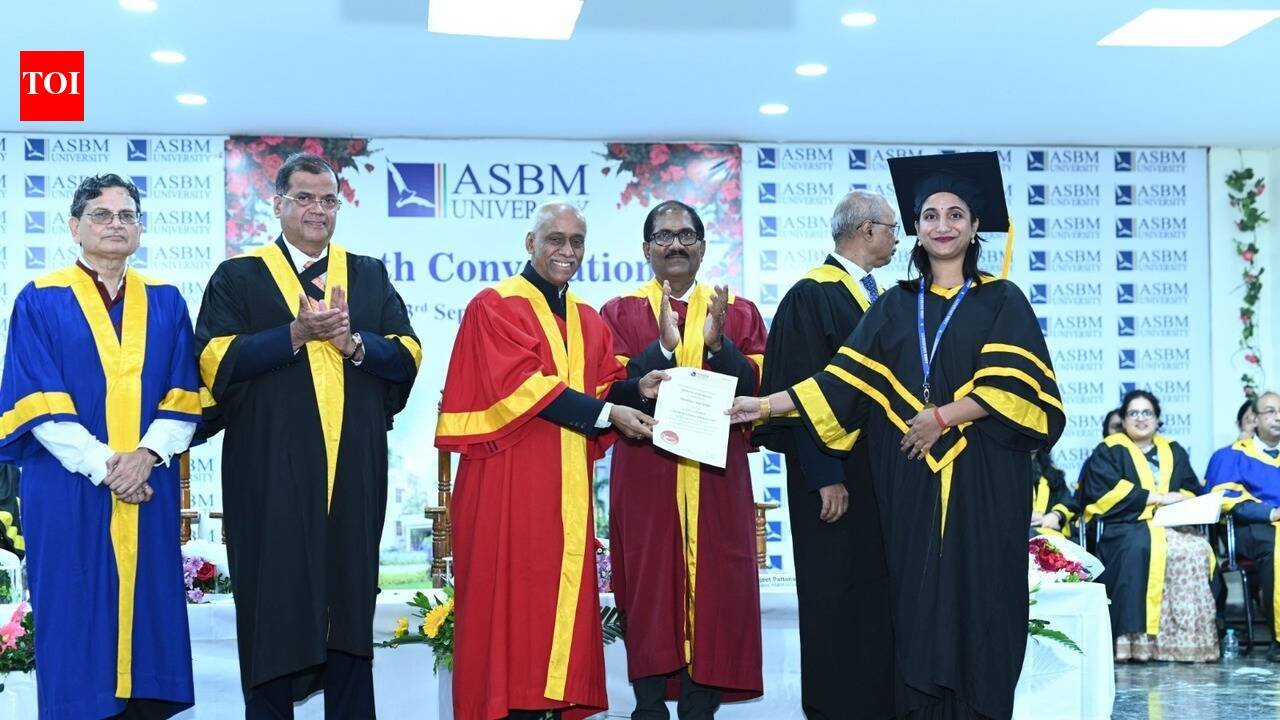
National Human Rights Commission (NHRC) chairperson and former Supreme Court judge Justice V Ramasubramanian stressed the importance of values and ethics while addressing the sixth convocation of ASBM University on its Shiksha Vihar campus in Bhubaneswar recently.Degrees were conferred on doctoral and graduating students across management, law, commerce, information technology and liberal arts during the ceremony.Justice Ramasubramanian said success without reflection and victory without compassion are “rootless and fruitless”. Appreciating the leadership of university founder-president Prof Biswajeet Pattanayak, he said the institution had placed Odisha firmly on the national higher-education map and built a reputation for academic excellence beyond the state.The guest of honour, TRL Krosaki Refractories Ltd managing director Prasant Kumar Naik, spoke about the changing workplace culture and need for employees to build long-term associations with organisations while nurturing a culture of learning. He lauded the university’s efforts to produce industry-ready professionals across disciplines.Three students received gold medals for academic excellence. Anamika Tripathy won the Infinity gold medal for MBA, Sannidhya P Swain received the Maithree gold medal, and Anushka Agarwal was awarded the gold medal in law.Postdoctoral fellowshipOdisha researcher Dr Sneha Senapati has been selected for the prestigious MIT-Novo Nordisk Artificial Intelligence Postdoctoral Fellows Programme and appointed as a postdoctoral associate in the department of mechanical engineering at Massachusetts Institute of Technology (MIT), Cambridge, Massachusetts.A native of Bhadrak district, Senapati was educated in Balasore before pursuing her PhD in biophysics at IIT Delhi’s School of Interdisciplinary Research. She defended her doctoral thesis in 2025 under Prof J P Singh of IIT-Delhi and Dr Smita S Kulkarni, former head of the department of virology at ICMR-NITVAR, Pune.The highly selective fellowship supports up to 10 researchers globally each year to undertake research at the intersection of artificial intelligence and life sciences. According to details of the 2026 cohort, Senapati is the only fellow selected from India and Asia and the only cohort member to have completed her PhD in India.Her research at MIT will focus on applying artificial intelligence and advanced technologies to healthcare. She had earlier joined Ben-Gurion University of the Negev in Israel for postdoctoral research but returned to India after being selected for the MIT fellowship. Senapati is scheduled to join MIT in Oct this year.Entrepreneurship lessonsA six-day faculty mentor development programme for 40 faculty members from Odisha’s govt colleges and universities concluded at Entrepreneurship Development Institute of India (EDII), Gandhinagar, on Saturday.Conducted from Sept 21 to 26, the programme was aimed at strengthening the startup ecosystem in higher education institutions. Launched by higher education minister Suryabanshi Suraj on Sept 5, it covered entrepreneurship pedagogy, business idea generation, business model canvas, startup mentoring, incubation centres, funding, innovation and IPR.On the final day, participants presented action plans proposing entrepreneurship cells/clubs and startup bootcamps on their campuses. EDII director general Sunil Shukla also addressed the participants.Discourse on social protectionFakir Mohan University (FMU), Balasore, hosted an academic discourse on ‘Inclusive Social Welfare in India’ under its Purbasuri Baktrutamala on Thursday, focusing on changing dimensions of welfare policy, social protection and participatory governance.Prof Prakash Chandra Sarangi, who was the chief speaker, discussed the evolution of welfare strategies in the country and the need to align policies with changing social needs. He said welfare should go beyond the distribution of benefits and encompass social inclusion, dignity, participation, protection and justice.Addressing the gathering, FMU vice-chancellor Prof Santosh Kumar Tripathy said the understanding of vulnerability had undergone significant changes, necessitating a broader assessment of emerging challenges faced by different sections of society. He stressed the need for sustained attention to social protection and social justice for inclusive and equitable development.Tripathy also highlighted the importance of communication between govt and citizens, referring to the ‘Mann Ki Baat’ programme as a platform for listening to people’s views, problems and questions and understanding issues at the grassroots.The lecture was followed by an interactive session with students, who discussed contemporary social realities and welfare concerns.The lecture was followed by an interactive session with students, who discussed contemporary social realities and welfare concerns.


