



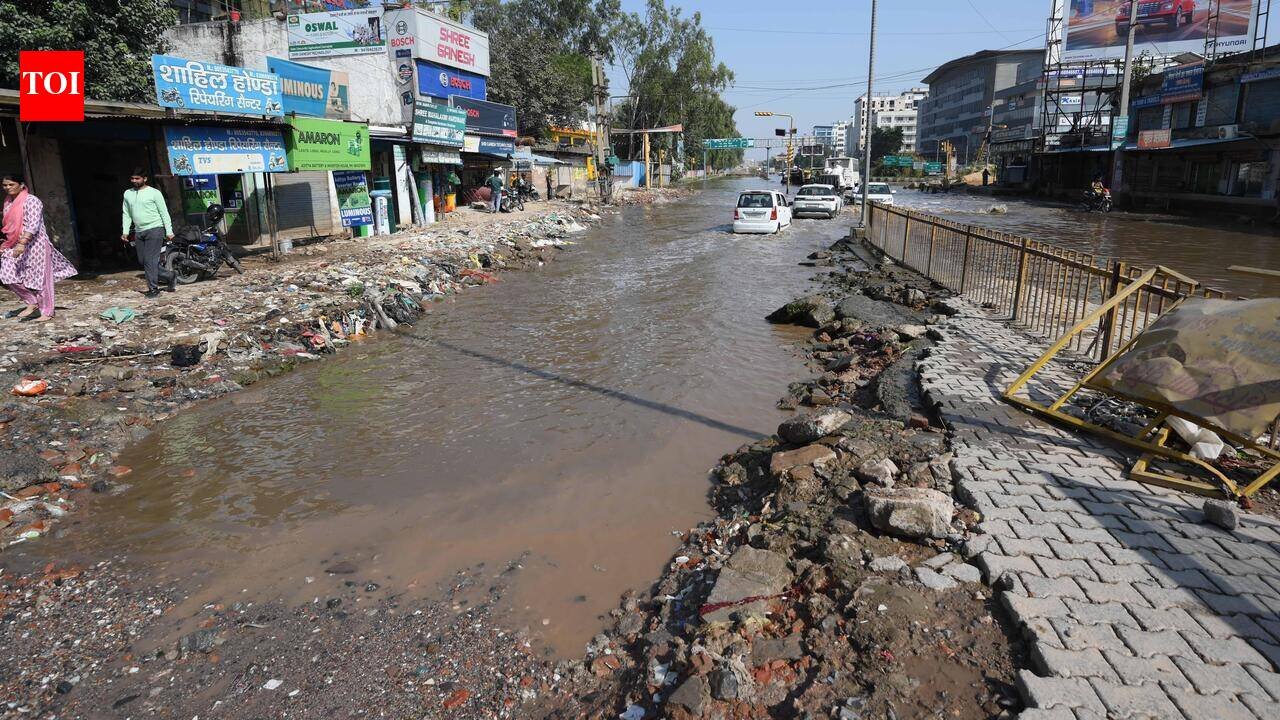
Gurgaon: National Highways Authority of India (NHAI) has shortlisted four engineering options to permanently address chronic waterlogging along the Bhiwadi-Dharuhera stretch of NH-919, with two proposals involving a 6km stormwater drain emerging as the most feasible, officials told TOI.The proposals aim to resolve a drainage problem that submerges stretches of the highway every monsoon and disrupts connectivity between Haryana and Rajasthan.A detailed project report (DPR) is under preparation and will be submitted to the ministry of road transport and highways (MoRTH) after consultations with state govts and other stakeholders.“The first two options are under active consideration. One proposes a stormwater drain along the left side of the highway, the other a similar drain on the right. In both cases, the drain would carry stormwater from the waterlogging-prone corridor to the Masani barrage on the Sahibi river,” a senior NHAI official said. The proposed drain will be around 3m deep and 5m wide, enabling rapid evacuation of stormwater.The remaining two alternatives, suggested by the irrigation department, involve creating storage ponds instead of discharging water directly into the barrage. Excess water would be temporarily held before release through the irrigation network. “The locations of these storage ponds have not been finalised because they will depend on land availability and acquisition,” the official added.NHAI said the technical feasibility of all four alternatives is being assessed, and the DPR will determine the final alignment, project cost and implementation strategy.The project follows a high-level meeting chaired by Union road transport and highways minister Nitin Gadkari in Jan to address polluted water drainage and waterlogging along NH-919 near the Haryana-Rajasthan border. The meeting also approved a 34-MLD sewage treatment plant and upgrading the common effluent treatment plant (CETP) to zero liquid discharge standards, besides a permanent drainage solution.The project has gained added urgency after a Rajasthan State Pollution Control Board inquiry found that some industries in the nearby Bhiwadi-Khushkhera industrial area exploit the chronic waterlogging to discharge effluents — underscoring the environmental cost of prolonged stagnation in the corridor.PWD executive engineer Pradeep Sandhu said NHAI had shared the broad contours of the four alternatives with state agencies. “The options are under technical evaluation. Once MoRTH approves the final proposal, the project can move ahead for execution,” he said.Residents welcomed the progress but said they want to see work begin on the ground. “We have heard about many plans over the years, but the road still goes under water every monsoon,” said Rajender Kumar, who runs a shop near the affected stretch. “People just want a permanent solution.”Daily commuter Sandeep Yadav said, “If the project is completed before the next monsoon, it will ease traffic and make the road much safer.”


