



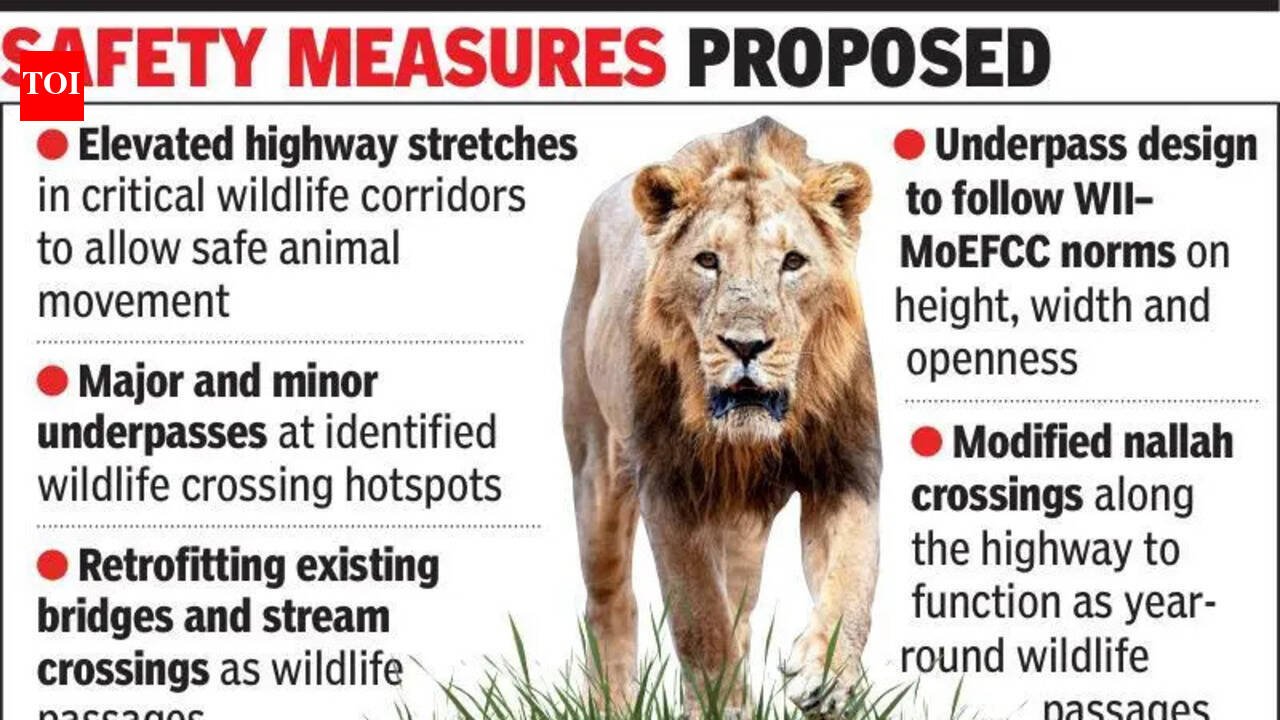
Rajkot/Ahmedabad: As plans firm up for 90-km National Highway 351-K connecting Bagasara in Amreli district to Una in Gir Somnath district via Dhari and Khambha, spotlight has once again fallen on the challenge of balancing road infrastructure with safety of Asiatic lions. The two-lane highway will pass through the Greater Gir landscape — one of the most important lion movement corridors in the state — prompting the forest department to carry out a detailed scientific assessment of wildlife movement in the region. However, the latest CAG report reveals that while such studies and recommendations are routinely prepared, their implementation in past road projects has been weak or absent. The proposed highway corridor cuts through a region that serves as a critical movement zone for lions dispersing between core protected areas and surrounding landscapes.There are around 300 lions in Greater Gir and other adjoining districts. In Jan, two lionesses were killed in separate vehicle collisions on Bhavnagar–Somnath highway in Jafrabad taluka.To address this, the Gir East forest division conducted a scientific study of lion movement across the proposed highway alignment. Using GPS tracking data, daily field monitoring and long-term ecological knowledge of the region, the team mapped wildlife movement patterns and identified critical crossing points along the corridor.Based on these findings, the highway stretch has been divided into four categories depending on the level of wildlife movement risk: red zones for critical wildlife corridors, orange zones for moderate movement areas, yellow zones for minimal activity and green zones where risks are relatively low.One of the most sensitive stretches identified in the study is the Borala–Kantala segment (around 70km), which acts as a key corridor supporting gene flow between the core Gir lion population and coastal habitats. Another important section, the Dhokadva–Una stretch, though having fewer forest patches, records frequent movement of leopards that have adapted to agricultural fields and village landscapes.To mitigate the risks, the forest department has proposed several infrastructure interventions. These include constructing elevated highway sections and dedicated wildlife underpasses in high-risk red zones, particularly along stretches such as Hamapur–Tri Junction and Kantala–Pachpachiya. The study also recommends modifying existing bridges and seasonal stream crossings so they can function as wildlife passages throughout the year, including during the monsoon.“These interventions are necessary to maintain safe and uninterrupted wildlife movement and to preserve genetic connectivity among lion populations,” said Vikas Yadav, deputy conservator of forests, Gir (East).The proposal further recommends that the National Highways Authority of India (NHAI) and the forest department conduct joint field surveys to verify the identified wildlife hotspots and integrate mitigation measures into the final highway design.


