



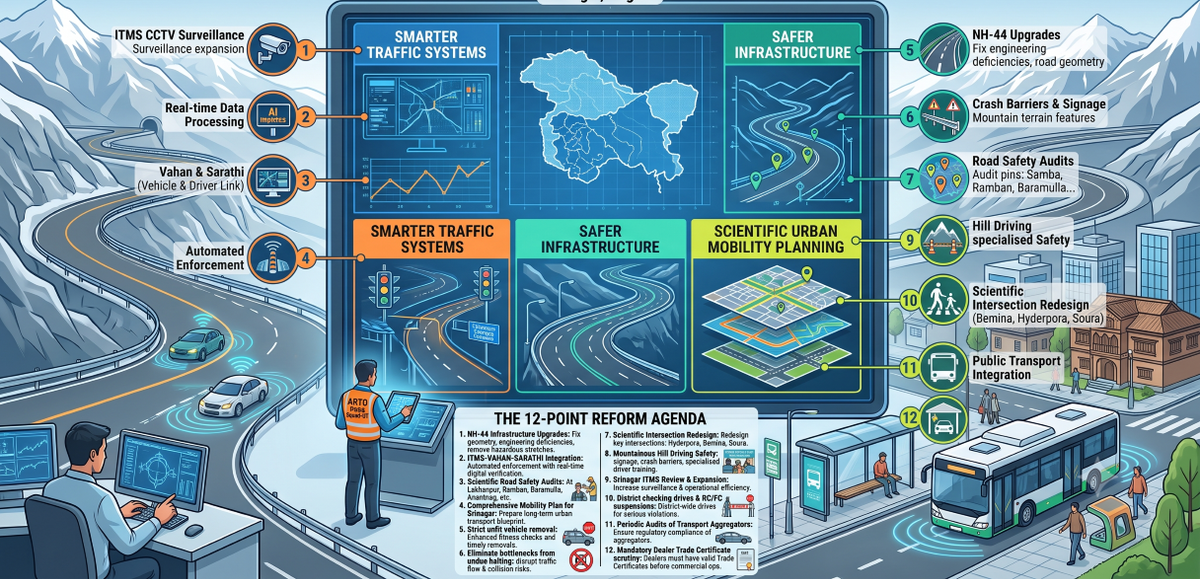
Srinagar, Aug 07: In a significant push towards improving road safety and modernising transport management, the Motor Vehicles Department has prepared a comprehensive 12-point technical reform agenda for Jammu & Kashmir that advocates upgrading the national highway, road safety audits and the complete mobility plan for Srinagar.
The technical report, prepared by the ARTO (Flying Squad)-UT and submitted to the Transport Commissioner J&K, recommends a series of engineering, technological and regulatory interventions aimed at reducing road accidents, improving traffic flow and strengthening transport governance across the Union Territory.
At the top of the recommendations is the need for immediate infrastructure improvement along the National Highway-44 (NH-44), the only all-weather road link connecting Kashmir with the rest of the country. The report, accessed by Rising Kashmir, states that addressing engineering deficiencies, improving road geometry, strengthening safety features and removing hazardous stretches are crucial for preventing accidents and ensuring smoother movement of traffic.
It recommends integrating the Intelligent Traffic Management System (ITMS) with the VAHAN and SARATHI digital platforms. According to the report, such integration would enable real-time verification of vehicle and driver records, facilitate automated enforcement of traffic violations and improve overall regulatory compliance.
Emphasising the importance of scientific interventions, the document seeks detailed road safety audits at Lakhanpur, Samba, Ramban, Rajouri, Baramulla and Anantnag, areas that witness heavy traffic movement and where engineering improvements could significantly reduce accident risks.
Recognising the mounting traffic pressure in the summer capital, the report proposes the preparation of a Comprehensive Mobility Plan for Srinagar to ensure sustainable urban transport, better public transport integration, improved parking management and long-term traffic planning.
The Flying Squad has also expressed concern over the increasing presence of unfit vehicles on roads, calling for stricter inspections and timely removal of vehicles that fail to meet prescribed fitness standards. It further recommends action against the undue halting of vehicles on roads, saying the practice creates bottlenecks, disrupts traffic flow and increases the likelihood of collisions.
“To ease congestion in Srinagar, redesigning key intersections at Hyderpora, Bemina and Soura based on scientific traffic studies and modern engineering principles is the need of the hour,” the report states.
Acknowledging the unique challenges posed by Jammu and Kashmir’s mountainous terrain, the report highlights the need to strengthen hill driving safety through specialised driver training, improved road engineering, better signage, crash barriers and enhanced awareness campaigns.
The report also reviews the present status of the Intelligent Traffic Management System in Srinagar, observing that while the system has improved traffic monitoring, there remains considerable scope for expanding surveillance coverage, strengthening enforcement and enhancing operational efficiency.
Among the enforcement-related recommendations, the report advocates comprehensive vehicle checking drives across all districts and calls for the suspension of Registration Certificates (RCs) and Fitness Certificates (FCs) in cases involving serious or repeated violations.
The technical reports further recommend periodic audits of transport aggregators to ensure regulatory compliance and suggest stricter scrutiny of vehicle dealers, making valid trade certificates and authorisations mandatory before undertaking commercial operations.
According to the technical reports prepared by the ARTO (Flying Squad)-UT, the recommendations are designed to create a safer, smarter and technology-driven transport ecosystem in Jammu and Kashmir by combining infrastructure upgrades, intelligent traffic management, scientific planning and stricter enforcement.
Officials believe the proposed measures, if implemented in a time-bound manner, could significantly reduce road accidents, improve commuter safety and bring greater efficiency and accountability to the transport sector across the Union Territory.


