



Key events
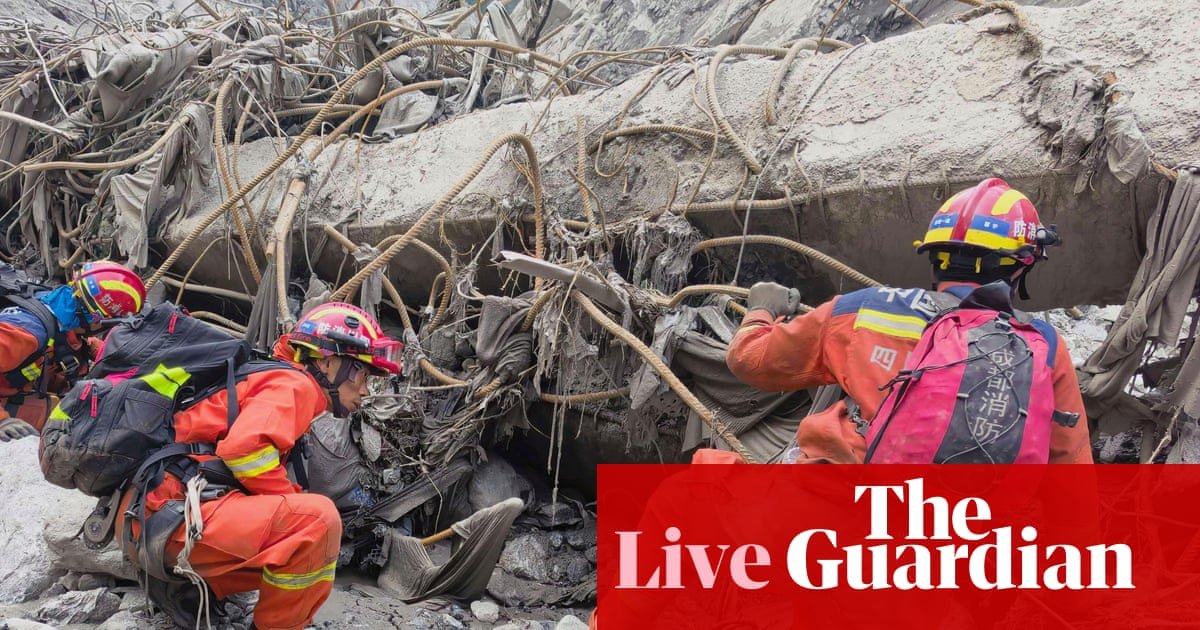
Search crews and the aftermath of the flood – in pictures
We have these latest pictures that illustrate the ongoing desperate search, rescue and relief operation in Nepal and Tibet.
Opening summary: race to rescue tunnel workers
Welcome to our continuing coverage of the aftermath of the deadly flash floods near the Nepal-Tibet border.
Rescuers in Nepal and China are still trying to locate thousands of people who are missing days after a wall of water and debris swept through the Himalayan region.
The combined toll in Nepal and Tibet rose to at least 750 dead and more than 3,000 people missing after China’s latest update on Sunday. Chinese authorities reported 16 deaths and 546 missing, while Nepali officials confirmed 734 dead and 2,498 people missing. There were reports of some dead swept downstream as far away as India.
China said 261 foreign nationals from 23 countries were missing on the Tibetan side of a border crossing with Nepal: the highest number was from Nepal at 104, while 49 Indian, 33 Latvian, 18 American and 15 British citizens were also unaccounted for.
In a breakthrough late on Saturday, the Nepali army was able to insert a pipe into a tunnel at the Trishuli 3A hydroelectric site where workers are believed to be trapped.
“We have already started sending air through the small opening, and we will now begin excavation work and send the rescue team inside,” said the home minister, Sudan Gurungd. More than 100 workers may still be alive and trapped inside such tunnels, with rescue efforts focused on the Trishuli 3A and 3B sites.
Here’s the other main developments:
-
Four days after the disaster, authorities said some bodies being recovered had decomposed beyond recognition. They would be buried after legal formalities because of health risks and a fear of disease outbreaks. “DNA samples will be collected, and the bodies will be buried in an open space,” the Chitwan district administration said in a notice.
-
The foreign minister, Shisir Khanal, said Nepal required specialist assistance to rescue people trapped in tunnels; restore transport and communication lines where bridges had been destroyed; identify bodies; conduct DNA testing; and store bodies for longer periods.
-
A team of Indian tunnel experts arrived in Nepal on Saturday, Khanal said. China’s Xinhua news agency reported Beijing had dispatched five tunnel experts to support rescue efforts, with four more due to join them.
-
The US will provide $3.6m in humanitarian aid to Nepal, “including up to three months of emergency food assistance to up to 10,000 flood-affected households,” the state department said in a post on X.


