



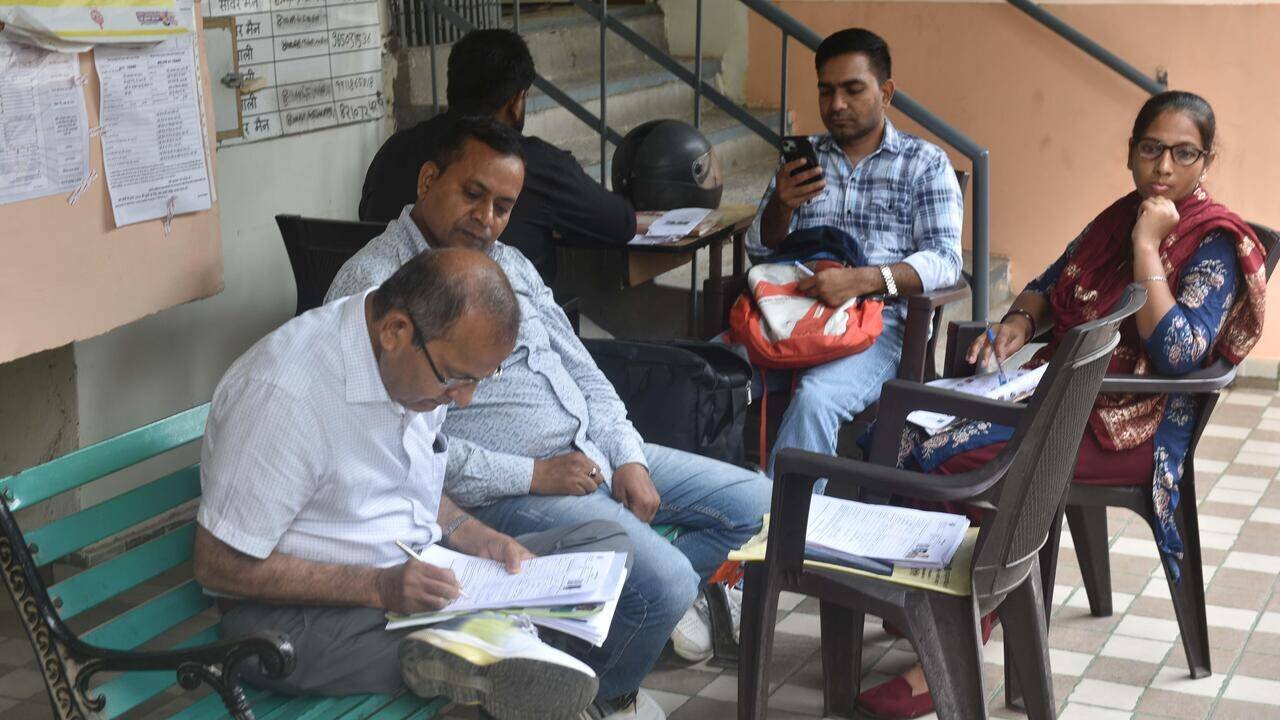
Gurgaon: With three days left for the first phase of Haryana’s special intensive revision (SIR) to be completed, nearly half of Gurgaon’s voters remain unenumerated — the worst showing among the state’s 22 districts.Booth level officers (BLOs) have been unable to even deliver or collect forms from large sections of the population living inside condominiums.Gurgaon has recorded the lowest digitisation rate in the state at 53.95%, followed by Faridabad at 55.91% — this despite both districts having better digital infrastructure, higher literacy and greater administrative resources than most of rural Haryana.Rural districts, by contrast, are nearing completion: Fatehabad leads at 90.14%, followed by Kaithal (87.18%), Mahendragarh (85.87%) and Charkhi Dadri (85.8%). Eleven districts have already crossed the 80% mark.Statewide, forms for 1.5 crore of Haryana’s over 2 crore electorate had been digitised as of 10am Friday, about 74% overall. Roughly 17 lakh electors, or one in every 11 voters (around 8%), remain unverified because their forms could not be collected. The gap between best-performing Fatehabad and worst-performing Gurgaon exceeds 36 percentage points.Faridabad recorded the highest number of unverified forms at 1,92,540, followed by Gurgaon (1,71,288) and Sonipat (1,30,384).Yamunanagar had the highest unverified rate at 13.27%, followed by Panchkula (11.65%), Gurgaon (11.02%), Ambala (10.89%) and Sonipat (10.67%) — all above the state average of 8.35%.Election officials attribute the urban slowdown to factors specific to large cities — restricted access to gated societies, a highly mobile workforce, summer travel, a large migrant population, vacant apartments, and difficulty reaching residents during working hours. BLOs have repeatedly found homes locked or been asked to return later, delaying both collection and digitisation.“The numbers point to a challenge that is less about technology than access,” an official said.Two districts bucked expectations: Nuh, often seen as administratively challenging, posted 82.26% digitisation — comfortably above the state average — while Hisar, despite having one of Haryana’s largest electorates at over 13 lakh voters, crossed the average with 76.71%. Officials said this suggests district size alone doesn’t determine performance.The district administration had earlier asking recognised political parties to mobilise voters and assist BLOs in ensuring enumeration forms are submitted on time.At a meeting chaired by district officials, parties were urged to help BLOs reach eligible voters and encourage residents to submit forms before the deadline. Officials said the revised draft electoral roll will be published on July 21, after which claims and objections can be filed before the final roll is prepared.Meanwhile, the electoral registration officer of the 76-Badshapur Assembly constituency suspended a BLO posted at Govt Senior Secondary School, Bhangrola, for alleged negligence after the officer was found absent from fieldwork despite repeated directions and allegedly failed to discharge his assigned duties.“We have made it clear that negligence in SIR-related work will invite disciplinary action, while political parties have been asked to complement the outreach by motivating voters to cooperate with BLOs,” said SDM (Badshapur) Sanjeev Singla.


