



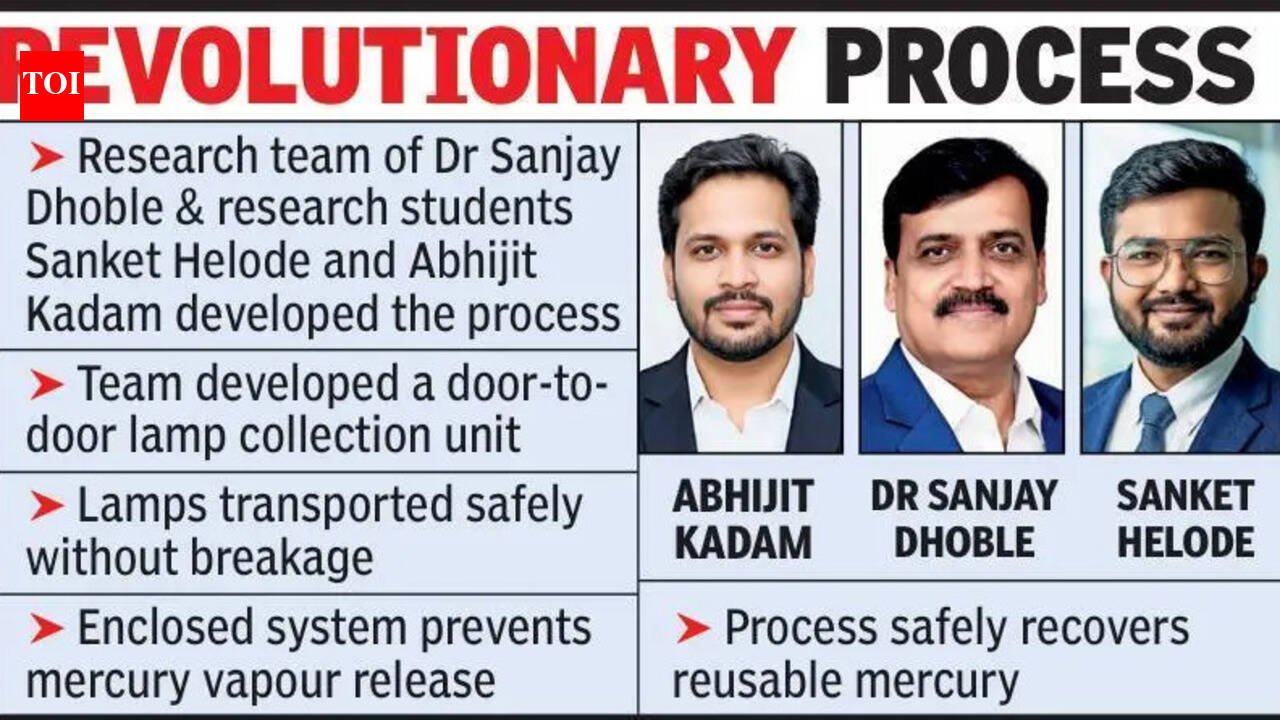
Nagpur: Researchers at Nagpur University (NU) have developed a method to prevent pollution from discarded mercury-based electric lamps, addressing a key environmental health concern in cities where fluorescent tubes, compact fluorescent lamps (CFLs) are used widely.The research team of Dr Sanjay Dhoble, senior professor and HoD, Physics dept and research students Sanket Helode and Abhijit Kadam created a collection and treatment process designed to stop mercury vapour from escaping when damaged lamps are handled. Their work resulted in two patents.Fluorescent tubes and CFLs contain hazardous mercury — typically around 44mg in fluorescent tubes and about 4mg in CFLs — in proportions depending on manufacturer. When these lamps are discarded carelessly and break, mercury is released as vapour, contaminating soil and water and posing health risks, including kidney damage and increased cancer risk. India lacks a comprehensive system and clear public guidelines for safe collection and disposal.A major challenge in the project was collecting used lamps from households without breakage and transporting them safely to a single location in accordance with instructions laid out by the local municipal corporation. To address this, the team developed a specialised ‘lamp collection unit’ to enable secure door-to-door collection and consolidated storage.The collected damaged lamps are then broken inside a specially designed enclosed system that prevents mercury from mixing with outside air. Using an associated chemical process, mercury is separated and collected safely in one place. The recovered mercury can be reused for other applications.NU described the initiative as a first-of-its-kind effort in India to curb mercury pollution from damaged fluorescent lamps and CFLs. VC Manali Kshirsagar, Pro-VC Akhilesh Peshwe, officiating registrar Vijay Khandal, and director Dr Dadasaheb Kokare congratulated the research team for their work.


