



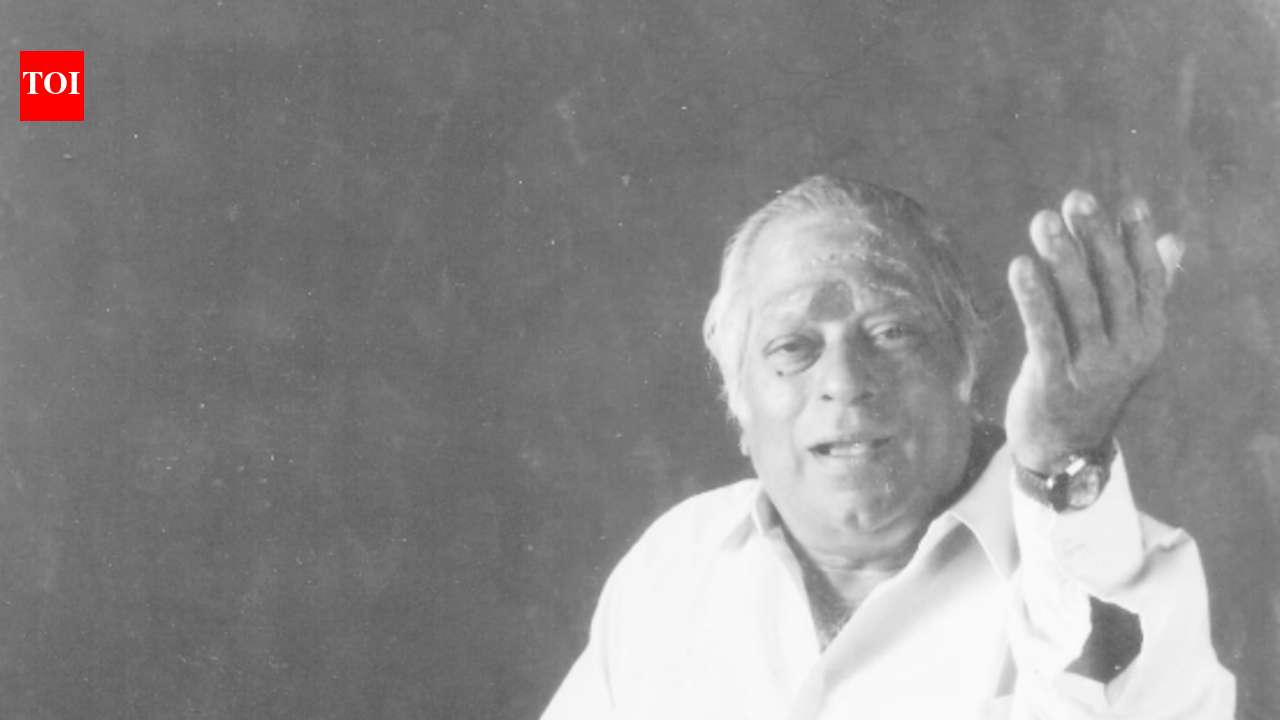
VamananDraw a line westward from the house where composer M S Viswanathan (MSV) once lived on Santhome High Road in Chennai, and you begin to trace a uniquely musical neighbourhood. The line crosses the home of playback singer Sirkazhi Govindarajan, passes the residence of another legendary singer, T M Sounderarajan, who sang more than 4,000 songs, and finally reaches Tiruchi Loganathan’s house. A furlong to the south stands the residence of V N Sundaram, a boy’s company actor who went on to become a film star and playback singer. Within a few streets of each other in and around Mylapore lived some of the voices that defined Tamil cinema. The recent renaming of three streets in Chennai after composer MSV and playback singers Govindarajan and Tiruchi Loganathan, along with the earlier honour accorded to Sounderarajan, draws attention once again to Mylapore and its surrounding localities as a long-standing residential hub of film music personalities, several of whom came to own their homes through the CIT scheme, introduced by the Madras City Improvement Trust (forerunner to the Tamil Nadu Housing Board) to help lower-income residents build houses. Over the decades, several factors drew musicians to the neighbourhood. Mylapore had already emerged as a centre of Carnatic music with the rise of sabha culture, while relatively affordable accommodation made it attractive to singers and composers hoping to build careers in cinema. The centuries-old Kapaleeswarar temple was another factor that drew musicians to the area. Papanasam Sivan, the composer behind many of the songs sung by star Thyagaraja Bhagavathar, first came to Mylapore to sing during the Kapali temple festival. His soulful bhajans on misty Margazhi mornings are still remembered with nostalgia. Sivan first lived in a rented portion on Srinivasan Street, off St Mary’s Road, and later bought his own house there. In the infant years of the Tamil talkie in 1933, residents of Mylapore were connected to the new medium. Mylapore lawyer and music patron A Sundaram Iyer travelled with his family to Kolhapur for the film ‘Sita Kalyanam’, a Tamil quickie director-actor V Shantaram decided to shoot on the sets of his ‘Sairandhri’ to offset its losses. In the film, Sundaram Iyer’s son Rajam played Rama, his daughter Jayalakshmi was Sita, while he appeared as Janaka, Sita’s father. S Balachander, Rajam’s younger brother, who had appeared as a precocious musician in Ravana’s court in ‘Sita Kalyanam’, went on to become a lead actor, comedian, director and producer of whodunnits, apart from scoring the music for his films. By the 1940s, several streets in Mylapore had begun to host composers associated with the growing film industry. R Sudarsanam of AVM Studios lived first in a rented portion on Brodies Road, later renamed Ramakrishna Mutt Road, before moving to his own bungalow in Karpagambal Nagar on the road leading to Vivekananda College. The Brodies Road house saw another resident connected to the film world. Rajeswari Ammal, who would later become A V Meiyappan’s wife, had once stayed there while visiting Madras to record a gramophone song for AVM’s Saraswathi Stores. In a nearby street, composer C R Subburaman worked out of a rented house, where he trained singers such as M L Vasanthakumari, preparing them for film recordings. Subburaman’s life was brief but intense; he died in the same house in 1952, at the age of 28. Subburaman’s circle also included several young musicians who would go on to define Tamil film music. Among them was MSV. When he first arrived in Madras as a musical assistant, Viswanathan lived in a small thatched portion on the crowded Adanjan Mudali Street in nearby Mandaveli before moving to his own residence on Santhome High Road. It was outside this house that the young Ilaiyaraja once waited to seek his blessings. The growth of Madras as the prime centre of Tamil film production in the second half of the last century was phenomenal. By 1953, the city had at least 15 film studios, most of them clustered around Kodambakkam, creating steady opportunities for singers and music directors. Many chose to live in Mylapore, which lay within easy reach of the recording studios and was also one of the city’s established residential neighbourhoods. The presence of film production companies in the area added to its appeal. There were more than 20 companies in 1950, and by 1956 the number had risen to 32. Mylapore’s narrow streets were soon home to several gurus, making it a natural destination for aspiring singers and musicians. One such teacher was Pattamadai Krishnan, who lived on Nattu Subbaraya Mudali Street and trained many students who would later find their way into cinema and the concert stage. Mylapore was home to one of the greatest teachers of Western music, Dhanraj Master, who taught generations of students from his little room in Sai Lodge (now near the Thirumayilai station). It was here that Ilaiyaraja learned the intricacies of harmony. Most of the residences have submitted to the ravages of time, and the few that remain are at the crossroads of change. But nothing can stop the nostalgia. (The writer has authored several books on cinema)


