






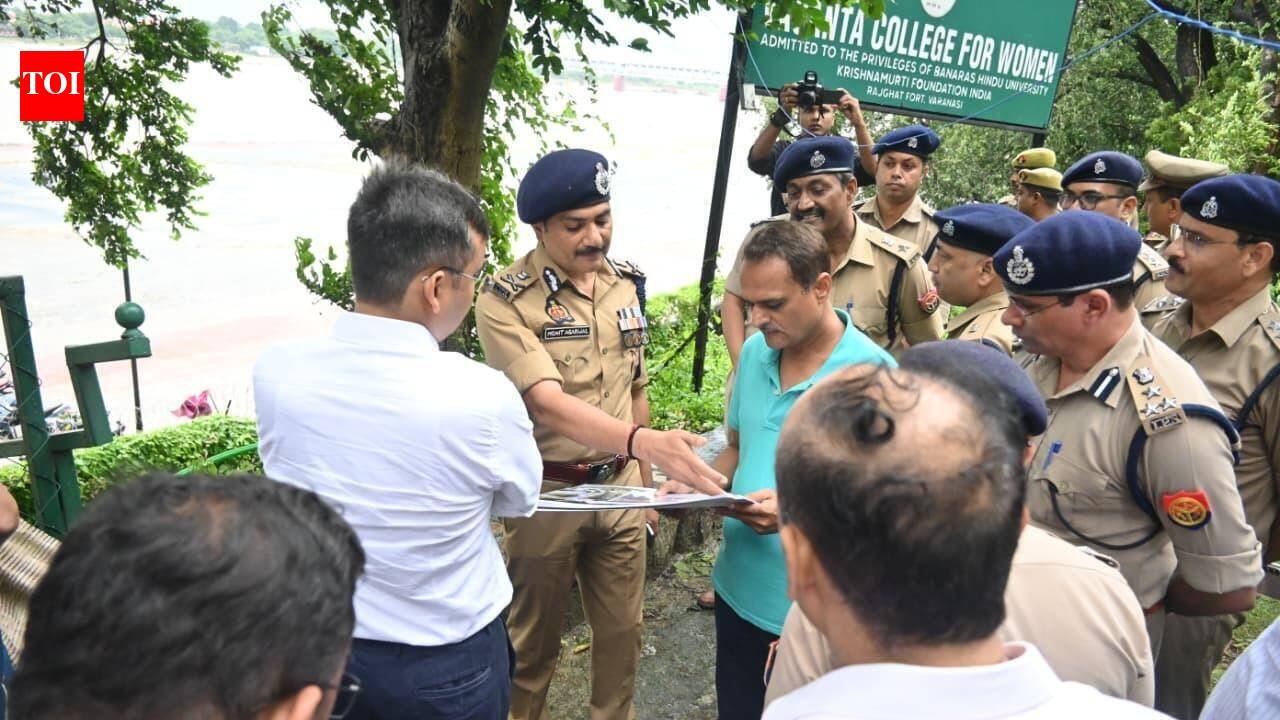
Varanasi: The skies over the Ganga are set to become the stage for a spectacular aerial display as the Indian Air Force’s Central Air Command steps up preparations for Aerial Display: 2026, bracing to handle an estimated 10 lakh to 20 lakh spectators each day on Oct 22, 23 and 25.With the event being held in Prime Minister Narendra Modi’s parliamentary constituency and an invitation also set to be extended to him, authorities are simultaneously fine-tuning arrangements for VIPs amid the massive crowds. Namo Ghat will serve as the base stand for the show, while the riverside ghats and the expansive sandbed on the opposite bank will transform into vantage points for spectators.Police Commissioner Mohit Agrawal and DM Magistrate Satyendra Kumar, along with a large team of officials, conducted continuous on-site inspections on Friday and Saturday, including at the VIP grandstand and at Namo Ghat for IAF and other officials. They also inspected the ghat steps and the sandbed on the opposite bank across an almost eight-kilometre stretch, where lakhs of people will gather to watch the proposed show.Talking to TOI on Sunday, Agrawal said, “All events and flypasts finalised for the proposed air show will take place on each day on Oct 22, 23 and 25. There will be no increase or curtailment of any event or flypast on any day. In view of the crowding in past airshows of IAF in Prayagraj, Chennai and other places, all our preparations are being done to manage the crowd between 10 lakh and 20 lakh per day.”Officials are expecting the arrival of VIPs like PM Modi to attend the show on October 25. Agrawal said that all arrangements, crowd diversion and security measures are being finalised to manage both the heavy crowd and VIP movement. Officials said that crowd management will be enforced each day to regulate people from their arrival until their hassle-free exit.During their inspections, the officials focused on finalising sites for parking areas, especially near Basanta College for Women, Rajghat; VIP movement routes; the helipad; traffic arrangements; and overall security preparedness. Apart from VIPs, considering the expected heavy footfall and vehicle movement during the event, the officials reviewed parking capacity, entry and exit routes, vehicle circulation, crowd-control measures and deployment requirements.The officials also discussed adequate police presence at parking locations and smooth traffic regulation on all connecting roads. The proposed routes for VIPs and distinguished guests were examined, and officials were directed to keep a comprehensive traffic diversion plan, including alternative routes, ready in advance.The officers also reviewed the system of vehicle passes for authorised vehicles entering the show area and directed that the process remain clear, organised and strictly monitored to prevent unauthorised entry. The helipad was inspected with specific focus on security, access control, emergency response arrangements and maintenance of a secure perimeter in the surrounding area. Police, traffic police and district administration officials were instructed to work in close coordination and conduct prior ground testing of routes, barricading, parking, entry and exit points, and security plans.Work on holding the air show in Kashi had started early this year when officials of the IAF Central Command began frequently visiting the city, especially the Namo Ghat area. The landing of IAF choppers had already been increasing the curiosity of people, while in July, the thunderous sound of three fighter jets flying over Kashi’s sky for several minutes made people eager to know the reason for all these developments.The IAF officials kept monitoring all the arrangements, and people had to wait for the formal announcement of the proposed event until Sept 21, when a Ministry of Defence spokesperson confirmed the IAF Aerial Display: 2026 at Namo Ghat.The event, which aims at inspiring young citizens and enhancing public awareness of the diverse roles, capabilities and proud service traditions of the IAF, will showcase the distinguished six-decade journey of the Central Air Command. Since its formation, the Command and its formations have made significant contributions to combat operations, humanitarian assistance, disaster relief and aid to civil authorities across a vast and operationally demanding area.CAC’s operational heritage includes notable contributions during the Indo-Pak wars of 1965 and 1971, Operation Cactus in the Maldives and Operation Safed Sagar during the Kargil conflict. Its aircraft and personnel have also undertaken evacuation, flood relief, casualty evacuation and humanitarian missions, frequently reaching affected communities in difficult terrain and challenging conditions.The Command’s ability to combine operational readiness with timely assistance to citizens reflects the Indian Air Force’s enduring commitment to national service.


