



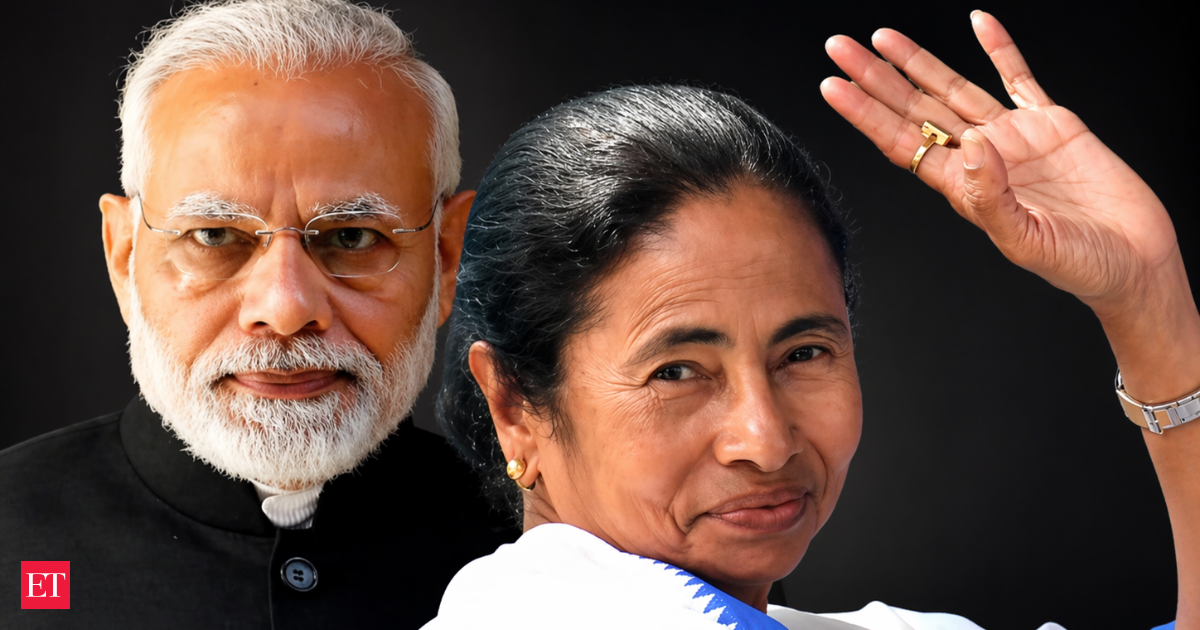
Over the past decade, the Bharatiya Janata Party (BJP) has surged from the margins to become the principal challenger in the state. On paper, it looks like the perfect setup for a power shift. In reality, though, Mamata’s Trinamool Congress (TMC) continues to hold the fort with surprising ease.
So why does this gap between perception and reality persist? Why hasn’t BJP, despite its rapid rise and pan-India strength, been able to crack Bengal’s political bastion? Here’s a clear, ground-level look at what’s really at play.
Mamata Banerjee’s strong grassroots connect remains unmatched
One of the biggest reasons behind BJP’s struggle in West Bengal is Mamata Banerjee’s deep-rooted connection with ordinary people. Her political brand isn’t just about speeches or campaigns, it’s built on years of street-level politics and a carefully cultivated image of being accessible and relatable.
TMC’s slogan “maa, mati, manush” (mother, land, people) is a narrative that resonates strongly, especially in rural Bengal. Many voters still see her not just as a distant political leader, but as someone who understands their daily struggles.
This kind of emotional connection is very hard for an ‘outsider’ party to replicate quickly.
BJP’s ‘outsider’ perception hurts its Bengal ambitions
A key hurdle for BJP in West Bengal elections is the persistent perception that it is an “outsider” party. Even though the party has expanded significantly in the state since 2019, this image continues to linger.
Bengal has a strong cultural identity, and regional pride plays a big role in voting behaviour. Mamata Banerjee has effectively used this sentiment to frame BJP as a force trying to impose external ideas and leadership on the state.
This “Bengali vs outsider” narrative may not dominate every constituency, but it’s powerful enough to influence swing voters, especially in close contests.
TMC’s organisational strength vs BJP’s local leadership gaps
Another major factor is organisation. The TMC has built a very strong booth-level network over the years. Its workers are deeply embedded in local communities, which helps with voter mobilisation, turnout and last-mile messaging.
BJP, on the other hand, has expanded quickly but unevenly. While the party has a strong central leadership and campaign machinery, it still lacks a widely accepted local chief ministerial face.
This creates a gap when voters are choosing who they actually want to run the state.
In elections, especially state-level ones, local leadership matters more than national branding, and that’s where BJP still struggles.
Welfare schemes give TMC a solid voter base
TMC’s welfare schemes have played a huge role in maintaining its dominance. Programmes aimed at women, farmers and economically weaker sections have created a loyal voter base that directly benefits from government support.
For many voters, this isn’t just abstract policy; rather it’s something that affects their daily lives. When people feel they are receiving tangible benefits, they are less likely to take risks with political change.
BJP has tried to counter this by highlighting central schemes, but in state elections, local delivery often carries more weight.
Anti-incumbency exists, but isn’t decisive yet
After more than 15 years in power, it’s natural for anti-incumbency sentiment to build against Mamata Banerjee’s government. Issues like corruption allegations, governance concerns and political violence have certainly dented the TMC’s image.
Incidents such as Sandeshkhali unrest, the RG Kar Medical College case and episodes of violence in districts like Murshidabad and Malda have given BJP strong talking points.
However, anti-incumbency in Bengal does not yet appear to be uniform or overwhelming. For many voters, dissatisfaction with the government does not automatically translate into support for BJP.
Polarisation strategy has limits in West Bengal politics
BJP has relied heavily on themes like Hindutva politics, border security and alleged infiltration in its West Bengal campaign strategy. These issues do resonate with certain sections of voters and have helped the party grow significantly.
But there’s a limit to how far polarisation can take you in Bengal: the state has a complex social fabric, and excessive focus on divisive issues can alienate moderate and undecided voters, various past instances have shown.
Mamata Banerjee has been quick to counter this by projecting herself as a protector of “Bengali Asmita”, which is likely to help her retain a broader cross-section of voters.
Fragmented opposition indirectly helps TMC
While BJP is the main challenger, it doesn’t always get the full advantage of anti-TMC votes.
That’s because other players, including Congress, the Left and smaller regional outfits, still contest elections and divide the opposition space.
Even if these parties are no longer dominant, they can still influence outcomes in close contests by splitting votes. In a tight race, even a small percentage shift can make a big difference.
Ironically, poll data shows that this fragmentation has often benefited TMC more than BJP.
BJP’s rise is real, but incomplete
It’s important to note that BJP has made significant gains in West Bengal over the past few years. In the 2021 Assembly elections, it won 77 seats, a massive jump compared to its earlier presence in the state.
This shows that BJP is no longer a fringe player. It has successfully replaced the Left and Congress as the principal opposition.
However, converting that momentum into a full-scale victory requires crossing a much higher threshold, one that involves not just gaining votes, but also breaking TMC’s entrenched support system.
Women voters could be a decisive factor
Both TMC and BJP are actively targeting women voters, who form a crucial part of the electorate in West Bengal.
Mamata Banerjee’s welfare schemes have traditionally given her an edge among women. BJP has tried to challenge this by raising issues related to women’s safety and governance failures, especially after high-profile incidents.
This is likely to be one of the most closely contested voter segments, and could play a decisive role in shaping 2026 election outcomes.
Law and order narrative: Advantage BJP, but not enough
BJP has consistently attacked the TMC government over law and order issues, citing violence, unrest and allegations of political intimidation.
While some of these concerns are real and resonate with sections of the electorate, they are unlikely to automatically translate into votes unless voters see BJP as a credible and stable alternative.
So far, that transition, from dissatisfaction to trust, appears to have remained incomplete.
Can BJP break the Bengal bastion?
BJP clearly has the momentum, the money, and a steadily growing voter base. There’s visible anti-incumbency, and governance issues have given it a real opening. But Mamata Banerjee isn’t likely to be easy to unseat: her deep grassroots network, welfare backing, and her “maa, mati, manush” pitch still act like a solid shield on the ground.
The real question now is: how deep has BJP actually managed to dig into Bengal’s political soil? The noise is loud, the push is strong, but whether it’s surface-level or a genuine shift underneath… that’s something only time (and voters) will reveal.
Inputs from agencies


