



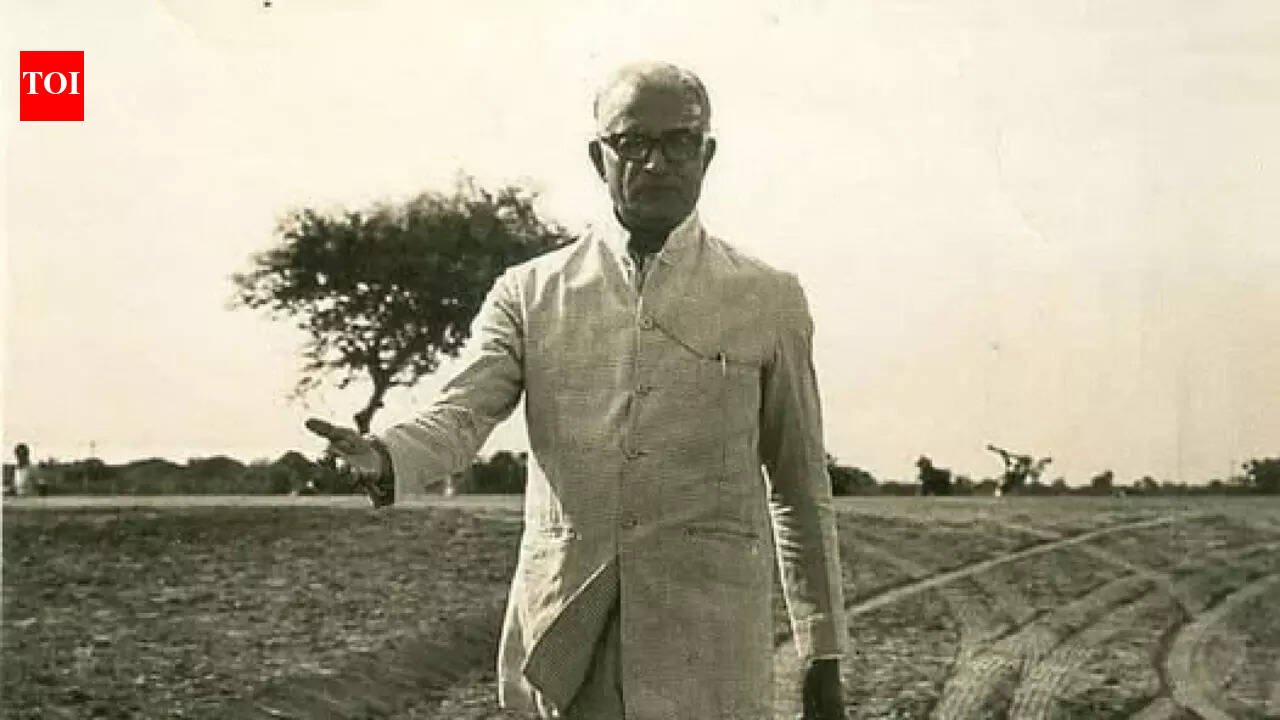
Tamil scholar V I Subramoniam once met Murli Manohar Joshi, the then union minister for education and sought funds for the development of a Dravidian university in Kuppam. Joshi told Subramoniam, “If the university replaced the word ‘Dravidian’ with ‘South Indian’ I can think about allocating funds.” Subramoniam replied, “If you remove the word ‘Dravida’ from the national anthem, I will think about changing the name of the university”.“Such was his love for Dravidian languages, rising above politics,” says M Rajendran, former vice-chancellor of Tamil University.Vadasery Iyamperumal Subramoniam (VIS) was born at Vadasery in Nagercoil, Kanyakumari district on Feb 18, 1926. After completing his Masters in Tamil at Annamalai University, Chidambaram, VIS worked as a Tamil lecturer at MDT Hindu College in Tirunelveli, and later at Annamalai University and All India Radio, New Delhi, for a brief period. In 1953, he joined the University of Travancore and worked under his mentor S Vaiyapuri Pillai at Tamil chair (department).“When the University of Travancore was founded in 1937, there were only two chairs—chemistry and Tamil. VIS succeeded Vaiyapuri Pillai in 1954 as professor of Tamil chair. When the university was rechristened University of Kerala, VIS took efforts to upgrade the Tamil chair into a full-fledged department and became its first head. Later, he moved to the linguistics department and became its head,” says K Nachimuthu, a close associate of VIS for nearly four decades.As the head of linguistics department, VIS established the Dravidian Linguistics Association (DLA) in Thiruvananthapuram with the help of the Kerala govt in 1971. Through the association, researchers studied the relationship between Dravidian languages and Dravidian culture and people. In 1972, the association launched the International Journal of Dravidian Linguistics, followed by the International School of Dravidian Linguistics (ISDL) in 1977.It was in 1784 that British philologist Sir William Jones founded the Royal Asiatic Society in Kolkata, to promote research on orientalism. Jones had given the impression to the Indologists in universities across the world that Sanskrit was the only language in India, says V Arasu, former head of Tamil department, University of Madras. “It was the discovery of the Indus Valley Civilisation (IVC) in 1924 that first suggested the existence of Dravidian culture,” says Arasu. “However, years before discussions on IVC discovery gained prominence in Tamil landscape, VIS had taken Dravidian research to the global sphere through his research on the Dravidian languages, and the institutions he found.“VIS believed that to understand Tamil, other Dravidian languages too should be studied. He modernised Tamil scholarship,” says Nachimuthu, former head of Tamil department, University of Kerala.During his student days in Annamalai University, VIS got introduced to Thani Nayagam Adigal, a Christian priest and Tamil scholar, and they became life-long friends. They founded the International Association of Tamil Research, through which VIS and Thani Nayagam conducted World Tamil Conferences in Malaysia, India, France, and Sri Lanka, between 1966 and 1981.With the funds raised by the second World Tamil Conference in 1968, then chief minister C N Annadurai had created the International Institute for Tamil Studies (IITS) at Taramani in Chennai. VIS played a major role in drafting the blueprint for IITS.“When many Tamil scholars tend to romanticise akam (personal) and puram (public) aspects of ancient Tamil culture, VIS insisted on looking beyond the romanticism — how the past impacts the current socio-cultural sphere,” says R Balakrishnan, former bureaucrat and president, IITS, which conducted a VIS birth centenary celebration, recently.VIS was more than a Tamil scholar, says Balakrishnan. “He was an institution builder. He opened a branch of DSL in Puducherry as Puducherry Institute of Linguistics and Culture; became the founding vice-chancellor of the Tamil University in Thanjavur; played a key role in establishing a Dravidian University at Kuppam in Andhra Pradesh,” says Balakrishnan.While the World Tamil Conferences brought Tamilology to centre stage at the global level, VIS made the Tamil University a platform to conduct research in Tamil. During his tenure, he encouraged research on migrant Tamils settled in Southeast Asian countries. He gave a new lease of life to Sri Lankan Tamil scholars by appointing them as visiting professors. When the Cauvery issue was at its peak, VIS published a book containing details and references about the river in Sangam literature and inscriptions. He also established a department for marine archaeology, through which Poompuhar, the ancient harbour city, became a discussion subject.In 1997, when the Dravidian University was founded in Kuppam, Andhra Pradesh, VIS became its first pro-chancellor.“When VIS retired from Tamil University, he sent a circular to all of us, saying that after his death, he wanted his ashes to be scattered on the university campus. Such was his love for the institution. It was after this institution that similar universities for other languages gained prominence,” says Rajendran.VIS’s wish came true during Rajendran’s period. “We built a stone inscription with the words of his circular. The memorial was inaugurated by his driver Vadivelu, for whom VIS had much affection. The stone stands even today,” says Rajendran. VIS had two dreams which are not fulfilled yet, says lexicographer P R Subramanian, a student of VIS.“He wanted to revise the 12-volume Tamil lexicon dictionary published by the University of Madras in 1924. Second, he wanted to bring out a pure Tamil dictionary. Making those dreams into reality could be the real tribute to VIS on his birth centenary,” says Subramanian.TimelineFeb 2, 1926: Born in Nagercoil, Kanyakumari1946: Completed masters in Tamil from Annamalai University 1947-1953: Worked as a Tamil lecturer in MDT Hindu College, Tirunelveli 1953-1958: Worked as a professor of Tamil chair in University of Travancore (later changed as University of Kerala) 1957: Earned his PhD in linguistics from Indiana University, USA, with a fellowship from Rockefeller Foundation 1958-1965: Founded and headed Tamil department in University of Kerala 1966: Organised first World Tamil Conference in Malaysia along with Thani Nayagam Adigal 1967: Founded linguistics department in University of Kerala 1969: Played a key role in setting up of International Institute of Tamil Studies, Chennai 1971: Established Dravidian Linguistics Association in Thiruvananthapuram 1972: Founded International Journal of Dravidian Linguistics 1977: Established International School for Dravidian Linguistics in Thiruvananthapuram 1981: Became the first V-C of Thanjavur Tamil University; founded Puducherry Institute of Linguistics and Culture 1997: Became the first pro-chancellor of Kuppam Dravidian University 2008: Served as a vice-chairman of the expert committee in shaping Central Institute of Classical Tamil, Chennai June 29, 2009: Died at the age of 84 More than 200 books related to Tamilology, and Dravidian languages have been published by DLA. Some of the major works include ‘Dravidian Encyclopedia – 3 volumes’, ‘Encyclopaedia of Dravidian Tribes – 3 volumes’ and ‘Index of Tolkappiyam’. Email your feedback withname and address tosouthpole.toi@timesofindia.com


