






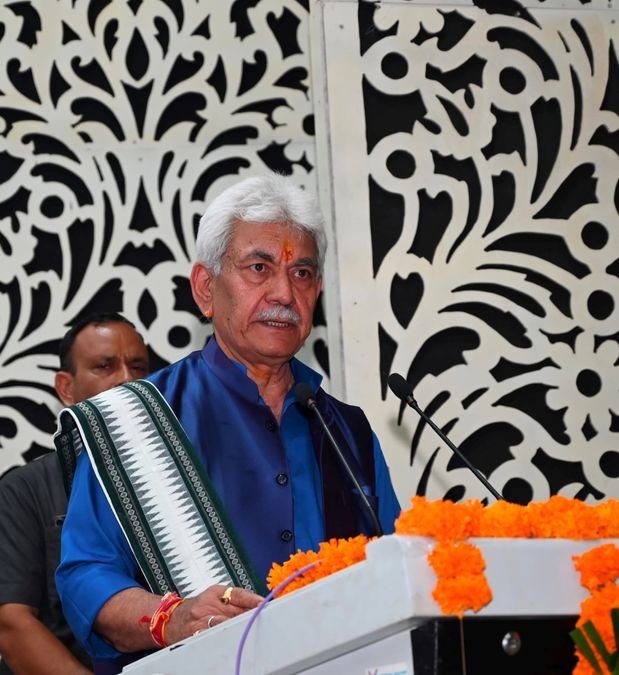
Jammu, Sep 21: “Countries across the world that are facing the challenge of climate change are also realising that the food of the future will not merely be food that can be produced in large quantities. It will have to be nutritious, profitable for farmers and sustainable for the planet,” Lieutenant Governor Manoj Sinha said on Monday, as he addressed two separate millet-focused events in Jammu—a National Dialogue on Millets for Health at SKUAST-J and a ‘Millets for Health’ seminar at Government Medical College (GMC).
Speaking at the National Dialogue on “Millets for Health: Building Healthy Ecosystems, Climate-Resilient Agriculture and Sustainable Food Systems” at SKUAST, Jammu, the Lieutenant Governor said the occasion was not merely a seminar but a celebration of a revolution rooted in India’s villages.
Expressing gratitude to Padma Shri Dr Khadar Vali, popularly known as the “Millet Man of India”, and Umendra Dutt of Kheti Virasat Mission, Sinha lauded their efforts in creating a new awakening through the Millets Mission in Jammu and Kashmir.
“Millets were part of our agricultural memory for centuries. The time has now come to restore them to the consciousness of society,” the LG said, tracing the heritage of sorghum, pearl millet, finger millet, kodo millet, little millet, foxtail millet, and barnyard millet, which he said have nourished generations of farmers and families.
He noted that millets, once sidelined as “food of the poor,” are now reclaiming their place at the intersection of tradition and modern science. He reiterated the ancient wisdom—”Annam Brahma”—that food is divine, and healthy food builds healthy citizens, strong societies, and resilient nations.
Highlighting the relevance of millets for Jammu and Kashmir, Sinha underscored that over 80 per cent of the region’s farmers are small and marginal, dependent on uncertain weather. Millets, requiring less water and fewer inputs, offer them confidence and sustainability.
“I see the Millets Mission as the greatest hope for the smallest farmer in our villages. Under the Holistic Agriculture Development Plan, we prepared a strategy three to four years ago to ensure the health of future generations, the prosperity of our farmers and the protection of our earth,” the LG said.
“I believe that millet cultivation can give marginal farmers in Jammu Kashmir a new sense of confidence while also helping reduce the risks associated with farming. Although the size of your landholding may be small, your contribution to building a self-reliant Jammu Kashmir can never be small,” he said.
The Lieutenant Governor also highlighted the health benefits of millets, noting their dietary fibre, low glycaemic index, and rich nutrients such as iron, calcium, magnesium, and zinc. He called upon citizens to bring millet-based foods like bajra rotis, ragi dishes, and barnyard millet rice back to their plates to combat lifestyle diseases such as diabetes, obesity, and hypertension.
“I see millet’s cultivation as a powerful means of empowering women, promoting dignity and respect for women, and reviving the rural economy. The value-added products can shape the region’s next economic success story,” he said.
Addressing the ‘Millets for Health’ seminar at GMC Jammu later, the Lieutenant Governor said the seminar was more than an academic exercise.
“It is a reminder of shared responsibility towards the Earth, its water, farming families, villages and the health of every citizen. Nature’s message is clear that limits cannot be crossed, and millets offer a credible alternative,” he said.
Citing the 2018 ICMR report, Sinha noted that non-communicable diseases accounted for 61.8 per cent of all deaths in 2016, up from 37.09 per cent in 1990. The National Family Health Survey, he said, records high blood pressure in 11 per cent of women and 15 per cent of men aged 15–49.
“I believe these are not merely medical problems but they directly affect family economic conditions, social life, and national productivity. I firmly believe that, in such times, greater inclusion of our traditional food, millets, can show us an important path towards disease prevention and a healthy lifestyle,” he said.
“Millets offer us a simple lesson from nature: the solutions to many health challenges due to modern lifestyle of today lie within our own traditions,” he added.
Stressing that the time has come to move from discussion to action, the Lieutenant Governor appealed to farmers to diversify their crops and to scientists to develop high-yielding, climate-suited varieties.
“I urge all doctors and nutrition experts to create evidence-based awareness about the role of millets in a balanced diet. I appeal to all citizens of Jammu Kashmir to prioritise the nutritious and balanced food of millets over processed food,” he said.
“I call upon every household to give millet products a place on their plate and strengthen farmers, empower women, and ensure a healthier future for generations. Let us work together to ensure that every village has opportunities and future generations inherit a healthy planet,” the Lieutenant Governor said.
On the occasion, the Lieutenant Governor released several publications, including ‘A Laboratory Manual on Soil Microbiology’; ‘Fundamentals of Geographical Information Systems and Remote Sensing’, and ‘Package of Practices for Minor Millets’.
Padma Shri Dr Khadar Vali; Prof B.N. Tripathi, Vice Chancellor, SKUAST Jammu; Umendra Dutt, Executive Director, Kheti Virasat Mission; Dr Anjani Kumar, IFPRI; Prof S.K. Gupta, Director Research, SKUAST Jammu; Dr Ashutosh Gupta, Principal, GMC Jammu; Ramesh Kumar, Divisional Commissioner Jammu; experts, policymakers, researchers, senior officials, progressive farmers, agri-preneurs, members of Self-Help Groups, faculty and students attended the events.


