


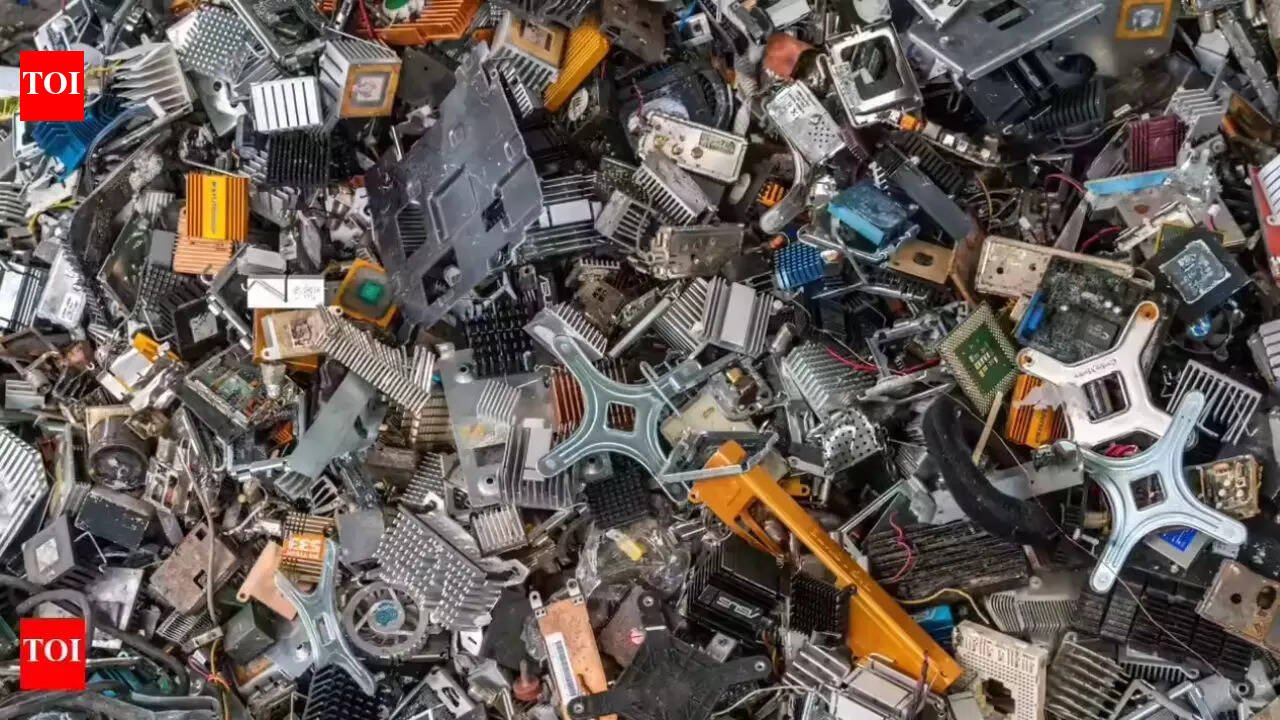
MUMBAI: As Mumbai pushes ahead with infrastructure projects, housing redevelopments and a growing manufacturing ecosystem, an invisible but critical industry is quietly shaping the city’s environmental future — metal recycling.In the Mumbai Metropolitan Region (MMR), metal recycling units together have a plant capacity of over 9,900 metric tonnes per month and are currently recycling more than 6,930 metric tonnes every month. Industry bodies such as the Material Recycling Association of India (MRAI) and the Bombay Non-Ferrous Metal Association, both active in the region, are driving discussions around efficient scrap management in ferrous and non-ferrous metals.Leaders from the sector have urged the government to establish dedicated scrap yards in every city and grant metal recycling “industry status” to improve efficiency and formalise operations — a move they say will benefit both the economy and the environment.The renewed focus on recycling comes at a time when India’s foundry industry — the world’s second-largest casting producer — is entering a growth phase increasingly shaped by sustainability. According to the Bharat Foundry 360° Insight 2025–2047 Report, released by the Indian Foundry Congress of India (IFCI) ahead of the 74th Indian Foundry Congress (IFC) and IFEX 2026, the sector is projected to grow from $23.6 billion in 2024 to $42.5 billion by 2029, registering a compound annual growth rate (CAGR) of 9.4%.The report underlines that recycling of ferrous and non-ferrous metals will be central to ensuring environmentally responsible growth. Increased use of scrap reduces dependence on mining, lowers energy consumption and cuts greenhouse gas emissions — key factors in balancing industrial expansion with ecological preservation.As India expands its manufacturing base under initiatives such as Make in India and Production Linked Incentive (PLI) schemes, integrating recycled metals into casting processes is expected to support both resource conservation and cost efficiency.Long-term projections by Global Market Insights suggest that India’s foundry industry could reach $169 billion by 2047, potentially placing the country among the top three global markets. However, stakeholders stress that this expansion must align with circular economy principles, including scrap recovery, waste minimisation and adoption of cleaner melting technologies.Currently, India produces around 12 million tonnes of castings annually, accounting for nearly 11% of global output. The industry comprises approximately 4,500 foundries, predominantly small-scale units, generating a turnover of around $20 billion and exports worth $3.54 billion, mainly to the United States, Germany and the United Kingdom.Technological upgrades are also reshaping the sector. Increasing adoption of robotics, Internet of Things (IoT), AI-based design systems and advanced furnace technologies is helping foundries improve efficiency while integrating recycled materials into production cycles.Ferrous castings account for 83.8% of total output, led by grey iron, ductile iron and steel. Non-ferrous castings make up 16.2%, with aluminium alone holding a 63.4% share and expected to grow at an 11.2% CAGR. Aluminium’s high recyclability makes it crucial to circular manufacturing, particularly in automotive, electric vehicles, electronics and renewable energy sectors where demand for sustainable materials is rising.Mumbai will be at the centre of these discussions when the 74th Indian Foundry Congress and IFEX 2026 are held from February 12 to 14 at the NESCO Exhibition Centre. The event will focus on innovations that enhance recycling efficiency, reduce emissions and promote environmentally responsible casting practices. It is expected to bring together global technology providers, manufacturers and sustainability experts to accelerate adoption of advanced recycling solutions and circular supply chains.Commenting on IFEX 2026, Indian Institute of Foundrymen (IIF) President 2025–26 Sushil Sharma said the exhibition represents a convergence of technology, policy and market opportunity, adding that future growth must be anchored in resource-efficient manufacturing and advanced recycling systems.Amish Panchal, chairman of the 74th IFC organising committee, said the Congress plays a key role in promoting sustainability through innovation in scrap processing and energy-efficient casting. IFEX 2026 chairman Subodh Panchal noted that the exhibition will showcase technologies aimed at reducing emissions, improving material recovery and moving the industry toward zero-waste manufacturing.With strong domestic demand, expanding exports and a growing focus on circular production, India’s foundry sector is increasingly aligning economic growth with environmental responsibility. Industry leaders maintain that scaling up recycling-driven manufacturing will be critical not only for global competitiveness but also for conserving resources, reducing pollution and sustaining long-term ecological balance.


