









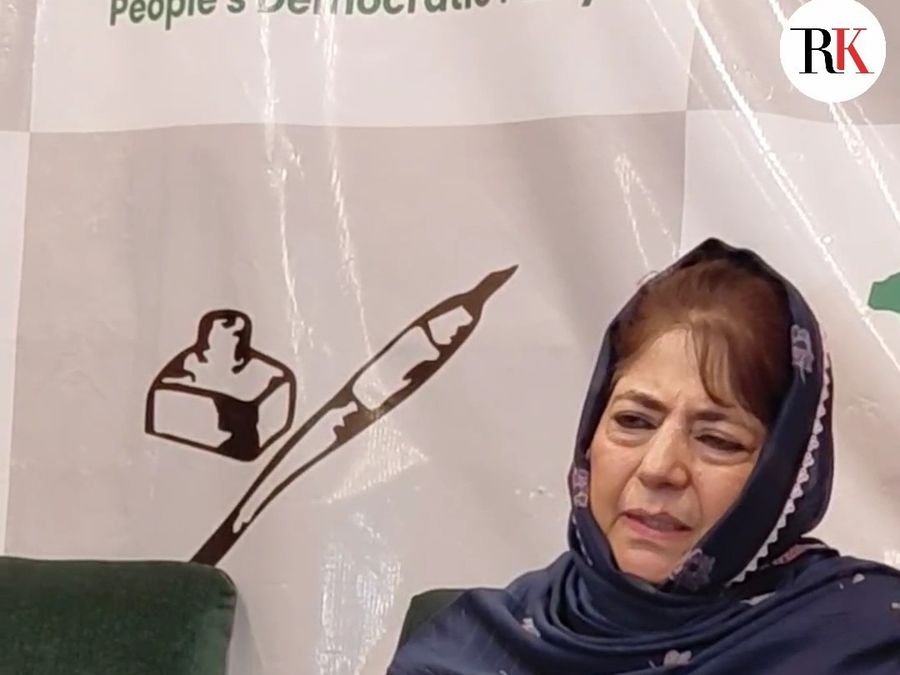
Srinagar, Oct 13 : Peoples Democratic Party (PDP) president Mehbooba Mufti on Tuesday accused the BJP of using Jammu and Kashmir as a “laboratory” to test policies aimed at interfering in the religious affairs of Muslims, as she strongly opposed the Waqf Board’s proposal to introduce uniform Friday sermons in mosques.
Addressing a press conference, the former Chief Minister alleged that the proposal was part of a broader political agenda to exercise control over Muslim religious practices and warned that similar measures could eventually be implemented across the country.
“Jammu and Kashmir has become a laboratory for the BJP. First, such measures are tested here and then implemented across the country,” Mehbooba said, drawing parallels between the proposed uniform Friday sermons and the BJP’s push for a Uniform Civil Code.
She questioned the authority of the Waqf Board and the Union government to determine the content of Friday sermons, saying religious scholars and Imams were best placed to address the concerns of their respective communities.
“These are our mosques, built with the money of our people. Our Imams and Maulvis know what to say and when to say it. Who will decide what Khutba our Imam should deliver on Friday?” she asked.
Mehbooba alleged that the BJP was attempting to interfere in Muslim religious affairs through administrative decisions and questioned the role of the Union Ministry of Minority Affairs in matters concerning Islamic practices.
“Our Minority Affairs Minister is a non-Muslim. What does he know about Islam and Muslims? Yet, they continue to issue one order after another,” she said.
The PDP chief argued that Friday sermons could not be standardised because religious and social concerns differed from one locality to another.
“Every area has its own issues. Sometimes an incident takes place in a particular locality, and the Maulvi addresses it during the Friday sermon. How can there be one uniform Khutba for everyone?” she asked.
She said mosques had historically played a central role in spreading Islamic teachings and addressing community concerns, and their religious functioning should not be subjected to political or administrative control.
Mehbooba also demanded that the Waqf Board be brought under the Jammu and Kashmir government, while maintaining that any coordination on religious sermons should be undertaken by recognised Islamic scholars rather than government-appointed authorities.
“First, the Waqf Board should be handed over to the Jammu and Kashmir government. If there is any need to decide matters concerning Khutba, it should be done by the Mutahida Majlis-e-Ulema under Mirwaiz Umar Farooq,” she said.
She described the Mirwaiz-led religious body as a legitimate platform representing Islamic scholars and questioned why a government-controlled institution should assume authority over religious discourse.
The former Chief Minister also referred to the PDP’s earlier opposition to the Waqf legislation, saying her party had consistently raised concerns over what it viewed as increasing government intervention in Muslim religious institutions.
“We have already brought a resolution against the Waqf Bill and have consistently opposed such interference,” she said.
Accusing the BJP of targeting Muslim religious institutions, Mehbooba alleged that mosques and religious sites were being subjected to interference while authorities simultaneously sought to regulate what religious leaders could preach.
She maintained that mosques belonged to the communities that had built and maintained them through donations and Zakat, and that decisions concerning religious teachings should remain with scholars and worshippers.
“These are not their mosques or their properties. People have built them with their own money and Zakat. This interference in our religion is totally unacceptable and will not be accepted,” she said.
The remarks come amid mounting political and religious opposition to the Jammu and Kashmir Waqf Board’s proposal to constitute a committee of Muftis, Imams and Khateebs to identify common themes for Friday sermons.
The Waqf Board has presented the initiative as an effort to promote religious awareness, moral values, social harmony and coordination among religious institutions.
However, critics, including religious organisations and political leaders, have questioned whether such coordination could amount to administrative interference in religious expression. (KNS)


