






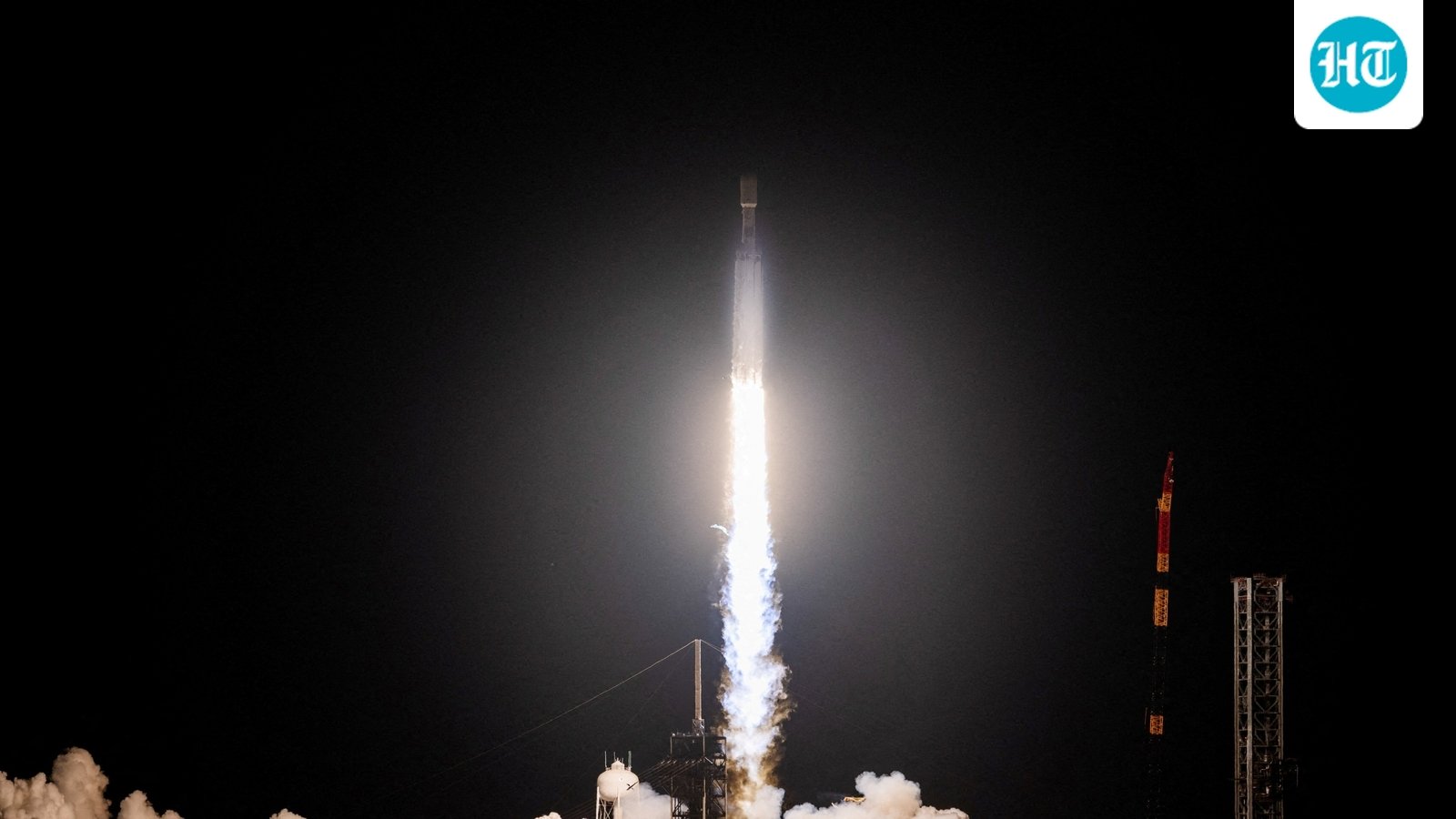
SpaceX launched a Falcon 9 rocket from Florida on Tuesday, October 13, carrying a Dragon cargo spacecraft filled with supplies and scientific equipment for astronauts aboard the International Space Station (ISS).

The rocket lifted off from Cape Canaveral Space Force Station in Florida at around 6:35 am EDT (10:35 GMT) on Tuesday. Florida Today reported that the launch was scheduled for 6:33 am from Launch Complex 40.
The launch marks the beginning of SpaceX CRS-35, the company’s 35th cargo resupply mission under its Commercial Resupply Services contract with NASA, according to Space.com.
The mission will send essential supplies, research equipment and scientific experiments to astronauts living and working aboard the ISS. The cargo will help support their daily needs and ongoing research in space, according to Space.com and Florida Today.
SpaceX launch today: Supplies for ISS astronauts
The Dragon spacecraft is carrying approximately 6,300 to 6,500 pounds of supplies and scientific equipment, equivalent to around 2,860 to 2,948 kilograms, according to Space.com and Florida Today. The two publications provided slightly different estimates of the cargo’s total weight.
One of the important items aboard the spacecraft is the final set of International Space Station Roll-Out Solar Arrays (iROSAs). These solar arrays will help increase the space station’s power supply, according to Space.com.
SpaceX Dragon cargo: Experiments for health research
The mission will also carry scientific equipment to help researchers study ways to improve human health. One experiment will focus on manufacturing artificial retinas in microgravity, or very low-gravity conditions, which could help scientists develop ways to restore vision on Earth, according to NASA officials in a CRS-35 launch preview published on October 7.
Also read: Amazon Prime refund update: Who gets up to $200 and when will payments arrive?
The spacecraft will also carry materials to create 3D heart tissue models. These models could help researchers improve drug testing during future space missions. Another experiment will study how a new type of glass forms in microgravity. Scientists hope to understand how materials behave differently in space compared with conditions on Earth, according to NASA officials.
The Dragon spacecraft will also transport brain organoids, which are small, lab-grown models of brain tissue. Researchers will study them to identify possible treatment targets for neurodegenerative diseases such as Alzheimer’s, Parkinson’s and multiple sclerosis.
The mission will include an experiment developed by students at Florida Tech, according to Florida Today. The publication did not provide further details about the student experiment in the supplied report.
SpaceX launch today: ISS docking time
The Dragon spacecraft is expected to reach the ISS on Thursday, October 15, at around 11 a.m. EDT (3 p.m. GMT), provided the mission proceeds as planned. Space.com reported that the spacecraft is expected to dock autonomously at the space-facing port of the station’s Harmony module.
Florida Today reported that the spacecraft is expected to dock at the ISS’s Zenith Port. The docking location became available after NASA’s SpaceX Crew-12 mission departed from the space station.
The Crew-12 Dragon spacecraft and its astronauts returned to Earth on October 8, splashing down off the California coast after spending nearly eight months aboard the ISS. The astronauts from Crew-13, which launched from Cape Canaveral on October 1, will receive the supplies delivered by the CRS-35 mission, Florida Today reported.
SpaceX Falcon 9 booster landing and Dragon return
The Falcon 9 rocket’s first-stage booster is expected to return to Landing Zone 40, near the launch pad, after separating from the rocket. Its return could produce sonic booms across parts of Central Florida. After delivering its cargo, the Dragon spacecraft will remain attached to the ISS for about a month. It will then return to Earth carrying scientific experiments and other equipment from the space station, according to Space.com.
Unlike several other cargo spacecraft, SpaceX’s Dragon can bring equipment and scientific materials back to Earth. This makes it important for researchers who need to recover experiments for further study.
Russia’s Progress spacecraft, Japan’s HTV-X and Northrop Grumman’s Cygnus XL are other cargo spacecraft that serve the ISS. However, these spacecraft are expendable and burn up in Earth’s atmosphere after completing their missions.
The CRS-35 mission is part of NASA’s ongoing effort to keep the ISS supplied and support scientific research in space. Its cargo includes equipment for power generation, medical research and materials science, helping astronauts continue experiments that could benefit people on Earth, according to NASA’s mission preview.


