






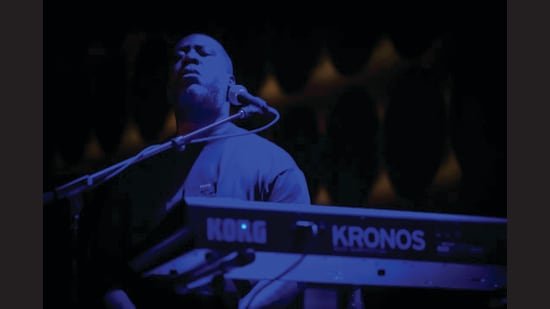
On the podcast Go with Elmo Lovano — a three-hour conversation that doesn’t feel half as long — pianist, composer and producer Robert Glasper describes walking into the Miles Davis vault for the first time.
He doesn’t reach for the obvious metaphors about legacy or reverence. He talks instead about fearlessness: how Davis’s archived material, even the unfinished fragments and discarded experiments, radiated a quality of the late jazz maestro’s absolute refusal to repeat himself.
The vault is an archiving effort led by the Miles Davis estate. Glasper says it changed how he thought about his own work.
Listening to him, you understand that this is not a musician paying tribute to a hero. It is one restless spirit recognising another, across decades. (Davis died in 1991, aged 65.)
Now Glasper is back in Davis’s orbit, this time as composer and producer of the score for Miles & Juliette, an upcoming period romance directed by Bill Pohlad, who also directed the superb Love & Mercy (2014), a biopic of Beach Boys co-founder Brian Wilson.
The new film focuses on Davis’s 1949 trip to Paris, where the 22-year-old finally escaped the suffocating segregation of America and fell into a passionate romance with the French singer and actress Juliette Greco. Damson Idris plays Miles; Anamaria Vartolomei plays Greco; and Mick Jagger produces through his Jagged Films banner. There is no release date yet, but the project was announced at Cannes last year.
The Paris story is an extraordinary one.
In the 1940s, France felt like a different universe to Black American musicians, a place where their genius was celebrated rather than suppressed, and where a young man from East St Louis could walk into the Salle Pleyel concert hall and be treated as the visiting royalty he was.
Greco later recalled not even noticing Miles was Black; not because she was oblivious, but because in that Paris milieu, it simply didn’t stand out. Their romance was brief. The imprint was permanent. There is a tenderness in Davis’s early recordings that some who knew him traced directly to those Paris weeks, a lyricism that is marked by its intimacy.
That Glasper has been chosen to give form to that emotional pulse makes complete sense: he has spent his career arguing that feeling and formal intelligence are not in competition.
Miles & Juliette is, remarkably, the third time Glasper has formally engaged with the Davis legacy, each time in a different format, and each time delving deeper.
The first was the soundtrack for Miles Ahead (2016), working alongside Don Cheadle on Cheadle’s audacious, semi-hallucinatory biopic. Glasper curated the music, contributed five original compositions, and assembled a closing studio jam, What’s Wrong with That?, which envisioned Davis playing in the present day alongside Herbie Hancock, Wayne Shorter, Gary Clark Jr and Esperanza Spalding. The soundtrack, unsurprisingly, won a Grammy.
His second Miles project, Everything’s Beautiful (2016), was an album formally credited to Davis and Glasper: a collaboration between a legend long gone and someone who could well be a legend in the making. Granted access to the Davis archive by Sony Music after his Miles Ahead work, Glasper reworked material from it into something totally new: not a remastered collection, but jazz remixed with hip-hop textures.
Miles’s trumpet is reimagined as a voice in a living conversation. On Ghetto Walkin’, master tapes of Davis from the 1960s are woven around the voice of the singer Bilal, to create something that sounds curiously like both the past and the present. It shouldn’t have worked. It very much did.
But to understand why Miles & Juliette fits Glasper, now 48, so perfectly, one must unpack what he actually does, and how differently he thinks about this music.
The standard story of the jazz and hip-hop crossover involves sampling.
Here, a producer lifts a chord progression or a bass line, loops it, and builds a beat around it. Glasper’s approach is entirely different. In the Lovano conversation, he talks about the sessions for Kendrick Lamar’s To Pimp a Butterfly, specifically the track These Walls, as evolving almost organically.
The recording wasn’t a formal arrangement. Glasper was responding in the moment, finding the harmonic space between jazz improvisation and hip-hop groove instinctively, the way a jazz soloist finds space in a live ensemble.
Nothing was pre-agreed. The connection between the two genres, as Glasper hears it, is not architectural but biological: hip-hop grew out of jazz the way a branch grows from a trunk, and retains cellular memory.
His job, as he sees it, is simply to make that memory audible.
His recent album, Code Derivation (2024), turns this philosophy into explicit structure. Each track appears twice: first played live by his jazz band, featuring trumpet player Keyon Harrold and saxophonist Walter Smith III, immediately followed by a “flipped” hip-hop production version crafted by producers including Hi-Tek, Black Milk, Karriem Riggins, and his son Riley Glasper, 18.
The lesson is delivered in sound. You hear the same music breathe differently in two bodies, and the kinship between them is clear.
FRESH BLUEPRINTS
This philosophy first found its full commercial expression in the Black Radio trilogy, the defining achievement of Glasper’s career. Black Radio (2012), recorded with his electric ensemble Robert Glasper Experiment, won a Grammy and genuinely reconfigured what contemporary music could sound like, blending jazz improvisation with neo-soul vocalists and hip-hop MCs.
Black Radio 2 followed in 2013, deepening the template. Black Radio III arrived in 2022, featuring HER, Killer Mike and Jennifer Hudson among others, and won another Grammy. Three albums bound by one coherent argument, made without seeming formulaic.
This is the work of a musician who has spent two decades building networks as carefully as he has built sound. His collaborators read like a map of contemporary Black music’s most adventurous spots: Lamar, Hancock, Erykah Badu, Mac Miller, Q-Tip, Meshell Ndegeocello. His supergroups — Dinner Party with Terrace Martin, Kamasi Washington and 9th Wonder; R+R=Now — are not vanity projects but solid creative collectives, each exploring a different juncture where jazz, soul and hip-hop converge.
He holds the piano together with what critics have called the “Glasper Dilla” technique: playing fractionally behind the beat, in the manner of the late producer J Dilla, giving every line the quality of a human feeling their way forward rather than a musician executing a plan.
For Miles & Juliette, Glasper will be scoring a younger Miles than he has engaged with before — the pre-revolution, romantic Davis. On the Lovano podcast, he talks about Davis’s fearlessness and his willingness to trust the instinct and sort out the theory later. It is a philosophy that has quietly governed Glasper’s entire career.
Miles & Juliette should be worth the wait, not least because it gives us another chapter in one of contemporary music’s most compelling ongoing dialogues: a living genius and a dead one, still finding new things to say to each other.
(Email sanjoy.narayan@gmail.com. The views expressed are personal)


