






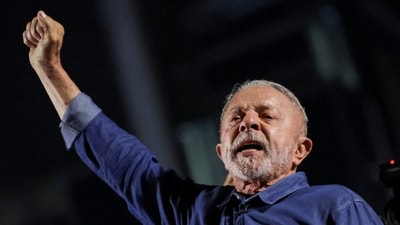
LULA WAS a goner—or at least that is what everyone had assumed. Instead, Luiz Inázio Lula da Silva, Brazil’s incumbent president, pulled off a win for the history books. The left-wing leader hung onto his job by a margin of nearly four points in a presidential run-off on October 25th, even though he had trailed his rival, Flávio Bolsonaro, in the first round. Never in Brazilian history has anyone come from behind in this way to clinch the presidency. In January Lula will become the country’s first democratically elected president to start a fourth term.

Yet if Lula’s supporters are elated, the markets are running scared. They fear economic drift and high-spending that Brazil cannot afford—and they are right to. On news of Lula’s victory, the real slumped by 7% against the dollar. The main stock-market index, the Bovespa, fell by 14%, tripping a circuit-breaker on the way down. If Lula wants to lift up poor Brazilians, avoid a crisis and protect his legacy, his final four years in office will have to look very different from the past four. He does not have much time to persuade investors that he will change course.
Lula’s surprise victory owed much to the inadequacy of Brazil’s right-wing politics. The right remains in thrall to Flávio’s father, Jair, a former president serving a 27-year sentence for plotting a coup in 2023, after himself losing an election. By picking Flávio as its candidate, the right sidelined politicians who would have been much more electable. Flávio spoke of cutting spending, which pleased markets, but provided no credible plans for doing so. His main policy was to spring his father from house arrest.
In spite of that, investors were counting on him winning—in large part because they trusted his opponent even less. For years successive governments, including Lula’s, have spent wildly. That has left Brazil paying a higher share of GDP in interest on its debt than all but a tiny handful of big countries. It has also resulted in a sky-high real interest rate, now at 9%. This is weighing on investment, squeezing businesses and households, and squashing growth. Though Brazil has vast natural resources, including oil, expansive farmlands and huge stocks of critical minerals, it has for decades grown more slowly than its peers.
Cutting government spending is key to getting things moving. But Lula’s government runs a budget deficit of more than 9% of GDP. The IMF predicts that public debt will hit 97% of GDP this year, up from 84% in 2022. And it is far from clear that Lula is preparing to change his ways. On the campaign trail he talked down the need for fiscal discipline. He also promised an extravagance of big new bungs. Expenses arising from new social policies that Lula has unveiled this year are likely to cost the government the equivalent of roughly 2% of GDP by the end of 2027.
Lula, who is 81 years old on October 27th, has harnessed admirable energy in the weeks since the first round of voting humbled him. He regrouped his campaign team, changed his strategy, and powered to a remarkable victory. Now he needs to muster the same energy to relaunch his programme of government. He should make a start immediately by naming a finance minister whom investors will trust. He then must announce a credible plan for fiscal reform.
An urgent task is to pass a spending cap to stabilise Brazil’s debt. Lula needs to scrap the many tax breaks that have proliferated under previous administrations—including his own—and which benefit inefficient firms with well-connected lobbyists. Brazilian spending is swelling in part because of cushy pensions, particularly for civil servants and the armed forces, which are rising faster than inflation. In his next term Lula will be able to fill an unusual amount of vacancies, including four seats on the Supreme Court, two members of the Central Bank’s board and positions on Brazil’s financial watch-dog. He must make technical, impartial appointments and resist the temptation to make political ones.
Little of this will be easy for Lula—which is the reason for the markets’ panic. However, if Brazil’s re-elected president believes that his election victory is an excuse to double down on the policies that saw off Flávio, he will cause a fiscal crisis and a deep recession. His golden victory will turn to ashes.


