






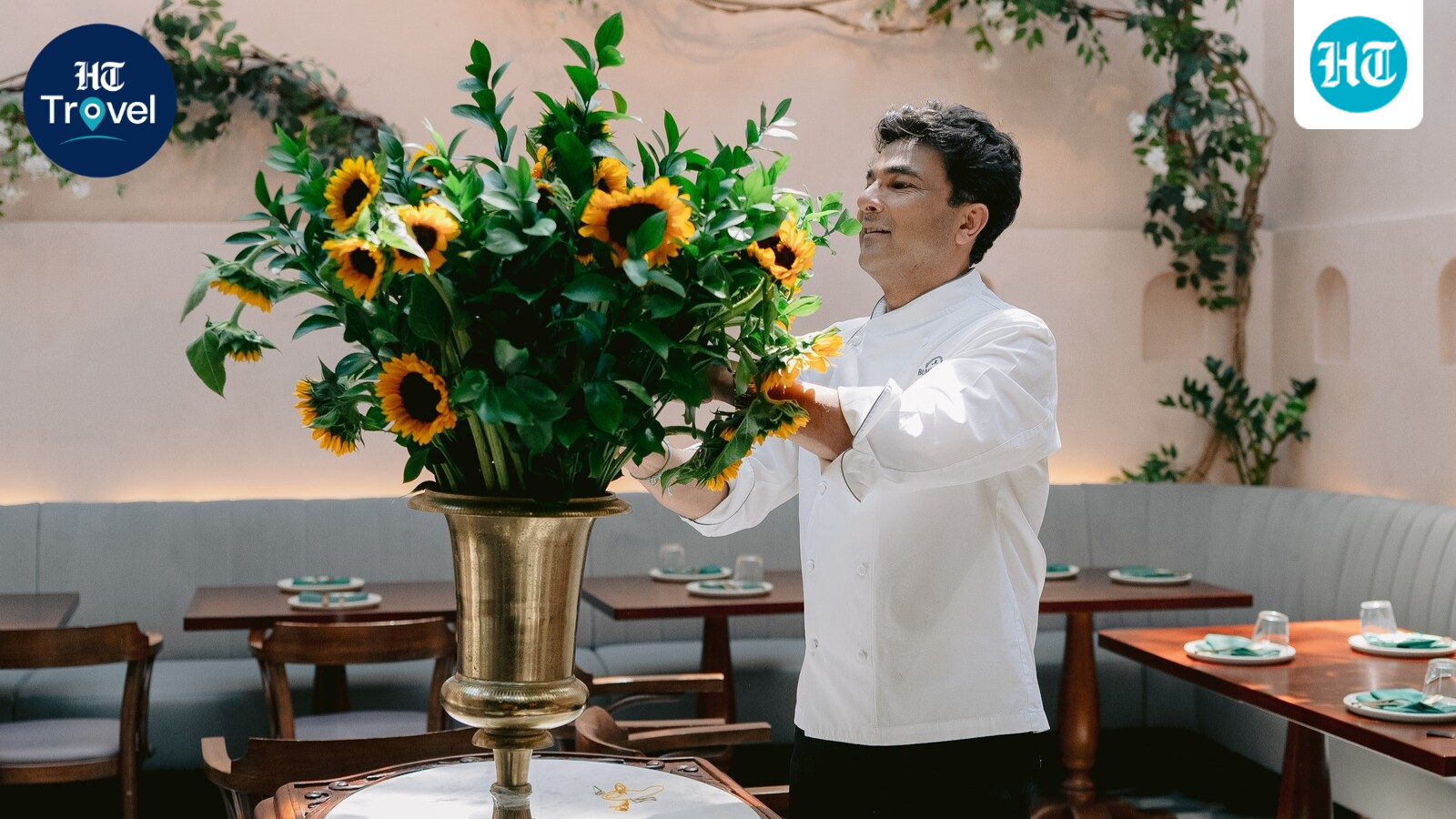
If you are travelling to New York from India, chances are Bungalow is already somewhere on your food list. For some travellers, getting a table at Vikas Khanna’s restaurant has become part of the New York plan itself. Some have tried for months to get a reservation, while others make it a point to stop by even if they can’t get a table. I asked Khanna about this during a conversation about his personal travel experiences and what it means for Bungalow to become a destination for Indian travellers in New York. His answer went well beyond food.
For Khanna, the restaurant is about giving people a reason to leave home at a time when getting food delivered has become so easy. “After the pandemic, I realised that people have the privilege of eating at home,” he told me. Food can now reach your doorstep quickly and conveniently, so a restaurant has to offer something different.
For him, that something is the human experience.
Bungalow is about the little details too
Khanna is keen to take diners beyond the usual paneer and dal choices and introduce them to food from different parts of India. During our conversation, he was excited about a Jharkhand dish that was about to go live on Bungalow’s social media. It is this regional focus that makes the restaurant interesting for Indian travellers too. You may be thousands of kilometres away from home, but the food on the table can take you to a part of India you may not have visited yourself.
The restaurant also changes with festivals and occasions. Vikas Khanna spoke about the preparations for Navratri and a rangoli inspired by his mother’s feet. It was planned to be made on the ceiling, a tiny personal detail that says quite a lot about how much of his own story goes into Bungalow.
There are cultural and gift teams working behind the scenes too. Khanna wants guests to feel that they have been welcomed into a home rather than simply served a meal. He compared it to leaving a grandmother’s house, where you rarely leave empty-handed. At Bungalow, he wants guests to take something with them when they leave.
“It is a business,” he said, but the aim is to take away that very transactional feeling that can sometimes come with dining out.
Perhaps that is also why the restaurant has become so important to some Indian visitors to New York. Khanna told me about people who mention Bungalow when explaining why they are travelling to the US, and others who simply want to take a photograph outside the restaurant.
The Puri food memory that stayed with him
Khanna has spent years travelling through India and the world through food, so I asked him about one meal or destination that had stayed with him. His answer took him back to Puri in 2009. He was at the Jagannath Temple and remembers its remarkable kitchen and a simple rice preparation with cinnamon. He was getting ready to leave when someone came to him with around 30 different things to eat. The experience has stayed with him ever since. For Khanna, it was not simply about the number of dishes. It was the generosity of the experience and the sense that there was something much bigger behind the food being served.
He still thinks about that meal when he talks about regional Indian food and Odisha’s influence.
There have also been moments at Bungalow that have made him think about the strange ways food, people and memories can come together. He recalled one diner who had spent years trying to get a reservation. When the booking finally came through, the date turned out to be the anniversary of his mother’s death. His mother had followed Khanna’s work and wanted to visit the restaurant herself. Khanna says he is an extremely practical person and not superstitious, but stories like this have made him think about the unexpected things that happen around food and people. “Sometimes you feel the magic in people,” he told me.
So where does Vikas Khanna eat in New York?
I had to ask Khanna this. If a friend were visiting New York and wanted to eat like him, where would he send them?
His list included a mix of familiar names and smaller food experiences.
• Una Pizza was one of his recommendations.
• Veselka, the Ukrainian restaurant in the East Village, is another favourite.
• Mamoun’s also made his list.
He then mentioned a simple rice and chicken place that he really wants people to try, before talking about a dosa maker near Washington Square Park. His advice there was simple. Be patient, stay in the line and let the man do his thing. “He does it from his heart,” Khanna said.
I liked that this was his New York food advice. There was no list of only the city’s big names or expensive restaurants. He was talking about the small food experiences that you might otherwise walk past, the places where someone has been making the same dish with care for years.
For Vikas Khanna, that is what makes New York so interesting. You can eat your way through different parts of the world without really leaving the city. And that idea feels quite close to what he is doing with Bungalow too, bringing different parts of India to a city where people already understand what it means to carry food and memories from home.
Perhaps that is the best way to look at Khanna’s New York recommendations. You do not need to make every meal a big occasion. Sometimes it is a plate of dosa, a Ukrainian meal in the East Village or a simple rice and chicken dish that will feed not just your stomach but also your soul.
And for someone who has spent years travelling through India and the world through food, Khanna seems to value those small food memories just as much as the grand ones. That came through in the way he spoke about Puri, Bungalow and the people who walk through its doors.
His New York is clearly a city best eaten slowly, one meal and one story at a time.
Similar articles for you
I spent a week in Hong Kong in November. Here’s how to plan your 2026 trip
I went to Chandigarh to learn golf and came back with a new way to holiday; Golf-cation decoded
I stopped folding my clothes while packing, and my suitcase suddenly had a lot more space
I fly often, and these are the handbag essentials that make long flights and layovers easier


