



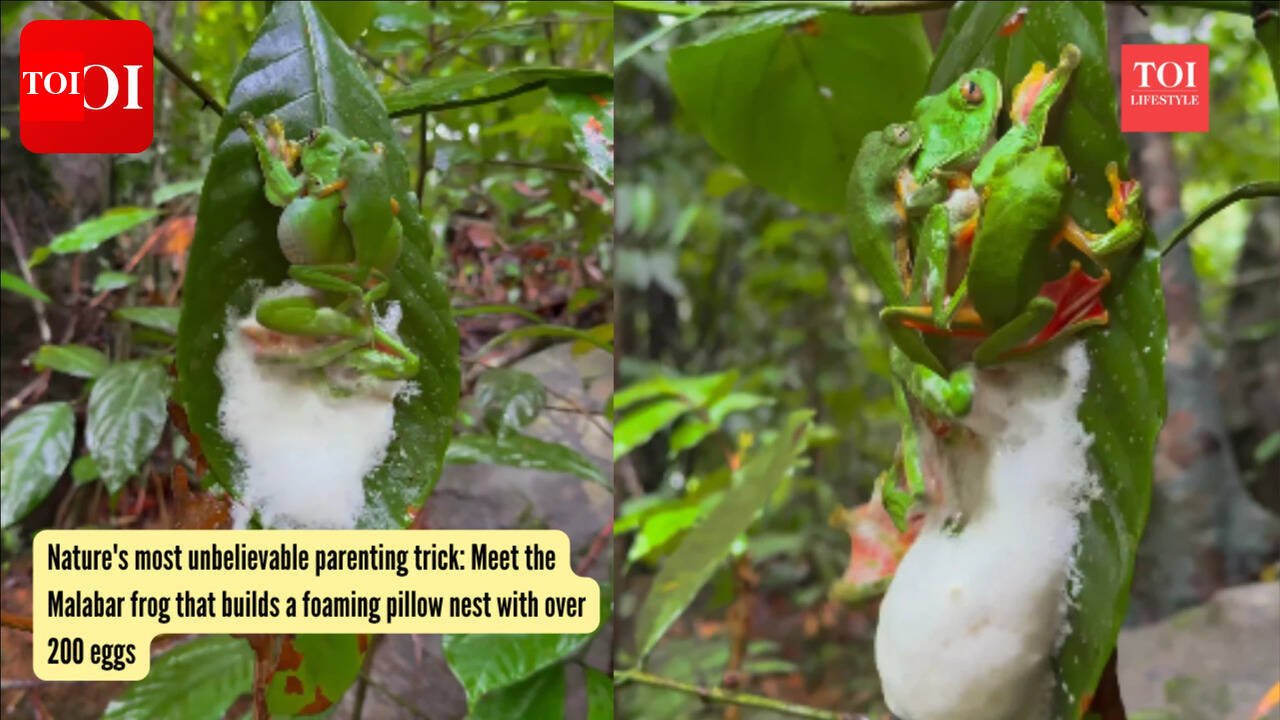
High in the misty forests of India’s Western Ghats lives a creature that seems to have leapt straight from a fantasy story.The Malabar gliding frog is a brightly green amphibian with flashy orange webbed feet that make it look no less than otherworldly. This unique frog isn’t just any ordinary amphibian; it has some abilities that look almost unreal and make it extraordinary!Indian Forest Services (IFS) officer Praveeen Kaswan re-posted about the same on his X account, captioning the post,” What a rare phenomenon he has documented !!”.
It makes a special nest with its exceptional mating behaviour
What makes this frog truly special is its unique breeding behaviour. Unlike most frogs that lay eggs directly in water, the Malabar gliding frog builds a foamy, suspended nest above ponds and streams, protecting its future offspring in the canopy. During the monsoon months of June to September, when the Western Ghats transform into a humid paradise, these frogs perform one of nature’s most beautiful parenting rituals.
How the frog builds a foam nest in the treetops
When monsoon rains change the Western Ghats into a humid paradise, the Malabar gliding frog begins its parenting ritual. Instead of laying eggs in water like most amphibians, the female selects a tree branch or leaf directly above a pond or slow-moving stream.The male climbs onto the female’s back in a position called amplexus and begins whipping up white, frothy foam using breeding fluids. This nest reaches about three inches in diameter, acting like a soft, protective pillow. The female deposits up to 200 eggs inside the foam, which the male fertilises simultaneously.
Photo: @ParveenKaswan/ X
The foam is a protective pillow and incubator for the eggs
It is almost unbelievable to see the marvelous engineering at work by these frogs that gradually build the foam nest during their mating ritual. The nest on the outside hardens to form a secure layer, while the inside stays moist, cushioning and protecting developing embryos.This foam shields the eggs from predators, drying out, and intense sunlight. It’s a natural incubator suspended in the air, placed in such a manner that the developing tadpoles have everything they need. The nest can contain up to 200 eggs, all protected in this floating cradle that has resulted from thousands of years of evolution.
So, what happens next after tadpoles hatch in the
After several days, tiny tadpoles begin hatching from their eggs. And what happens next is more surprising.As tadpoles wriggle out from their eggs, they drop from the nest and plunge safely into the water below. The foam nest is placed so that gravity pulls down the hatchlings directly into their aquatic nursery, requiring no parental transport. Once in the water, tadpoles begin their usual frog development cycle, feeding on algae and gradually growing until they develop legs and lose their tails.
It is a survival strategy that evolved over thousands of years
This beautifully coordinated series of events makes sure to provide better protection from predators, reduced risk of eggs drying out, and a safe transition of the tadpoles from nest to water. The Malabar gliding frog inhabits moist evergreen forests across Kerala, Karnataka, Tamil Nadu, and Goa, found at altitudes from 43m to 1,894m above sea level. Reproduction occurs during the monsoon months of June to September when males call loudly to attract females.


