






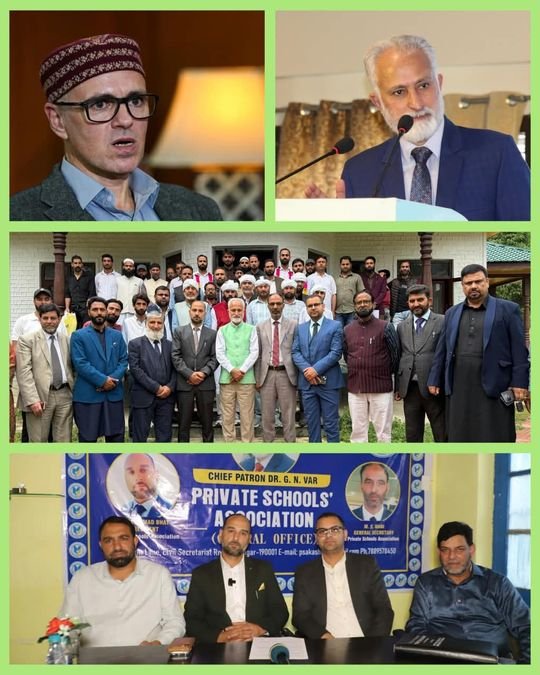
Srinagar, Oct 7: The (Regd.) Jammu & Kashmir Private Schools’ Association (J&K-PSA) has warmly welcomed the Government of Jammu & Kashmir’s significant decision to simplify and rationalise several No Objection Certificate (NOC) and compliance requirements applicable to private schools, describing the move as a progressive, practical and long-awaited regulatory reform that will provide much-needed relief to the private school sector across the Jammu & Kashmir.
The Association said the Government’s latest decision represents an important step towards reducing repetitive procedural requirements, improving ease of doing business, strengthening institutional confidence and creating a more supportive regulatory environment for genuine educational institutions, while retaining the essential focus on the safety and welfare of students.
The J&K-PSA expressed its sincere gratitude to J&K Chief Minister Omar Abdullah; Lieutenant Governor Manoj Sinha; Health & Education Minister Ms. Sakina Itoo; Commissioner Secretary School Education Department, Ram Niwas Sharma; Chairman, J&K Board of School Education (JKBOSE); Directors of School Education Jammu and Kashmir and all concerned officers and officials whose efforts contributed to bringing about this important reform.
The Association also placed on record its appreciation for the Government’s willingness to consider the genuine concerns repeatedly raised by the private school fraternity through formal representations, meetings, policy discussions, press statements and appeals at various levels.
J&K-PSA said the issue of multiple and repetitive NOCs has remained one of its long-standing policy concerns and has been consistently raised before the Government and concerned authorities.
The PSA leadership said the Association had, on numerous occasions, highlighted through its policy statements, press conferences, media interactions, official representations and meetings with high level govt offices, senior Government authorities that excessive procedural requirements were particularly difficult for schools operating in low income budget schools, rural, remote, far-flung and economically challenging areas.
The Association said these concerns were not raised merely as an institutional demand, but as part of a broader effort to ensure that school managements spend more time and resources on teaching-learning, teacher development, student welfare, infrastructure, sports and other educational priorities rather than navigating repetitive administrative procedures.
The J&K-PSA specifically welcomed the amendments notified by the School Education Department on 05 October 2026 under S.O. 251, issued in exercise of powers under Section 29 of the Jammu and Kashmir School Education Act, 2002.
The Association noted that the amendments to the Jammu and Kashmir School Education Rules, 2010 provide for the omission of specified clauses under Rule 4 and Rule 6 and, in important areas, replace earlier procedural requirements with self-attested certificates from the concerned schools.
Among the significant changes, the Government order provides for: Omission of the specified requirement under Rule 4, sub-rule (2), clause (a); Replacement of the specified traffic-related compliance requirement with a self-attested certificate from the concerned school confirming necessary compliance with traffic rules for the safety of students; Replacement of specified requirements under Rule 4, sub-rule 2A with self-attested certificates concerning: compliance of the school building with applicable building laws and safety measures; installation of necessary fire-safety equipment to avoid fire-related risks and safe storage of chemicals, where applicable, in accordance with directions of the Hon’ble Supreme Court and other courts from time to time; Omission of specified sub-clauses under Rule 6, sub-rule (1).
Veteran educationist, NISA Joint Secretary for Organisational Development & Partnerships and PSA Chief Patron Dr. G.N. Var, appreciated the Government for responding positively to the long-standing concerns of the private education sector.
He said a modern education system requires a simple, stable, transparent and facilitative regulatory framework that protects essential safety standards without placing unnecessary procedural burdens on educational institutions.
Dr.Var said the repeated requirement of multiple NOCs had, for years, consumed considerable financial resources, administrative time and institutional energy of private schools, particularly smaller schools operating in rural and far-flung areas.
Instead of directing these limited resources towards teacher training, academic infrastructure, learning materials, student facilities, sports, technology and other educational needs, school managements were often compelled to spend substantial time and resources on completing repetitive regulatory formalities.
Dr. Var said such procedural burdens could indirectly affect the academic functioning and overall development of students & schools, as resources that should ideally be invested in improving teaching-learning outcomes and student welfare were diverted towards recurring administrative compliances.
He said the latest decision should be viewed as part of a wider effort to strengthen cooperation between the Government and private educational institutions.
“Private schools are an important stakeholder in the education sector of Jammu & Kashmir. A responsive regulatory environment builds confidence among institutions and enables them to concentrate more effectively on their educational responsibilities. We appreciate this positive approach and hope that the remaining genuine concerns of the sector will also receive due consideration,” he said.
J&K-PSA State President Bilal Ahmad Bhat said the Government’s decision was a welcome recognition of a concern that the Association had been consistently raising.
“We have always maintained that student safety are fundamental responsibilities of every educational institution. At the same time, genuine schools should not be subjected to unnecessary, repetitive and cumbersome procedures. The Government’s decision to rationalise these requirements is a positive step towards creating a more practical and trust-based regulatory framework.”
Bhat said the private education sector welcomed the Government’s approach and hoped that the same spirit would guide the resolution of other pending issues confronting educational institutions especially PNIC.
“This is not merely about reducing paperwork. It is about allowing school managements to redirect their time, resources and institutional attention towards what matters most quality education, teacher development, student welfare and the holistic development of children,” he said.
J&K-PSA General Secretary (Organisation) Mohammad Syed Wani said the Association’s approach has consistently been based on constructive engagement, dialogue and result-oriented representation.
He said the Association had repeatedly taken up the NOC issues and other regulatory concerns with senior Government authorities and the Education Department.
“We have continuously maintained that the private education sector needs a regulatory system that is firm where it must be firm and flexible where unnecessary procedures can be simplified. The latest order demonstrates that sustained dialogue and constructive engagement can produce practical solutions,” Wani said.
He added that the Association would continue to present the concerns of member schools before the Government in a responsible and institutional manner.
J&K-PSA Director Media & Communications and District President Budgam Dr. Owais Mattoo said the decision would be particularly meaningful for schools operating in urban, rural and far-flung areas, where repeated administrative procedures can create disproportionate difficulties.
“Every administrative reform that removes unnecessary hurdles gives schools additional capacity to focus on students. The objective should be to ensure that compliance strengthens education rather than allowing procedural complexity to overshadow the core educational mission,” Dr. Mattoo said.
J&K-PSA Secretary and District President Shopian Hilal Ahmad Khan welcomed the decision and said its successful implementation at the grassroots level would be equally important.
“Policy reform becomes meaningful when it translates into practical relief at the school level. We hope the latest amendments will lead to a uniform, transparent and hassle-free compliance process across Jammu & Kashmir,” Khan said.
The J&K-PSA said regulatory reform should ultimately enable schools to invest greater institutional energy in areas that directly affect children, including: teacher training and professional development; academic improvement and innovative teaching methods; sports and physical education; arts, culture and extracurricular activities; environmental education; moral and value-based education; career guidance and skill development; student counselling and wellbeing; infrastructure improvement and identification and nurturing of student talent.
The Association said its recently constituted Academic, Sports, Moral Education, Environmental and other dedicated councils reflect its commitment to ensuring that private schools contribute to the broader educational and social development of children.
While welcoming the present decision, J&K-PSA said several other genuine issues raised by the private school sector remain under consideration and require continued Government attention.
The Association reiterated its broader policy position in favour of permanent school registration; rationalisation and longer validity of NOCs wherever appropriate; elimination of repetitive and overlapping certificates; transparent single-window mechanism for school-related approvals; time-bound disposal of files and applications; land lease-related policies; resolution of pending school files before concerned departments; responsive institutional Help Desk for private schools; categorization of municipality sanitation fees etc.
The Association said Government and private schools should not be viewed as competing systems but as complementary stakeholders and knowledge partners in the larger educational mission of Jammu & Kashmir.
Private schools provides educational opportunities to a large number of children, employment thousands of teachers and other staff members, invest in educational infrastructure and contribute significantly to the academic, social and overall development of students.
The Association expressed confidence that a cooperative regulatory partnership between the Government, Education Department, JKBOSE, school managements, teachers, parents and other stakeholders can create a stronger and more responsive education ecosystem.
The PSA further expressed hope that the Government would continue the same progressive, consultative and practical approach while examining the other genuine concerns of the private education sector.
“Our objective is simple, a regulatory system that safeguards children, supports genuine institutions and allows educators to devote maximum attention to education. We believe that Government and private schools can achieve this together through mutual trust, transparency, accountability and continuous dialogue,” the Association said.
The Association said the latest reform marks an important step towards a simpler, more transparent and education-focused regulatory environment in Jammu & Kashmir, and reaffirmed its commitment to working constructively with the Government for the strengthening of the Jammu & Kashmir’s education system.


