






On September 16, a former Cornell University student filed a 101-page civil lawsuit alleging that seven members of a campus fraternity drugged and sexually assaulted her in October 2024. Three weeks on, New York’s attorney general has taken over a criminal investigation that local prosecutors had closed in 2024 and reopened after the lawsuit was filed. Hundreds of students and faculty have marched across the campus in Ithaca, and the Ivy League university in New York state has brought in a former deputy US attorney general to review how sexual-assault complaints are handled.

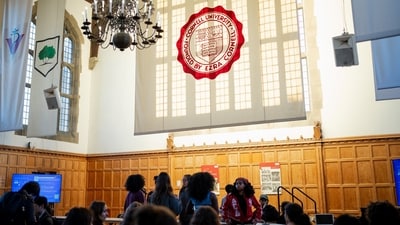
The woman, identified in court records as ‘Jane Doe’, says Cornell failed to investigate her complaint properly and punished the men too lightly. The local prosecutor declined to bring charges in 2024. The lawsuit says Cornell’s disciplinary process let the accused mitigate their conduct by writing essays. The university says none of them was offered an essay as the sole consequence. The seven men deny wrongdoing, The New York Times reported, citing Cornell documents.
The case has also renewed attention on a problem US researchers have documented since the 1950s. Surveys in 1985 and 2019 found roughly one in four women students reporting rape, attempted rape or non-consensual sexual contact, and Cornell’s records, too, indicate that complaints rarely ended in suspension or expulsion.
What the lawsuit alleges
The woman, then a 20-year-old second-year student and a member of the Tri Delta sorority (a social club for women students), says she went to the Chi Phi fraternity house on the night of October 19, 2024, after drinking at her sorority house and two bars in Ithaca. The lawsuit alleges that she was gang-raped by several members of the fraternity, with most invited to join through a group chat, over seven hours. It also details how she was plied with alcohol and ketamine through the night.
She reported the assault to the Cornell University Police Department, the campus police force, on November 8, 2024. The fraternity was suspended that day. A Chi Phi representative told Bloomberg that the chapter voted to remove the accused members three days after she filed the police report.
The lawsuit names the seven men, all students and Chi Phi members at the time, along with Cornell, the fraternity, her sorority and the bars, alleging that they failed to protect her. Lawyers for two of the men have denied taking part in an assault, the Associated Press reported. Some of the accused told Cornell’s investigators the sexual activity was consensual or disputed that they took part, according to court records and the NYT.
Why the case has drawn outrage
The Cornell Daily Sun, an independent student newspaper, followed the case for nearly two years and broke the news of the lawsuit, which put the case before a national and then international audience. Much of the anger concerns what happened after she came forward.
Tompkins County district attorney Matthew Van Houten brought no charges in 2024. He has said prosecutors relied on a six-page statement she signed for campus police, which he said “described her participation in drug use and sexual conduct as voluntary, conscious, and consensual”. In the transcript of her interviews with the police, obtained by CBS News, she said, “I can say with 100% confidence I was raped.”
Van Houten reopened the case after the lawsuit was filed. Earlier this month, New York governor Kathy Hochul, saying she was “deeply disturbed” by how it had been handled, appointed state attorney general Letitia James as special prosecutor.
Cornell’s own inquiry under Title IX, a 1972 federal law that bars sex discrimination at schools receiving federal funding, held at least 12 hearings in May 2025. Two of the men were expelled, two were suspended for at least two semesters and two were found not responsible, Cornell president Michael Kotlikoff said late last month. The seventh had already graduated and was barred from campus, NYT reported.
The lawsuit also faults Cornell Health, the campus medical service, which the woman visited on October 22, 2024, for a urinary tract infection she said she had contracted “in a traumatic way”. Her lawyer told CNN the disclosure warranted a rape kit and a physical examination, but that she was only advised to “speak with somebody”.
On September 21, the Sun published the names of the seven men in an editorial headlined “Cornell Won’t, We Will”. The editorial said “this is not a dark chapter in Cornell’s history, it’s a morbid pattern”.
Seven decades of evidence
One of the earliest studies on the topic – ‘Male Sex Aggression on a University Campus’, published in the American Sociological Review in 1957 – described how men used secrecy and stigma to pressure and exploit women, NPR reported.
In 1985, a study by Ms. magazine, a magazine first published in 1972, and psychologist Mary P Koss found that one in four women college students surveyed had experienced rape or attempted rape.
The Rape, Abuse and Incest National Network (RAINN), a US non-profit working against sexual violence, describes campuses as particularly high-risk environments, because students living away from home, building new social circles and attending parties involving alcohol and drugs are more exposed to sexual violence.
About 19.4 million students were enrolled at US colleges in autumn 2025, according to the National Student Clearinghouse Research Center. Women account for roughly 58% of college students, the Education Data Initiative said.
Citing a 2018 study of college party culture, RAINN said victims of college age, 17 to 24, accounted for about a third of all rapes reported to law enforcement.
A 2019 survey of 33 universities by the Association of American Universities (AAU) found that 13% of students had experienced non-consensual sexual contact by physical force or inability to consent since enrolling, including 26% of undergraduate women and 7% of undergraduate men.
Risk was highest for first-year women, 16% of whom reported such contact, a figure that fell to 14%, 12% and 11% in the second, third and fourth years. RAINN said the early months of college are often called the “red zone”. “The data show why colleges must reach students before and during the first weeks of campus life, not only after harm has already occurred,” it noted.
Graduate students report lower rates: one in 10 women and one in 33 men in graduate or professional programmes reported non-consensual sexual contact, according to RAINN.
In the police data analysed in the 2018 study, 60% of rapes of people aged 17 to 24 involved a perpetrator known to the victim, and 69% of those known perpetrators were described as friends or acquaintances.
Harassment is even more common. In the AAU survey, 42% of students reported at least one form of sexual harassment since enrolling. Nearly one in five, 19%, said it had interfered with their academic or professional performance, limited their participation in their programme or created a hostile environment. Women in graduate and professional programmes who were harassed were the most likely to name a faculty member or instructor as the harasser; about a quarter (24.5%) did so. “Sexual harassment can shape whether students feel safe, how they participate, whether they can focus, and whether campus feels like a place where they belong,” RAINN noted.
The former Cornell student’s lawyer, Thomas P Giuffra, told CNN that in the days after the alleged assault, she was “traumatised, numb and unable to function or accept the horror of what had happened”. She also left the university without completing her degree.
In January 2014, then US president Barack Obama set up the White House Task Force to Protect Students from Sexual Assault to raise awareness of sexual violence on campuses and address it. Two years later, Brock Turner, a former Stanford University swimmer, was convicted of sexually assaulting an unconscious woman on the university’s campus. The woman had gone with her sister to a fraternity party.
Cornell’s record
Cornell’s biennial survey of sexual assault and misconduct, which New York state law requires, was released on November 4, 2025. It found that 35% of women undergraduates and 8% of men undergraduates had experienced non-consensual sexual contact involving force or incapacitation since entering Cornell. The figure for women undergraduates was up from 23% in 2023. Among women undergraduates in sororities, 52% reported such contact, against 29% of those outside fraternities and sororities. Only 15% of the students invited took part, and Cornell said the lower response rate made its estimates less reliable.
USA Today, analysing data Cornell reported to New York state, found that more than 1,200 incidents of sexual assault, dating and domestic violence and stalking were reported to the university’s Title IX office between 2018 and 2024.
Cornell filed disciplinary charges against an accused student or employee in 162 of them, and found at least one person responsible in 51, most of whom received lighter sanctions such as probation or training.
Fourteen cases led to suspension and seven to expulsion or dismissal.
New York is one of the few US states that require all colleges, including private ones, to report such outcomes, under a 2015 law. Across the state, 81 of 9,910 reported incidents ended in expulsion, fewer than 1%, the analysis found.
How Cornell has responded
Cornell has defended its handling of the case, citing the closure of the Chi Phi chapter and the sanctions imposed. Last week, Kotlikoff said the university would examine the role of fraternities and sororities on campus and added, “Being part of a group can never diminish individual responsibility.”
On Tuesday, the trustees appointed Sally Yates, a former US deputy attorney general who led a 2022 inquiry that found systemic abuse in US women’s professional soccer, to carry out an independent review. It will examine how the woman’s complaint was handled, how Cornell investigates and disciplines sexual misconduct, campus police responses and its oversight of fraternities and sororities.
James’s office may soon appoint outside lawyers to assist its criminal investigation. No one has been charged.


