



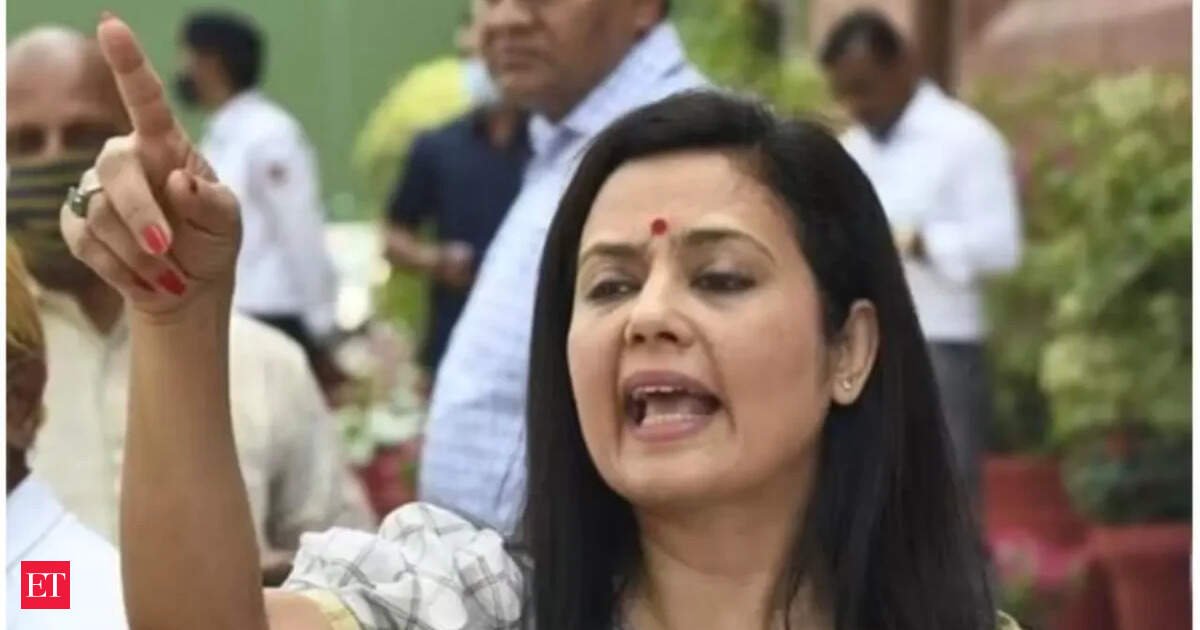
Addressing reporters after a meeting at TMC supremo Mamata Banerjee‘s Kalighat residence, Moitra alleged that the BJP government had launched an “operation” aimed at weakening the TMC at the grassroots level by preventing party workers from holding meetings and rallies.
“There is an operation underway to eliminate the Trinamool Congress by uprooting it from its roots. Workers are allegedly being threatened with false cases and police action if they organise programmes,” she claimed.
Drawing a parallel with the Emergency era, Moitra asserted that political voices could not be suppressed indefinitely and urged party workers not to be intimidated by the administration ahead of the TMC’s annual July 21 martyrs’ rally.
“The voices of millions of voters cannot be silenced. Even during the Emergency, people could not be suppressed. July 21 will take place, and our leader will show us the path ahead,” she said.
The sharpest attack, however, was reserved for the state’s proposed West Bengal Public Safety and Control of Anti-Social Activities Bill, 2026, which Moitra described as more stringent than some of India’s most controversial security legislations.
Holding up copies of the proposed legislation, she claimed it was “far harsher” than the Emergency-era MISA and the UAPA.”A person can allegedly be detained for up to a year without trial. There are no adequate judicial safeguards. It gives enormous powers to the police based merely on suspicion,” she alleged, warning that the legislation could have far-reaching consequences for civil liberties in the state.
The Suvendu Adhikari-led BJP government in West Bengal is all set to introduce the Uniform Civil Code (UCC) Bill in the state on Monday during its ongoing Budget session of the Assembly.
Besides the UCC, the government is also scheduled to table two bills on Monday to strictly deal with public disorder, vandalism and attacks on police personnel and public servants, sources said.
Among the bills, one seeks to amend the West Bengal Maintenance of Public Order Act, 1972, which deals with riots, arson, looting, use of explosives and other actions that threaten public order.
The second is a new legislation, titled the West Bengal Public Safety and Control of Anti-Social Activities Bill, 2026, which proposes to strengthen public safety and address anti-social activities more comprehensively.
The BJP, however, dismissed the allegations, accusing the TMC of resorting to fear-mongering after losing power.
Senior BJP leaders said the proposed legislation was aimed at tackling organised crime, political violence and lawlessness that had allegedly flourished during the previous regime.
“The TMC is uncomfortable because for the first time there is a government determined to act against criminal syndicates and restore rule of law. The bill is intended to strengthen public safety, not curb democratic rights,” a BJP leader said.
Moitra also attacked the government’s proposed UCC, arguing that its objective was political rather than reformist.
“We already have a uniform criminal justice system. The real question is whether this is being introduced for people’s welfare or to deepen religious polarisation,” she said.
India’s strength lies in its diversity, she argued, contending that a one-size-fits-all approach would disproportionately affect tribal communities and minorities.
“If exemptions are given to some communities and not others, then it is not truly a Uniform Civil Code. It becomes a selective civil code,” she said.
Responding to the criticism, BJP leaders maintained that the proposed UCC was intended to ensure equality before the law and gender justice across communities.
“The opposition is trying to communalise a reform measure. The objective is equal rights for all citizens, irrespective of religion,” a BJP functionary said.
Beyond legislation and politics, Moitra sought to strike a chord on issues of everyday livelihood and nutrition, reviving a debate that has repeatedly surfaced in Bengal’s political discourse.
Referring to the government’s decision to engage ISKCON for cooked mid-day meals in schools under the Kolkata Municipal Corporation area and replace eggs with vegetarian alternatives, she claimed the move ignored the nutritional realities of children from economically weaker backgrounds.
“Our children and your children may not depend on mid-day meals, but lakhs of underprivileged children do,” she said.
Recalling the once-popular Doordarshan slogan ‘Sunday ho ya Monday, roz khao ande’, Moitra described eggs as one of the most affordable and accessible sources of protein available to poor families.
The BJP rejected the charge, asserting that nutritional standards in government schools would not be compromised and that the meal programme was being restructured to ensure quality, hygiene and accountability.


