






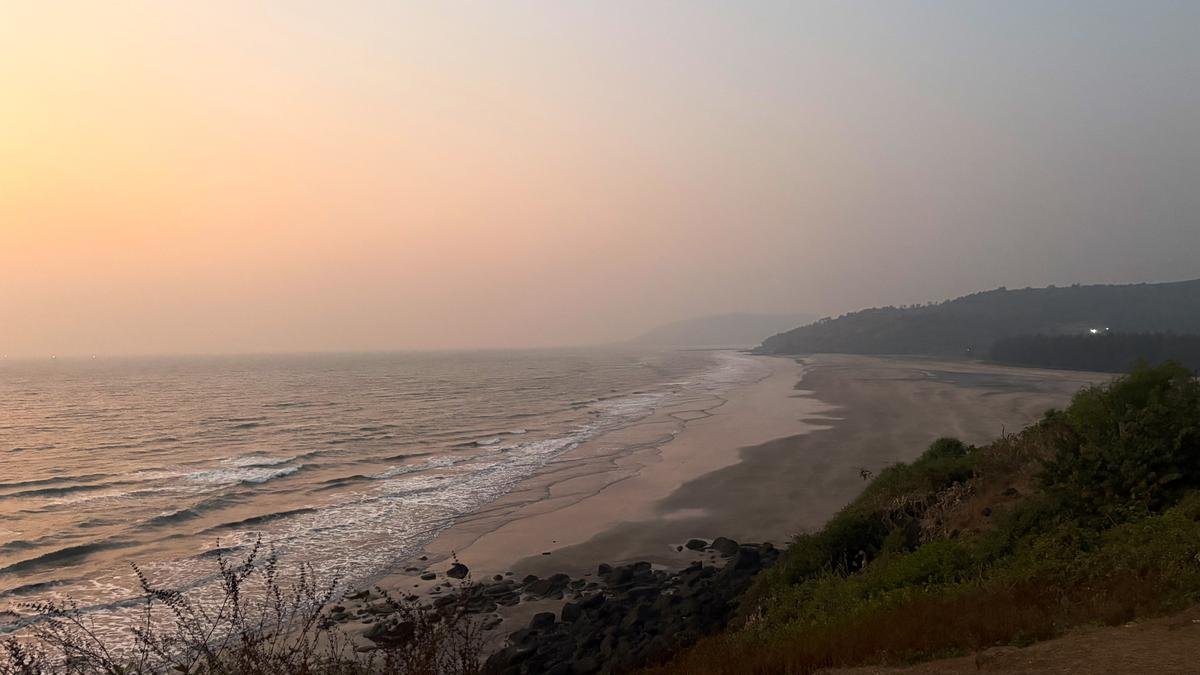
In February this year — as I set out to plan a vacation with my sister — her travel checklist left me flummoxed. I were to find us a spot away from the urban chaos that had a beach, several sightseeing options, and authentic regional cuisine. And that is how we landed up spending four days in Dapoli, a small town in Maharashtra’s Ratnagiri district.
Our trip started with a visit to the 12th Century Kadyavarcha Ganpati temple famous for the idol of lord Ganesh wherein his trunk us turned toward the right, which is both rare and considered auspicious. There is also a Shiva temple on the premises.
Kadyavarcha Ganpati Temple
| Photo Credit:
Khursheed Dinshaw
On that summer day, my eyes veered towards the shops lining the temple that offer sherbets made from kokum, amla, jamun, and karvand (wild berry). This, alongside ladoos made from nutritionally dense aliv seeds; poli, a sweet flatbread made with a filling of either jackfruit or mango; and crunchy raw jackfruit chips satiated our morning cravings.
From the temple, we took the steps leading down to the stone believed to be imprinted with the footprint of lord Ganesh. Sitting next to it, watching the sunset over the hills, was both relaxing and therapeutic. Away from the blaring horns, the serenity of Dapoli was refreshing. A short drive from the temple got us to the imposing 30 metre tall Kelshi (Anjarle) lighthouse whose range of light of 23 nautical miles has been helping boats to navigate the Arabian Sea.
Murud Beach
| Photo Credit:
Fahad Puthawala
Across the lighthouse is the pristine Anjarle beach, which is less crowded than the other beaches in the Konkan. Though it was dark by the time we reached, the moonlit the beach with its glow, made our night stroll enjoyable. Two other secluded beaches include the three kilometre long Kelshi beach, known for stunning sunsets, and Tamastirth beach, characterised by its distinct reddish shade of water.
Dinner at our resort’s in-house Konkan restaurant included Konkani curries prepared with jackfruit and coconut, vegetables cooked in freshly ground local spices, rotis made from rice flour with seafood specialities of prawns, pomfret, rawas and surmai. Desserts were the delectable puran poli (a flatbread with a stuffing of Bengal gram and jaggery) and ukadiche modak (rice flour dumplings with a filling of jaggery and coconut).
Himmatgad Fort
| Photo Credit:
Khursheed Dinshaw
The next morning, we strolled to Murud beach to catch the sun bathe the horizon in an orange glow above the silhouettes of coconut trees lining the beach.
Our plan for the day was to drive to the historically significant Himmatgad fort, also known as Bankot fort or Fort Victoria. The two-hour drive was peppered with winding roads and mango orchards heralding the arrival of the mango season with flowers in bloom. Ratnagiri is well-known for its GI-tagged alphonso mangoes or hapus, and as ardent mango lovers, hapus is our absolute favourite.
Parshuram Bhumi
| Photo Credit:
Khursheed Dinshaw
Surprisingly, we were the only visitors at the coastal fort. With the sun beating down upon us, the cool breeze from the Arabian Sea provided a welcome respite. We took the stone steps to get to the fort’s bastions, and soaked in sweeping views of the sea. A solitary cannon with etchings of 1797 and the symbol of the British crown still stood guard facing the sea.
Another morning, a half-day excursion took us to Burondi village to visit Parshuram Bhumi, which is a meditation hall located atop a scenic hill. The 21-foot-high statue of Parshuram, believed to be the sixth incarnation of Lord Vishnu, stands upon a semi-circular dome representing Mother Earth. This dome doubles up as a meditation hall, and since it is built using the ferrocrete technique, the chanting inside it echoes evenly. In fact, even when we walked inside, our footsteps echoed.
Energised from our chanting, we drove further to the Chandika Devi temple, which is located in Dabhol. The vermillion-covered stone idol of the goddess i is inside an oil-lit cave. No artificial light is present inside the temple.
Chandika Devi Temple
| Photo Credit:
Khursheed Dinshaw
The cave temple set amidst rocks and lush trees has ample parking space. The lady selling solkadhi, Konkan’s pink coloured beverage made with kokum and coconut milk, was doing brisk business. Since it was our last evening in Dapoli, we relaxed at the resort, playing indoor games, honing our archery skills and gazing at the star-studded, clear sky surrounded by the property’s jackfruit and coconut trees.
When it was time to head back home, we reminisced about how our Dapoli vacation allowed us to unwind, bond as siblings and briefly experience a slow-paced lifestyle.
Published – May 05, 2026 03:29 pm IST


